
Best VPN to Hide Your IP Address in 2026
Updated 8 September 2026- Fast & secure servers in USA, UK, Canada & 100+ countries
- Keep your online activity private from your ISP & advertisers
- Use your favorite apps & services securely from anywhere

Quick answer
Proton VPN is our #1 pick for this guide
We test every VPN for real IP masking effectiveness — running leak tests, verifying connection privacy, and checking IP blocklist status. These are the best VPNs for hiding your IP address in 2026.
Best alternatives: ExpressVPN and NordVPN.

Proton VPN Swiss-based VPN with strong privacy focus. Audited no-logs policy and open-source apps. Great for privacy-conscious users.
Proton VPN Swiss-based VPN with strong privacy focus. Audited no-logs policy and open-source apps. Great for privacy-conscious users.

ExpressVPN Ultra fast & secure. Great for privacy, downloads, and everyday browsing on all your devices. 24/7 live chat support.
ExpressVPN Ultra fast & secure. Great for privacy, downloads, and everyday browsing on all your devices. 24/7 live chat support.
NordVPN Excellent speeds with one of the largest server networks. Strong security features and easy-to-use apps. 24/7 live chat support.
NordVPN Excellent speeds with one of the largest server networks. Strong security features and easy-to-use apps. 24/7 live chat support.
Private Internet Access High-speed VPN with a large server network and advanced security settings. Ad blocker included and 24/7 live chat support.
Private Internet Access High-speed VPN with a large server network and advanced security settings. Ad blocker included and 24/7 live chat support.

CyberGhost Fast speeds and strong privacy tools. Simple apps, automatic WiFi protection, and 24/7 live chat support.
CyberGhost Fast speeds and strong privacy tools. Simple apps, automatic WiFi protection, and 24/7 live chat support.

Surfshark Unlimited device connections at a budget-friendly price. Includes ad blocker and strong privacy tools. Great value for money.
Surfshark Unlimited device connections at a budget-friendly price. Includes ad blocker and strong privacy tools. Great value for money.

IPVanish Fast speeds with unlimited device connections. Strong no-logs privacy and 24/7 live chat support. Great for families.

IPVanish Fast speeds with unlimited device connections. Strong no-logs privacy and 24/7 live chat support. Great for families.

TotalVPN Affordable VPN with strong privacy and reliable speeds. Easy-to-use apps for all major devices. No-logs policy.
TotalVPN Affordable VPN with strong privacy and reliable speeds. Easy-to-use apps for all major devices. No-logs policy.
Rankings are based on our independent testing methodology. Each guide applies the criteria described on that page, including relevant performance, privacy, product features, and value data. We may earn affiliate commissions from links on this page, which helps fund our testing — this does not influence our rankings.
2026 Rankings At a Glance
| # | VPN | Overall score | Lowest long-term price | Money-back | Key strength |
|---|---|---|---|---|---|
| 1 | Proton VPN | 9.6/10 | $2.99/mo | 30 days | 15,000+ servers in 120+ countries |
| 2 | ExpressVPN | 9.9/10 | $2.79/mo | 30 days | 3,000+ servers in 105 countries |
| 3 | NordVPN | 9.7/10 | $3.09/mo | 30 days | 7,400+ servers in 118 countries |
| 4 | Private Internet Access | 9.3/10 | $1.75/mo | 30 days | Servers in 91 countries |
| 5 | CyberGhost | 9.5/10 | $2.03/mo | 45 days | Servers in 100 countries |
| 6 | Surfshark | 9.2/10 | $1.78/mo | 30 days | 3,200+ servers in 100 countries |
| 7 | IPVanish | 9.8/10 | $2.19/mo | 30 days | 3,200+ servers in 112+ countries |
| 8 | TotalVPN | 9.4/10 | $1.59/mo | 30 days | Servers in 50+ countries |
Scores follow our testing methodology. Prices reflect the current long-term promotional rate, billed upfront; term length varies by provider.
Why Use a VPN to Hide Your IP
Your IP address reveals your approximate location, ISP, and can be used to track your online activity across websites. Over 85% of websites log visitor IP addresses, and advertisers use IP-based fingerprinting to build profiles. A VPN replaces your real IP with one from the VPN server.
Encrypted Connections in 60+ Countries
A VPN gives you fast, encrypted connections through servers in 60+ countries. Whether you need a nearby server for the lowest latency or a distant one for added privacy, you always have a fast, secure option a click away.
Hide Your IP From Trackers
Your IP address is logged by every website you visit and used for targeted advertising, price discrimination, and behavioral profiling. A VPN masks your real IP so websites see only the VPN server's address — breaking the tracking chain.
Prevent IP-Based Attacks
Exposing your real IP makes you vulnerable to DDoS attacks, port scanning, and targeted hacking. This is especially dangerous for gamers, streamers, and remote workers. A VPN hides your IP behind the VPN server, making direct attacks impossible.
Static vs. Rotating IPs
Most VPNs assign shared dynamic IPs that change each session. For tasks like accessing banking or remote servers, a dedicated static IP (offered by NordVPN for +$3.09/month and Surfshark for +$3.49/month) ensures consistency while still masking your real location.
What to Look for in an IP-Changing VPN
Not all VPNs are equally effective at changing and masking your IP. Here are the features that matter most:
Large Server Network
More servers in more countries means more IP options. NordVPN offers 6,400+ servers in 111 countries, ExpressVPN has servers in 105 countries, and Surfshark covers 100+ countries. Larger networks also mean less IP overcrowding and better speeds.
DNS & WebRTC Leak Protection
An IP-changing VPN is useless if your real IP leaks through DNS requests or WebRTC. All recommended VPNs include built-in DNS leak protection, WebRTC blocking, and IPv6 leak prevention to ensure your real IP is never exposed.
Kill Switch Reliability
If your VPN connection drops, your real IP is exposed instantly. A reliable kill switch blocks all internet traffic until the VPN reconnects. We test kill switches by simulating connection drops and verifying zero packets escape with the real IP.
Dedicated IP Options
For banking, remote work, or avoiding CAPTCHAs, a dedicated IP stays the same every session. NordVPN offers dedicated IPs in 10+ countries. This avoids the IP blocklists that shared VPN IPs sometimes end up on.
How changing your IP actually works
Most guides to this topic list six methods and rank them by effort. That ordering hides the thing that decides whether any of them works: there is more than one address in play, and the methods do not all reach the same one. This section separates them, sources each claim to the standards document that defines the behaviour, and is honest about what a new address does not do.
The address you can edit by hand is not the one websites see
A large share of "change your IP" advice tells you to open your network settings, switch IPv4 assignment from automatic to manual, and type in a new address. That instruction is real and it works — it just changes an address no website has ever seen. Understanding why takes one paragraph and saves you the whole exercise.
- →Your private address: the one in your device settings, almost always inside 10.0.0.0/8, 172.16.0.0/12 or 192.168.0.0/16. RFC 1918 reserved these three blocks for private networks and is explicit that they do not travel: routing information about private networks "shall not be propagated on inter-enterprise links", and providers are expected to filter them out.
- →Your router's address: the gateway on the same private range. It performs the translation that lets every device in the house share one outward address.
- →Your provider-assigned address: what your ISP or mobile carrier hands your router. On some networks this is itself a shared address rather than a public one — see the carrier NAT section below.
- →Your public address: the only one a website can log. It is assigned to you from outside, which is exactly why you cannot type a new one into a settings panel.
⚠️ If a guide's first step is "go to Network & Internet settings and enter a new IP address", it is describing a change to your local network only. Nothing outside your home sees the difference. You can confirm this in under a minute: note what our What Is My IP tool reports, make the settings change, reload, and watch the number stay the same.
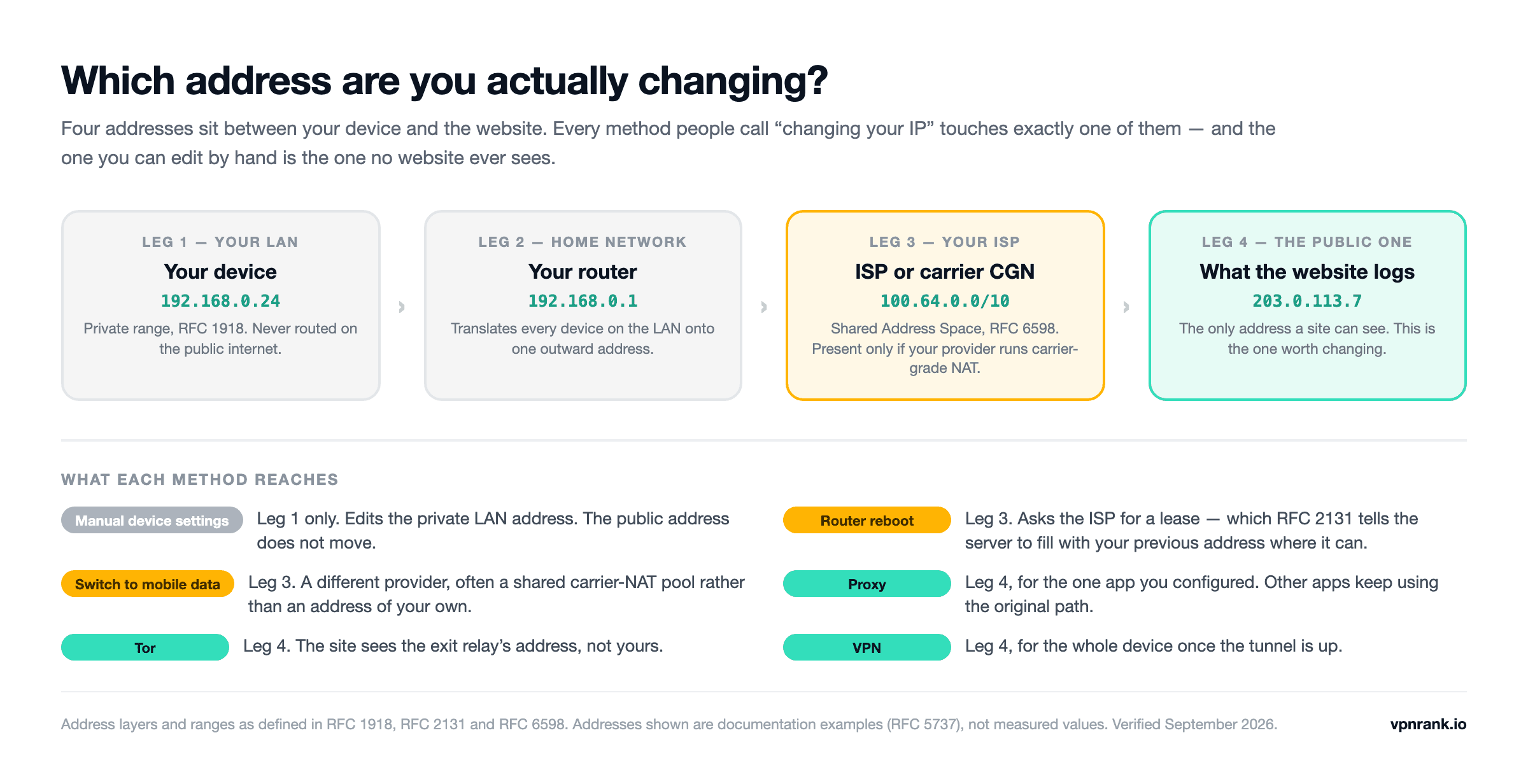
Six ways to change your IP, and what each one leaves behind
The methods differ on three axes that matter and one that does not. What matters: which address moves, whether the traffic is encrypted on the way, and who can still associate the new address with you. What does not matter much is how many clicks it takes. The final column is the one competing guides leave out — the claim each method cannot support, however well it performs at the job it does.
| Method | Which address moves | Traffic encrypted? | Who can still link it to you | What it doesn't automatically prove |
|---|---|---|---|---|
| VPN | Public address, for the whole device once the tunnel is up | Yes, between your device and the VPN server | The VPN provider, which sees both ends by design | That you are anonymous. It relocates trust from your ISP to your provider — it does not remove it. This is what a no-logs policy is meant to address, and why the audit behind it matters more than the wording. |
| HTTP or SOCKS proxy | Public address, for the single app you configured | Not by itself | The proxy operator; also your ISP, which still sees the traffic | That the rest of the device moved with it. Apps you did not configure keep using the original path, which is the most common way a "changed" address turns out not to have changed. |
| Tor | Public address, to the exit relay's | Yes, in layers across the circuit | No single relay sees both you and the destination | That the site will serve you. Exit-relay addresses are published, so services that choose to block them can. Slow by construction, which rules it out for streaming. |
| Rebooting the router | Provider-assigned address — sometimes | No | Your ISP, which holds the lease record either way | That you got a new address at all. RFC 2131 directs the server to prefer your previous address where it is still available. See the next section. |
| Switching to mobile data | Provider-assigned address, to the carrier's | No | Your carrier | That the address is yours alone. Carrier NAT commonly puts many subscribers behind one public address, which is also why this route attracts CAPTCHAs. |
| Editing device network settings | Private address only | No | Everyone who could see you before | Anything at all, externally. The public address is unchanged, so no website observes a difference. |
Read down the last column and a pattern appears: every method delivers a narrower result than the phrase "change your IP" implies. That is not an argument against using one. It is an argument for matching the method to the reason — a point the VPN versus Tor comparison takes further.
Rebooting the router usually hands back the same address
"Unplug your router for five minutes" is the most repeated free tip on this topic, and it is repeated without the caveat that decides whether it works. When your router comes back up it asks the ISP's DHCP server for an address. The protocol tells that server which address to pick, and your old one is near the top of the list.
RFC 2131, section 4.3.1, sets the server's order of preference when it receives a request. After the client's current binding, the next candidate is "the client's previous address as recorded in the client's (now expired or released) binding, if that address is in the server's pool of available addresses and not already allocated". Only if that fails does the server reach for a fresh address.
Practical ruleA router reboot changes your address only if someone else took it while you were offline. That is a race you do not control, on a pool you cannot see — which is why the method works for some people, fails for others, and cannot be relied on by anyone.
- →It is free, so it is worth one try: check your address, power the router down, wait, bring it back, check again. Two minutes spent to find out.
- →Longer is better, but not decisive: the longer you stay offline, the more chance the lease expires and the address is handed to someone else. There is no waiting time that guarantees it.
- →A static address will never move: if you pay for a static IP, or your provider assigns one, no amount of rebooting changes it. That is what you bought.
- →It does nothing for privacy either way: your ISP recorded which address it gave you and when. A new one from the same provider does not break that link.
A new IP does not reset the rest of your fingerprint
The address is one identifier among several, and it is not the strongest. Swapping it while leaving the others in place produces a smaller change than the effort suggests, so it is worth knowing which of them a new address touches.
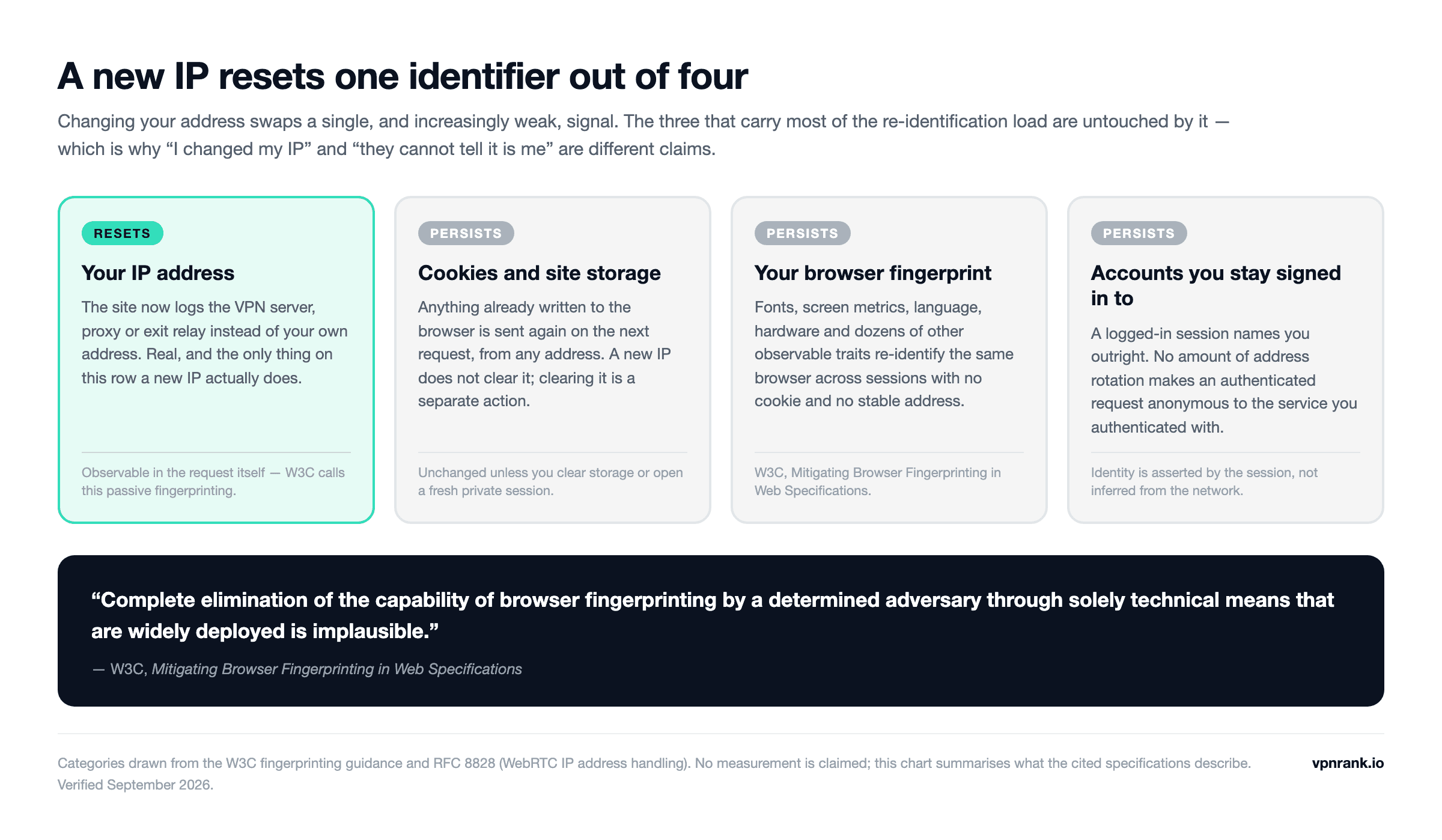
- →Browser fingerprinting: the W3C defines this as re-identifying a user or device "via configuration settings or other observable characteristics", and separates passive fingerprinting — which reads what is already in the request, your address included — from active fingerprinting, which runs code to measure more. Its own conclusion is blunt: complete elimination "by a determined adversary through solely technical means that are widely deployed is implausible".
- →WebRTC: RFC 8828 is specifically about this failure. It notes that where a client is multihomed — the ordinary situation for anyone running a VPN — "additional public IP addresses for the client can be learned", meaning a page can end up seeing both the tunnel address and the one underneath. It defines four modes with different privacy trade-offs and recommends the balanced one as default. Test your own browser with our WebRTC leak test.
- →Cookies and stored state: already written to your browser and sent again from any address. A new address does not clear them.
- →Signed-in accounts: an authenticated request identifies you by name. The network path is irrelevant to a service you have logged into.
None of this makes changing your address pointless. It makes it a specific tool with a specific effect: it breaks the link between your traffic and the address your provider assigned you. Treat it as one control among several rather than a switch labelled anonymous, and read what an IP address actually reveals for the detail underneath.
Four checks that tell you the change actually took
A method that silently fails looks exactly like one that worked, which is why verification belongs in the process rather than after it. These four take about four minutes together and use tools we host free, with no sign-up.
- Record the starting point. Before connecting anything, note the address and location shown by What Is My IP. Without this you cannot tell a change from a coincidence.
- Connect, then re-check the same tool. The address should differ and the location should match the server you chose. A location that does not match the server usually means the geolocation database is stale rather than that the connection failed — the lookup tool shows what a site would infer about the new address.
- Check for a WebRTC leak. Run the WebRTC leak test in the browser you actually use. This is the check that catches the RFC 8828 case above, where the page sees the underlying address alongside the tunnel one.
- Test what happens when the tunnel drops. The address only stays changed while the connection holds. The kill switch test shows whether traffic is blocked or falls back to your real address when it does — and is my VPN working covers the whole set in one pass.
💡 Run the same four checks again after any major operating system or browser update. Leak protection is enforced partly by the app and partly by the platform, and the settings that hold it in place are the kind that updates quietly reset.
How to Hide Your IP with a VPN
Choose a VPN with wide server coverage
Select a VPN from our comparison above. NordVPN offers 111 countries, giving you the most server location options for fast connections worldwide.
Install the app on your device
Download and install the VPN app on your computer, phone, or tablet. All recommended VPNs support Windows, macOS, Android, iOS, and Linux.
Select your preferred server
Open the app and browse the server list. For lowest latency, pick a nearby server. For maximum privacy, choose a server outside Five Eyes jurisdiction.
Connect and verify your new IP
Hit Connect and wait 2-3 seconds. Visit whatismyip.com to verify your real IP is now hidden behind the VPN server's IP.
How We Test VPNs for IP Changing
Our IP-change testing goes beyond basic IP checks. We verify that your real IP is completely hidden across multiple vectors.
IP Replacement Verification
We connect to 50+ servers per VPN and verify the displayed IP matches the expected server location using multiple IP-checking services (ipleak.net, browserleaks.com, whatismyip.com). We flag any discrepancies between expected and actual IP locations.
Leak Testing Suite
We run comprehensive DNS, WebRTC, and IPv6 leak tests on every connection. We test with browser-based tools, command-line utilities, and packet capture to ensure zero leaks across Windows, macOS, Android, and iOS.
Service Compatibility Rate
We test each VPN's compatibility with popular services from 10+ countries, tracking success rates across Netflix, BBC iPlayer, banking sites, and government services. We re-test monthly as streaming services update their VPN detection.
IP Rotation & Freshness
We measure how frequently VPNs rotate their IP pools and check IPs against blocklists (Spamhaus, AbuseIPDB). Fresh IPs are essential for reliable connectivity to websites that flag suspicious traffic patterns.
IP leak tests and service compatibility rates are re-verified monthly across all recommended VPNs.
Frequently Asked Questions
Does a VPN completely hide my IP address?
Yes, a properly configured VPN replaces your real IP with the VPN server's IP for all internet traffic. However, WebRTC leaks in browsers can expose your real IP if leak protection is not enabled. All our recommended VPNs include automatic WebRTC, DNS, and IPv6 leak protection.
Can websites detect that I changed my IP with a VPN?
Some websites can detect VPN IP addresses by checking against known VPN IP databases. However, premium VPNs regularly rotate their IP pools and use advanced privacy tools. NordVPN's advanced privacy servers and Surfshark's Camouflage mode make VPN traffic look like regular HTTPS traffic.
What is the difference between a shared and dedicated IP?
A shared IP is used by multiple VPN users simultaneously, providing better anonymity but sometimes triggering CAPTCHAs. A dedicated IP is assigned only to you, providing consistency for banking and remote work. NordVPN offers dedicated IPs from $3.09/month in 10+ countries.
How many server locations do top VPNs offer?
Top providers cover 100+ countries. NordVPN offers 111 countries, ExpressVPN covers 105, and Surfshark has 100+. Larger networks mean less congestion, faster speeds, and a nearby server for low latency wherever you are.
Is changing your IP address legal?
Yes. Changing your IP address with a VPN is legal in most countries, including the US, UK, Canada, Australia, and the EU. VPN use is restricted in China, Russia, UAE, and a few other countries, though enforcement varies. Using a VPN to commit illegal activities remains illegal regardless.
Sources & Further Reading
- RFC 1918 — Address Allocation for Private Internets (IETF)
- RFC 2131 — Dynamic Host Configuration Protocol, §4.3.1 (IETF)
- RFC 6598 — IANA-Reserved IPv4 Prefix for Shared Address Space (IETF)
- RFC 8828 — WebRTC IP Address Handling Requirements (IETF)
- Mitigating Browser Fingerprinting in Web Specifications (W3C)
- Types of relays on the Tor network (The Tor Project)