

Every head-to-head quotes a price, and every one of those prices moved this summer
A comparison article is a snapshot, and the shortest-lived thing in it is the price. We capture the lowest per-month rate advertised on each provider’s own order page every day — no account, no cookies carried between runs — and over the 49 days captured between 10 July 2026 and 6 September 2026, all 7 of the 7 services with a readable per-month rate raised it. None held flat, and none cut.
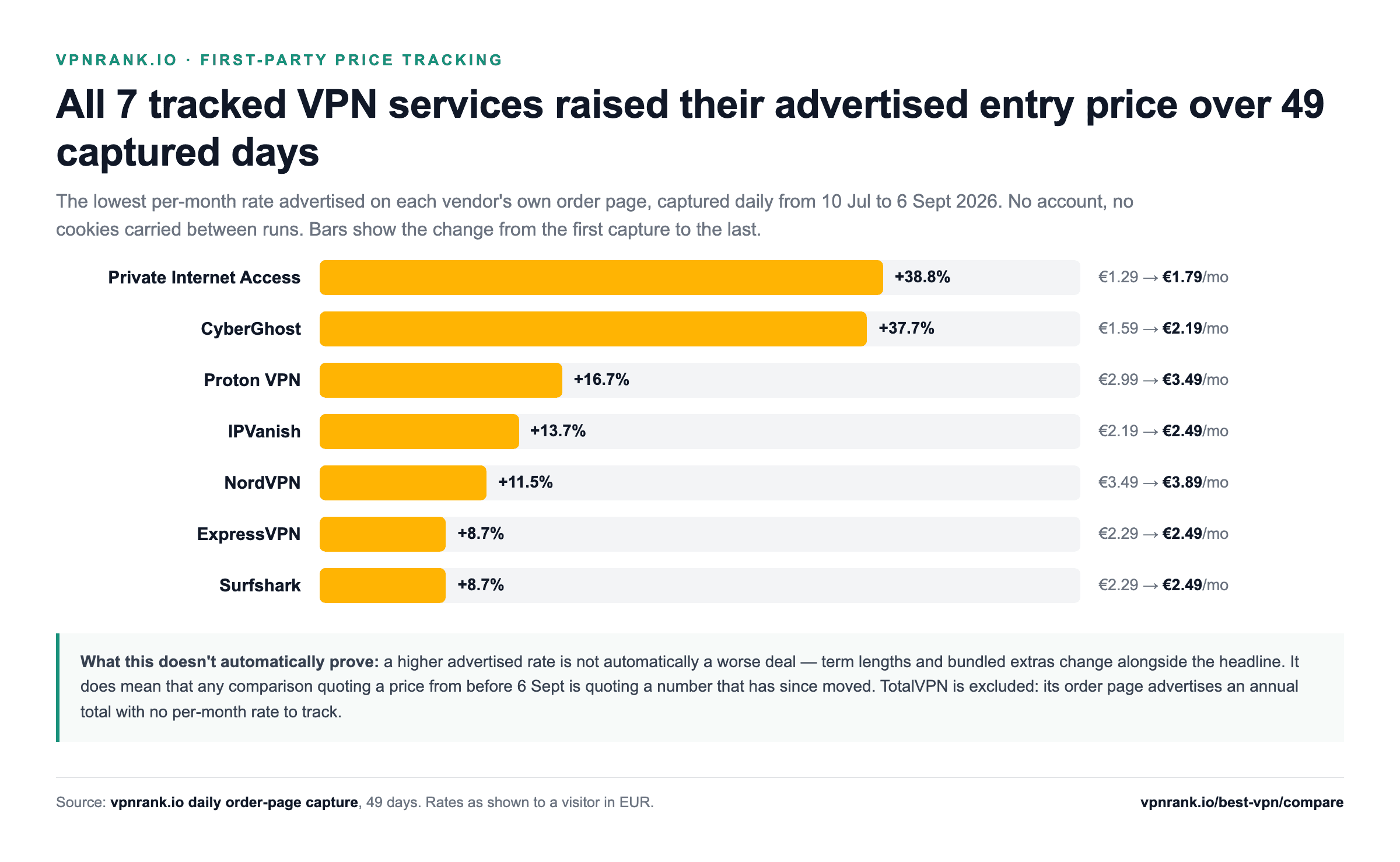
That matters more for a comparison than for a review. A review can be wrong about a price and still be useful about the software; a head-to-head that calls a winner on price is only as good as the two numbers underneath it. The spread here runs from 8.7% to 38.8%, so the gap between two providers can invert without either of them announcing anything.
| Service | Advertised entry rate, 10 July 2026 | Same rate, 6 September 2026 | Change | First day it moved | What it doesn't automatically prove |
|---|---|---|---|---|---|
| Private Internet Access | €1.29/mo | €1.79/mo | +38.8% | 2026-07-21 | A rise in the advertised rate is not automatically a worse deal: term length, device count and bundled extras move alongside it, and this figure tracks only the headline per-month number on the order page. |
| CyberGhost | €1.59/mo | €2.19/mo | +37.7% | 2026-07-21 | A rise in the advertised rate is not automatically a worse deal: term length, device count and bundled extras move alongside it, and this figure tracks only the headline per-month number on the order page. |
| Proton VPN | €2.99/mo | €3.49/mo | +16.7% | 2026-08-04 | A rise in the advertised rate is not automatically a worse deal: term length, device count and bundled extras move alongside it, and this figure tracks only the headline per-month number on the order page. |
| IPVanish | €2.19/mo | €2.49/mo | +13.7% | 2026-08-14 | A rise in the advertised rate is not automatically a worse deal: term length, device count and bundled extras move alongside it, and this figure tracks only the headline per-month number on the order page. |
| NordVPN | €3.49/mo | €3.89/mo | +11.5% | 2026-07-29 | A rise in the advertised rate is not automatically a worse deal: term length, device count and bundled extras move alongside it, and this figure tracks only the headline per-month number on the order page. |
| ExpressVPN | €2.29/mo | €2.49/mo | +8.7% | 2026-07-21 | A rise in the advertised rate is not automatically a worse deal: term length, device count and bundled extras move alongside it, and this figure tracks only the headline per-month number on the order page. |
| Surfshark | €2.29/mo | €2.49/mo | +8.7% | 2026-07-22 | A rise in the advertised rate is not automatically a worse deal: term length, device count and bundled extras move alongside it, and this figure tracks only the headline per-month number on the order page. |
The practical consequence is that the comparisons below are built to be re-read rather than read once. Every numeric spec on them — score, speed, price, servers, devices — is pulled live from the same data at render time rather than typed into the copy, so a page you open next month reflects next month’s figures. The live index behind those prices is the VPN price index, and the rules it follows are set out in its published methodology.
Practical rule
Check the renewal before the intro rate. The introductory number is what you pay once; the renewal is what you pay every year after, and in this category it is routinely the larger of the two.
Pick the matchup by the question you are actually asking
Most people arrive at a comparison having already narrowed to two names, but the more useful route is the other way round: start from the trade-off you care about and let it choose the pair. Each matchup below turns on something different, and the ones that look similar on paper are usually decided by the least glamorous column.
| Matchup | What it turns on | Read it if | What it doesn't automatically prove |
|---|---|---|---|
| ExpressVPN vs NordVPN | Polish against package — the two highest-scoring providers we rank, separated by very little. | You have shortlisted ExpressVPN and NordVPN and want one of them ruled out. | A winner in a two-way comparison is a winner against that one opponent, not against the market. A provider that loses this matchup may still be the right pick against a different rival, or for a use case neither page is about. |
| ExpressVPN vs Surfshark | A premium single subscription against an unlimited-devices one. | You have shortlisted ExpressVPN and Surfshark and want one of them ruled out. | A winner in a two-way comparison is a winner against that one opponent, not against the market. A provider that loses this matchup may still be the right pick against a different rival, or for a use case neither page is about. |
| NordVPN vs Surfshark | Two large server networks at opposite ends of the price ladder. | You have shortlisted NordVPN and Surfshark and want one of them ruled out. | A winner in a two-way comparison is a winner against that one opponent, not against the market. A provider that loses this matchup may still be the right pick against a different rival, or for a use case neither page is about. |
| NordVPN vs CyberGhost | Feature suite against headline price. | You have shortlisted NordVPN and CyberGhost and want one of them ruled out. | A winner in a two-way comparison is a winner against that one opponent, not against the market. A provider that loses this matchup may still be the right pick against a different rival, or for a use case neither page is about. |
| CyberGhost vs Surfshark | Two value picks, decided on device limits and term length. | You have shortlisted CyberGhost and Surfshark and want one of them ruled out. | A winner in a two-way comparison is a winner against that one opponent, not against the market. A provider that loses this matchup may still be the right pick against a different rival, or for a use case neither page is about. |
| ExpressVPN vs CyberGhost | The most expensive against one of the cheapest on the 2-year term. | You have shortlisted ExpressVPN and CyberGhost and want one of them ruled out. | A winner in a two-way comparison is a winner against that one opponent, not against the market. A provider that loses this matchup may still be the right pick against a different rival, or for a use case neither page is about. |
| NordVPN vs Proton VPN | Bundled security tooling against an independent privacy pedigree and a free tier. | You have shortlisted NordVPN and Proton VPN and want one of them ruled out. | A winner in a two-way comparison is a winner against that one opponent, not against the market. A provider that loses this matchup may still be the right pick against a different rival, or for a use case neither page is about. |
| NordVPN vs PIA | Mainstream defaults against configurability and the longest terms we track. | You have shortlisted NordVPN and PIA and want one of them ruled out. | A winner in a two-way comparison is a winner against that one opponent, not against the market. A provider that loses this matchup may still be the right pick against a different rival, or for a use case neither page is about. |
| PIA vs Surfshark | Two of the cheapest long-term plans, and what each gives up to get there. | You have shortlisted PIA and Surfshark and want one of them ruled out. | A winner in a two-way comparison is a winner against that one opponent, not against the market. A provider that loses this matchup may still be the right pick against a different rival, or for a use case neither page is about. |
| ExpressVPN vs IPVanish | Where the renewal, not the intro rate, decides it. | You have shortlisted ExpressVPN and IPVanish and want one of them ruled out. | A winner in a two-way comparison is a winner against that one opponent, not against the market. A provider that loses this matchup may still be the right pick against a different rival, or for a use case neither page is about. |
Four dimensions decide almost every head-to-head, and they are not equally reliable
A comparison that scores ten categories is mostly padding. In practice the outcome comes down to a short list, and it is worth knowing how much weight each one can carry.
- Price you keep paying: the renewal rate, not the introductory one. It is the number least likely to appear in a comparison and most likely to decide whether the choice was right two years on. Our deals pages carry the captured renewal alongside the offer.
- Speed under load: useful, but the least transferable figure on any comparison page. A result measured on one line, in one country, on one day tells you about relative ordering rather than the throughput you will personally see. Our figures and the conditions behind them are on the speed test page.
- Streaming reliability: genuinely volatile, because it is an adversarial contest that changes week to week rather than a fixed property of the software. Treat any streaming verdict as perishable and check the date on it.
- Privacy posture: the slowest-moving of the four, and therefore the one where a comparison ages best. Audit history, jurisdiction and ownership change rarely, which is why they carry more weight in a decision meant to last.
What a two-way comparison cannot settle
A head-to-head is a good instrument for a narrow question and a poor one for a broad one. It compares two products against each other, which is not the same as telling you whether either is the right answer. Three limits are worth stating plainly, because none of them are visible from inside a comparison page.
The first is selection: the pair was chosen by whoever wrote the page. A matchup between two providers we rank highly cannot surface a third that would beat both, which is what the full ranking is for. The second is that a category win can be won by a margin too small to notice — a few Mbps between two providers on a gigabit line is a real measurement and an irrelevant difference. The third is that cost is not a fixed property of a product at all. Our affordability index measures the same subscription against local income across 172 countries and finds a 467-fold spread, so the provider that is “cheaper” on a comparison page can still be the unaffordable one depending on where it is being read.
There is a fourth, narrower limit worth naming because it affects the pages linked above: not every spec is equally verifiable. Where a provider does not publish a figure on a page we can capture, we leave the claim out rather than carry a number we cannot re-check. That is why some comparisons say less about a given dimension than others — the silence is deliberate.
How these comparisons are put together
Every matchup follows the same shape so that two of them can be read against each other. Editorial judgement — which provider suits which reader, what the trade-off actually is — is written by a named reviewer and does not change unless the underlying assessment does. Everything numeric is separated from that copy and read live from our provider data at render time, so prices and scores cannot drift out of step with the rest of the site.
The price data comes from the daily order-page capture described above, which also feeds the price index and the renewal figures on our deals pages. Testing conditions are documented in how we test. We earn commission when a reader subscribes through our links, which is the reason the price tracking exists in the form it does: a figure captured daily from a vendor’s own page and published whether it moved up or down is harder to bend than one typed into an article once.
If none of the ten matchups covers your shortlist, the ranked list of every provider we cover is the better starting point, and the picker narrows by use case rather than by brand.