
ExpressVPN vs IPVanish
Prices verified 17 September 2026- Overall winner: ExpressVPN
- Side-by-side on speed, price, streaming, privacy & devices
- Both backed by a money-back guarantee

ExpressVPN is the better all-round pick, edging IPVanish 9.9 to 9.8 thanks to faster everyday speeds, a flawless 10/10 privacy score, and the most reliable streaming we tested. The single biggest reason to flip the other way is money: IPVanish costs $2.19/mo on its 2-year plan versus ExpressVPN's $2.79, and it lets you connect unlimited devices instead of ten. Both are independently audited, both ship a 30-day money-back guarantee, and both clear 460 Mbps on a gigabit line. So this comes down to polish and consistency (ExpressVPN) versus price and household coverage (IPVanish).
ExpressVPN vs IPVanish: side by side
| ExpressVPN | IPVanish | |
|---|---|---|
| Overall score | 9.9/10 | 9.8/10 |
| Speed (US-East, 1 Gbps) | 478 Mbps | 468 Mbps |
| Price (2-year plan) | $2.79/mo | $2.19/mo |
| Servers | 3,000 | 3,200 |
| Countries | 105 | 112 |
| Simultaneous devices | 10 | Unlimited |
| Money-back guarantee | 30 days | 30 days |
Speed figures from our Q3 2026 benchmark (US-East, 1 Gbps line). Prices in USD, verified 2026-09-05. Green = category winner.
Category by category
Speed
Winner: ExpressVPNExpressVPN takes speed, hitting 478 Mbps to IPVanish's 468 Mbps on the same US-East gigabit line.
Price
Winner: IPVanishIPVanish wins on price at $2.19/mo on the 2-year plan, undercutting ExpressVPN's $2.79/mo.
Streaming
Winner: ExpressVPNExpressVPN is the streaming pick, posting a near-perfect 9.9 streaming score against IPVanish's 9.
Privacy
Winner: ExpressVPNExpressVPN leads on privacy with a perfect 10/10 score versus IPVanish's strong 9.7.
Value
Winner: IPVanishIPVanish offers the better value, scoring 9.6 to ExpressVPN's 8.5 once price and features are weighed together.
Devices
Winner: IPVanishIPVanish wins on devices, supporting unlimited simultaneous connections against ExpressVPN's cap of 10.
Choose ExpressVPN if…
Choose ExpressVPN if you want the fastest, most dependable VPN for unblocking streaming services and the strongest, longest-audited privacy record, and you're happy to pay a small premium for that polish and its wide app support across 105 countries.
Choose IPVanish if…
Choose IPVanish if you want to cover an entire household or a small business on one account with unlimited devices, at the lowest price here ($2.19/mo), without giving up serious speed or an independent audit.
What the rate card leaves out
The section above compares the two providers on the terms they advertise. This one compares them on evidence we collected ourselves: fifty daily reads of both checkout pages between 10 July and 5 September 2026, and both Android listings read on 5 September 2026. Analysis by Martín Rossi, who owns our pricing and testing methodology. vpnrank.io earns a commission if you buy through our links, which is exactly why we publish the renewal figures below rather than only the headline discounts.
The number that decides this matchup is the one neither provider puts on the button
Both order pages lead with a per-month figure that applies only to the first term. Both then state, in smaller type on the same page, what happens afterwards — and afterwards is where the two plans separate. We read both pages on 5 September 2026. ExpressVPN's Basic plan quoted €2.49/mo, billed as €69.72 for the first 28 months, then autorenewing at €79.95 a year. IPVanish's Essential plan quoted $2.49/mo, billed as $59.76 for the first 2 years, then renewing yearly at $99.99.
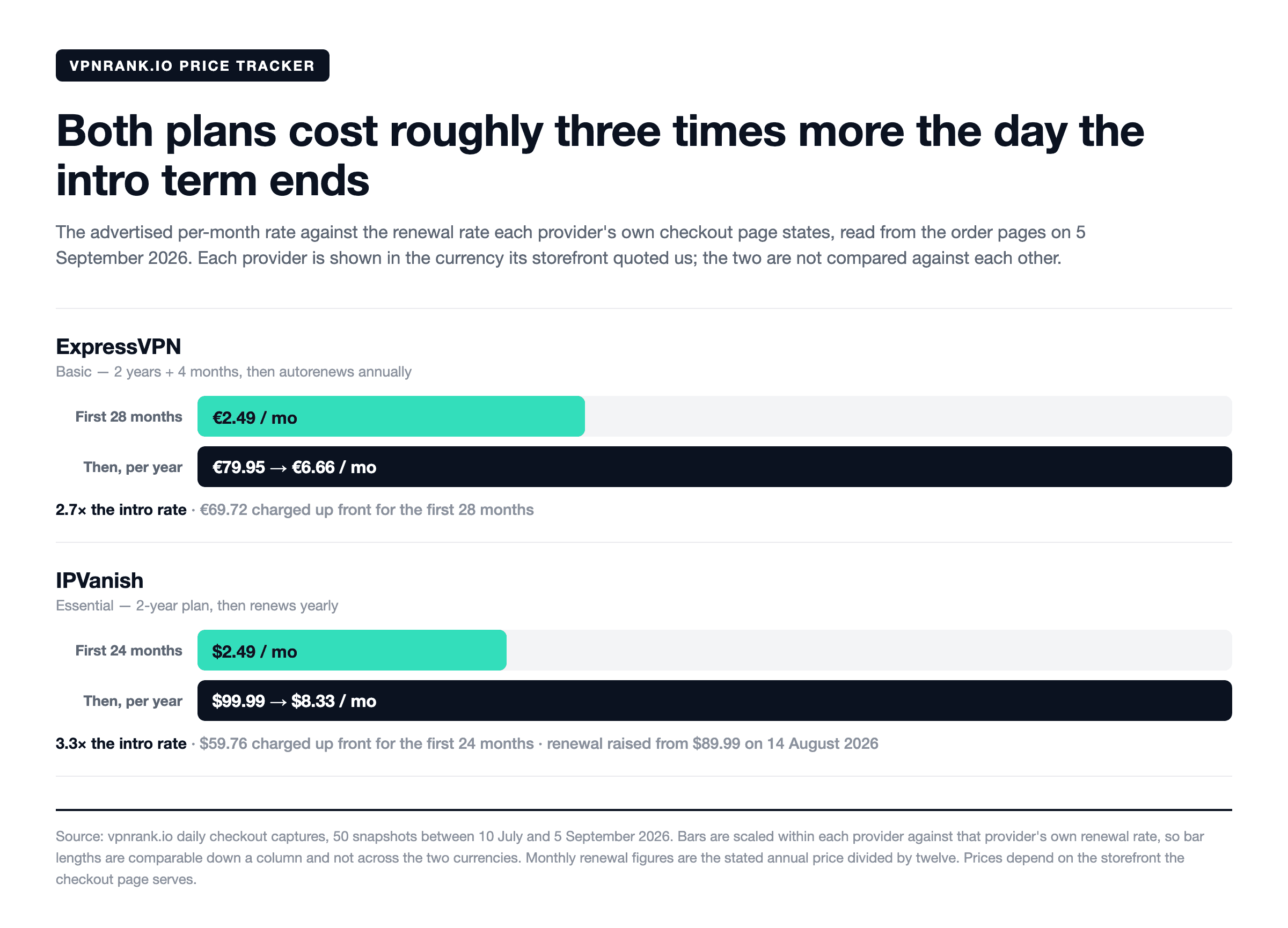
The two currencies cannot be converted into each other honestly — a storefront quoting euros is not telling you the dollar price — so the comparable figure is each plan's multiple: how far the renewal sits above the rate that sold you. ExpressVPN's renewal works out at €6.66 a month, 2.7 times its intro rate. IPVanish's works out at $8.33 a month, 3.3 times its intro rate. The provider that wins the price row in the table above is the one whose price climbs further when the intro term ends.
| ExpressVPN | IPVanish | What this doesn't automatically prove | |
|---|---|---|---|
| Advertised rate | €2.49 / mo | $2.49 / mo | Each is the price its storefront served our tracker, not a universal price. Change country and both can change. |
| Length of that rate | 28 months | 24 months | A longer intro term is more months at the low rate, but also a longer commitment before you can leave without losing the balance. |
| Charged up front | €69.72 | $59.76 | Neither is a monthly billing arrangement. Both take the whole first term as a single charge. |
| Stated renewal | €79.95 / year | $99.99 / year | This is what each page says today. Both are the provider's own figure and both have moved before. |
| Renewal per month | €6.66 | $8.33 | Arithmetic on the annual figure, not a plan you can buy monthly at that rate. |
| Multiple of intro rate | 2.7× | 3.3× | A smaller multiple means a gentler step up, not a cheaper product — the two start from different currencies. |
| Renewal changed in our window | No change in 27 captures | Raised from $89.99 on 14 Aug 2026 | One raise in eight weeks is a data point, not a trend, and it does not predict the next one. |
Practical ruleCompare VPNs on the renewal rate divided by the intro rate, not on the intro rate. The intro rate tells you what the first term costs; the multiple tells you what the provider expects to charge you for staying.
This matters more than it looks, because both plans autorenew by default. If you buy either and forget about it, the first bill after the intro term is the one in the right-hand bars above. Both providers do also carry a 30-day money-back guarantee, which is a refund window on the purchase — not a cancellation reminder before renewal.
Neither entry price stayed put across the eight weeks we watched
We read both order pages every day. A provider's advertised price is not a fixed property of the product; it is a number on a page that changes without announcement, and the only way to know whether the deal in front of you is a good one is to have watched the same page for a while.
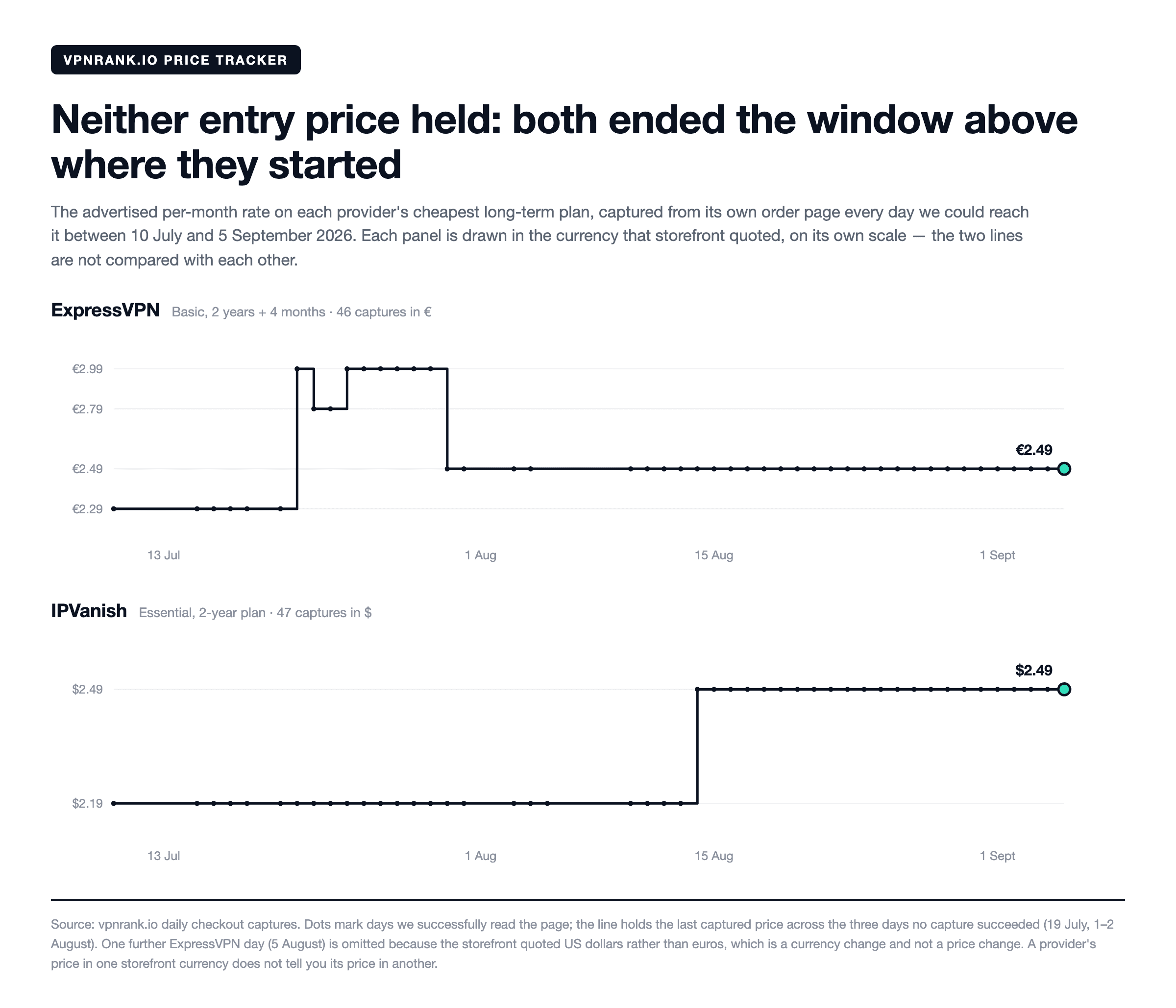
- →IPVanish held $2.19 for five weeks, then moved to $2.49 on 14 August 2026 — the same day its stated renewal went from $89.99 to $99.99. Across 47 captures in dollars it showed its own best price on 24 of them, so a shopper arriving at random had roughly even odds of seeing it.
- →ExpressVPN was noisier. Across 46 captures in euros it ran between €2.29 and €2.99, showed its own best price (€2.29) on only 6 days, and has sat at €2.49 since 30 July 2026. The provider that looks stable on a rate card was the less stable one on the page.
- →Both ended the window above where they started. Neither of the current prices is the cheapest that provider offered this summer, which is the opposite of what a countdown timer implies.
- →Three days are missing (19 July, 1–2 August) because no capture succeeded. A gap in our data is a gap, not a price change, and the chart holds the last known figure across it rather than inventing one.
- →One ExpressVPN day (5 August) is excluded because the storefront quoted US dollars instead of euros. That is a currency change, not a price change, and mixing the two would have manufactured a fake spike.
💡 The practical read: on this evidence, neither provider's current price is a deadline. Both have moved within a 30-cent band all summer, and both back the purchase with a 30-day refund window — so the cost of buying on the wrong day is small, and the cost of missing a renewal date is not.
The Play listing settles two questions both marketing pages talk around
Every claim on this page so far has come from the providers. Google's app listing is one of the few places where a third party publishes facts about a VPN that the VPN cannot edit: the star average and the sample behind it, the install bucket, when the app was last shipped, and whether Google displays an Independent security review badge in the Data safety panel. We read both listings on the US storefront on 5 September 2026.
| ExpressVPN | IPVanish | What this doesn't automatically prove | |
|---|---|---|---|
| Play rating | 4.6 | 4.4 | Play ratings mix billing and support complaints in with technical ones. A higher average is satisfaction, not a leak test. |
| Reviews behind it | 485,000 | 70,800 | Review volume tracks marketing reach at least as closely as app quality. ExpressVPN's sample is about seven times larger. |
| Installs | 100M+ | 10M+ | Google publishes coarse buckets, never exact numbers, and counts lifetime installs rather than people currently paying. |
| App last updated | 3 Sep 2026 | 15 Jul 2026 | A recent build shows an active release cadence. It does not tell you the change was security work. |
| Independent security review badge | Not shown | Shown | The badge appears only when a developer commissions and passes a paid lab assessment. Its absence is a business decision, not a failed review. |
| Data safety — declared collection | Personal info, App activity and 2 others | Personal info | This is a self-declaration the developer files with Google, not an audit finding. It describes the app, not the VPN tunnel. |
The badge row is the one worth sitting with, because it runs against the shape of the rest of this comparison. IPVanish — the cheaper provider, the one based in the United States, the one that loses the privacy row in the table above — is the one whose listing carries Google's Independent security review badge. ExpressVPN's does not. That does not make IPVanish the more private service, and it does not overturn the privacy scores: the badge is an opt-in, paid assessment of the app, and a provider with a long public audit history has less to gain from adding one. It is a reminder that a privacy score is a judgement and a badge is a fact, and the two answer different questions.
One more discrepancy is worth recording rather than smoothing over. On the day we read it, ExpressVPN's own Play listing described servers in 113 countries, while the figure the company publishes on its website — the one in the specification table above — is 105. Both numbers come from the same company on the same day. Country and server counts are vendor-declared everywhere they appear, including in our table, and no comparison site can verify them independently.
Jurisdiction is the only difference here that an update cannot change
Speed figures move with each release. Prices moved twice this summer. App ratings drift monthly. The structural difference between these two providers is the one that stays put: ExpressVPN is registered in the British Virgin Islands, IPVanish in the United States. Everything else in this comparison is a snapshot; this is the part that will read the same next year.
- →What it means in practice: a US-registered provider can receive US legal process directly, including instruments that arrive with a gag order. A BVI-registered one sits outside that system and outside the intelligence-sharing arrangements built around it.
- →What it does not mean: jurisdiction is not evidence that a provider logs anything. Both providers publish no-logs policies and both have had those policies examined by an outside auditor. A company with nothing recorded has nothing to hand over, wherever it is registered.
- →Why it still belongs in the decision: a no-logs policy is a promise plus an audit of that promise at a point in time. Jurisdiction is the thing that determines what happens if the promise ever fails. If your threat model includes a legal adversary, you are choosing between those two layers rather than relying on one.
- →Where it is irrelevant: if you are buying a VPN to watch a streaming library from another country or to avoid using an open café network unencrypted, this row should not decide your purchase. Speed, app quality and price should.
Practical ruleLet jurisdiction break the tie, not lead the decision. It matters most to the smallest group of buyers, and it is the only factor on this page that neither provider can improve with a software update.
Read together, the evidence points to different buyers, not a single winner
The specification table at the top of this page and the first-party evidence in this section disagree in one specific way, and the disagreement is the useful part. On the rate card, IPVanish is the cheaper provider. On our tracker, it is the one with the steeper renewal and the one that raised both its entry price and its renewal price on the same day in August. Neither reading is wrong; they describe different stretches of time.
| If this is your situation | The better buy | Why | What would change the answer |
|---|---|---|---|
| You want the fastest connection and the most reliable streaming | ExpressVPN | 478 Mbps against 468 Mbps on the same 1 Gbps line in our Q3 2026 benchmark, and the stronger streaming score. | A 10 Mbps gap is about 2% — on a slower home line neither provider will be your bottleneck. |
| You need to cover a whole household or a small office | IPVanish | Unlimited simultaneous connections against ExpressVPN's cap of 10. | If you have fewer than ten devices, this row is worth nothing to you and the price and speed rows decide it. |
| You intend to keep the subscription past the intro term | ExpressVPN | Its renewal is 2.7× its intro rate; IPVanish's is 3.3×, and IPVanish raised that renewal in August 2026. | Diarise the renewal date on either and switch before it lands, and this row stops mattering. |
| Your threat model includes legal process | ExpressVPN | British Virgin Islands registration sits outside US legal process; IPVanish is US-registered. | If you are choosing a VPN for streaming or café Wi-Fi, this row should not decide anything. |
| You want the app with the most maintenance behind it | ExpressVPN | Shipped 3 Sep 2026 against 15 Jul 2026, on a 485,000-review sample against 70,800. | IPVanish's listing is the one carrying Google's Independent security review badge; ExpressVPN's is not. |
If you buy either, the 30-day money-back guarantee is the part to actually use: install the app, run it on your own line at the hour you normally stream, and decide from that rather than from anyone's benchmark, ours included. Our figures come from a wired gigabit connection in one location, and the only network that matters for your decision is yours.
Bottom line
ExpressVPN is the winner for most people: faster, better at streaming, and unbeaten on privacy at 10/10. But if budget or a device-heavy household is your priority, IPVanish is the smarter buy at $2.19/mo with unlimited connections. Either way you get an audited, no-questions-asked 30-day trial.
ExpressVPN vs IPVanish — FAQ
Is ExpressVPN or IPVanish better?
ExpressVPN is the better overall VPN, scoring 9.9/10 to IPVanish's 9.8. It's faster (478 vs 468 Mbps), better for streaming (9.9 vs 9), and has a perfect 10/10 privacy score. IPVanish is the better choice only if price or unlimited device support matters more to you.
Which is cheaper, ExpressVPN or IPVanish?
IPVanish is cheaper at $2.19/mo on its 2-year plan (83% off), versus $2.79/mo for ExpressVPN (79% off). Both back the purchase with a 30-day money-back guarantee, so you can test either risk-free before committing.
Which is better for streaming, ExpressVPN or IPVanish?
ExpressVPN is the stronger streaming VPN, earning a 9.9 streaming score against IPVanish's 9. Its faster 478 Mbps speeds and reliable unblocking across services make it the safer pick if streaming is your main reason for getting a VPN.
How many devices can I connect with each VPN?
IPVanish allows unlimited simultaneous connections, so a single subscription can cover an entire household or small office. ExpressVPN caps you at 10 simultaneous devices, which is plenty for most individuals but the deciding factor if you need to protect many devices at once.