
Best Free VPN for Android TV in 2026
Updated 1 September 2026- Which VPNs ship a native Android TV / Google TV app — from vendor docs
- Tested on Google TV, Sony, Nvidia Shield & Chromecast
- Real AES-256 encryption & audited no-logs policies

Quick answer
Proton VPN is our #1 pick for this guide
These are the genuinely safe VPN options for Android TV and Google TV in 2026 — native Play Store apps, audited no-logs, real encryption — plus an honest warning about sideloaded free VPN APKs. Among free options, ProtonVPN's unmetered free plan is the only one from a provider we'd vouch for, though Proton's own Android TV setup guide now states a paid subscription is required (see the deep dive). For nightly 4K streaming, a paid VPN with a 30-day money-back guarantee remains the better tool — providers such as ExpressVPN, NordVPN, Surfshark, CyberGhost and PIA refund within 30 days, so you can run a full premium VPN on your TV for a month at no risk.
Best alternatives: TotalVPN and Private Internet Access.
Proton VPN Swiss-based VPN with strong privacy focus. Audited no-logs policy and open-source apps. Great for privacy-conscious users.
Proton VPN Swiss-based VPN with strong privacy focus. Audited no-logs policy and open-source apps. Great for privacy-conscious users.

TotalVPN Affordable VPN with strong privacy and reliable speeds. Easy-to-use apps for all major devices. No-logs policy.
TotalVPN Affordable VPN with strong privacy and reliable speeds. Easy-to-use apps for all major devices. No-logs policy.
Private Internet Access High-speed VPN with a large server network and advanced security settings. Ad blocker included and 24/7 live chat support.
Private Internet Access High-speed VPN with a large server network and advanced security settings. Ad blocker included and 24/7 live chat support.
Surfshark Unlimited device connections at a budget-friendly price. Includes ad blocker and strong privacy tools. Great value for money.
Surfshark Unlimited device connections at a budget-friendly price. Includes ad blocker and strong privacy tools. Great value for money.

CyberGhost Fast speeds and strong privacy tools. Simple apps, automatic WiFi protection, and 24/7 live chat support.
CyberGhost Fast speeds and strong privacy tools. Simple apps, automatic WiFi protection, and 24/7 live chat support.

IPVanish Fast speeds with unlimited device connections. Strong no-logs privacy and 24/7 live chat support. Great for families.

IPVanish Fast speeds with unlimited device connections. Strong no-logs privacy and 24/7 live chat support. Great for families.

ExpressVPN Ultra fast & secure. Great for privacy, downloads, and everyday browsing on all your devices. 24/7 live chat support.
ExpressVPN Ultra fast & secure. Great for privacy, downloads, and everyday browsing on all your devices. 24/7 live chat support.
NordVPN Excellent speeds with one of the largest server networks. Strong security features and easy-to-use apps. 24/7 live chat support.
NordVPN Excellent speeds with one of the largest server networks. Strong security features and easy-to-use apps. 24/7 live chat support.
Rankings are based on our independent testing methodology. Each guide applies the criteria described on that page, including relevant performance, privacy, product features, and value data. We may earn affiliate commissions from links on this page, which helps fund our testing — this does not influence our rankings.
2026 Rankings At a Glance
| # | VPN | Overall score | Lowest long-term price | Money-back | Key strength |
|---|---|---|---|---|---|
| 1 | Proton VPN | 9.6/10 | $2.99/mo | 30 days | 15,000+ servers in 120+ countries |
| 2 | TotalVPN | 9.4/10 | $1.59/mo | 30 days | Servers in 50+ countries |
| 3 | Private Internet Access | 9.3/10 | $1.75/mo | 30 days | Servers in 91 countries |
| 4 | Surfshark | 9.2/10 | $1.78/mo | 30 days | 3,200+ servers in 100 countries |
| 5 | CyberGhost | 9.5/10 | $2.03/mo | 45 days | Servers in 100 countries |
| 6 | IPVanish | 9.8/10 | $2.19/mo | 30 days | 3,200+ servers in 112+ countries |
| 7 | ExpressVPN | 9.9/10 | $2.79/mo | 30 days | 3,000+ servers in 105 countries |
| 8 | NordVPN | 9.7/10 | $3.09/mo | 30 days | 7,400+ servers in 118 countries |
Scores follow our testing methodology. Prices reflect the current long-term promotional rate, billed upfront; term length varies by provider.
Why You Need a VPN on Android TV
Android TV and Google TV power a huge share of smart TVs and streaming boxes (Sony, TCL, Philips, Nvidia Shield, Chromecast with Google TV), and unlike Samsung or LG smart TVs, they run real Android apps — including VPN apps from the Google Play Store. That makes Android TV one of the few TV platforms where a free VPN can run natively. A VPN on Android TV encrypts your streaming traffic from ISP throttling, protects your Google account credentials, and gives you control over your apparent location. The catch: most free Android TV VPNs log or inject tracking, so only a few are safe.
The Free Option — and What Proton's Own Docs Now Say
ProtonVPN is the only provider we track with a free tier, and its free plan is genuinely unmetered: AES-256, no ads, an independently audited no-logs policy from Swiss-based Proton. On Android TV specifically, Proton's documentation is currently inconsistent — its free-plan download page lists Android TV, while its Android TV setup guide says you need a paid subscription to get started (both checked July 2026). Plan around that, not around a review site's assumption; the deep dive below quotes both sources.
Stop ISP Throttling on the Big Screen
ISPs throttle video traffic at peak hours, dropping Android TV streams from 4K to SD. A VPN encrypts your traffic so the ISP can't selectively throttle it. Even free tiers help — though limited free server locations and medium speeds make a paid VPN the better fix for nightly 4K.
Avoid Sideloaded 'Free VPN' APKs
Sideloading random free VPN APKs onto Android TV is a major malware vector — and Android TV's app sideloading makes it easy. Independent research on free Android VPN apps found widespread tracking and malware. Install only from the Google Play Store, from named reputable providers.
Protect Your Google Account
Your Android TV is signed into your Google account. On shared or hotel networks, a VPN encrypts everything the device sends — worth having even on a limited free tier.
What to Look For in a Free Android TV VPN
Android TV's remote-driven interface and modest hardware add constraints. The criteria that matter:
Native Play Store App
A real Android TV app means a remote-friendly interface and no sideloading risk. ProtonVPN Free qualifies, with an app you can install straight from the Play Store. If a 'free VPN' requires sideloading an APK, treat it as hostile.
Enough Data for Streaming
Netflix publishes its own figures: up to 1 GB/hour in SD, up to 3 GB/hour in HD and up to 7 GB/hour in 4K. Most free VPNs cap you at a couple of gigabytes a month, which is one film. An unmetered free tier is the only kind that survives real Android TV use — ProtonVPN's free plan is unmetered, though its free servers cover a handful of locations at medium speeds, and its TV app has the plan caveat noted above.
WireGuard Support
Android TV boxes have modest CPUs; OpenVPN-only apps bottleneck speeds. WireGuard-based free tiers run efficiently even on lower-end Google TV devices and the Chromecast.
Audited No-Logs Policy
Your Android TV traffic maps your household's viewing. Only use free tiers from providers with independent audits — ProtonVPN publishes one, and its no-logs policy has been independently verified.
Free VPN for Android TV: What the Providers' Own Documentation Says
Almost every "free VPN for Android TV" list assumes the free tier you install on a phone behaves the same way on a television. It often doesn't — the TV build is a separate app with its own sign-in flow, its own minimum Android version, and, in at least one case, its own plan requirement. This deep dive is built entirely from the providers' own published setup documentation, Google's TV documentation and Netflix's published data-usage figures, all re-checked in July 2026. Where a provider's documentation contradicts itself, we quote both sides instead of picking the convenient one.
Is there genuinely a free VPN for Android TV?
Short answer: of the eight providers we track, only Proton VPN operates a free tier at all — and on Android TV specifically, Proton's own documentation is currently inconsistent about whether that free tier can be used on the TV app. That is an uncomfortable answer, but it is the accurate one, and it changes what you should do next.
Proton's Android TV setup guide states plainly, under "How to use Proton VPN on your Android TV": "To get started, you'll need a Proton Account with a paid Proton VPN subscription." The same page opens with "If you're on a paid Proton VPN subscription, you can download the app on your Android TV and stream content from 140+ countries."
Yet Proton's free-plan download page lists Android TV and Fire TV among the platforms the free plan can be installed on, and Proton's original Android TV launch announcement said the opposite of the support guide outright: "Free users can connect to our servers in the usual ten countries" — the Netherlands, Japan, Romania, Poland, Norway, Switzerland, Singapore, Mexico, Canada and the United States. That announcement is visibly older than the support guide (it still lists Android 5 as the minimum; the current support guide says Android 8), so the support guide is the more likely reflection of today's app.
⚠️ What this means for you: do not plan your TV setup around a free Proton account working on the Android TV app. It may sign in; the vendor's current setup guide says it needs a paid plan. If free-for-now is the requirement, the routes in the free routes section below are the ones that don't depend on unresolved documentation.
The wider free-VPN market makes this worse rather than better. Search "free VPN" in the Play Store on a television and most of what comes back is ad-funded software from publishers with no audit history, no named legal entity and no meaningful support — which is why our list of names on this page is short, and why the rest of this guide is about mechanics rather than rankings.
Which VPNs actually have a native Android TV app
A "native" Android TV app matters more here than on any other platform. Without one you are navigating a phone-shaped interface with a directional pad, and in many cases you cannot reach the connect button at all. The table below records what each provider's own documentation says about its TV build — not what a review site says about it.
| Provider | Native Android TV app | Install route in the vendor's guide | Minimum OS version stated | Free tier on the TV app |
|---|---|---|---|---|
| Proton VPN | Yes | TV's app store; or push from a desktop browser | Android 8 or later (Amazon Appstore builds: 7.1 or later) | Contradictory — setup guide says a paid subscription is required; free-download page lists Android TV |
| ExpressVPN | Yes | Google Play, or the vendor's APK download | Android 5.0 or newer | No free tier — 30-day money-back |
| NordVPN | Yes | Google Play, or download from the vendor's site | Not stated in the setup guide | No free tier — 30-day money-back |
| Surfshark | Yes | Google Play, operated with the standard TV remote | Not stated in the setup guide | No free tier — 30-day money-back |
| CyberGhost | Yes | Google Play; sideloading documented for TVs without Play | Android TV 7.0 (Nougat) and newer | No free tier — 45-day money-back on the 26-month plan (14 days on the 1-month plan) |
| Private Internet Access | Yes | Google Play on the TV box | Not stated in the setup guide | No free tier — 30-day money-back |
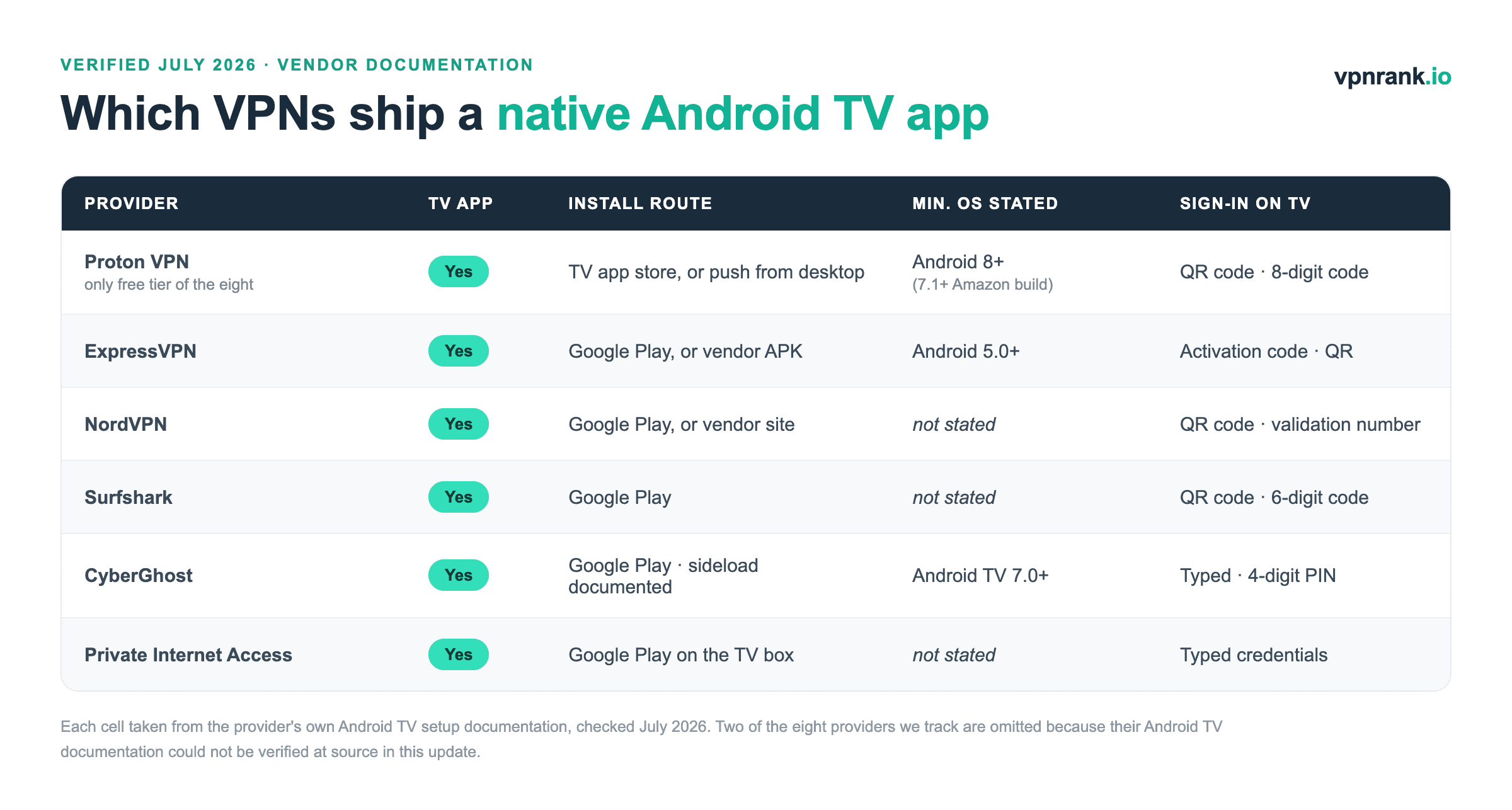
Notice what the table does not contain: a score column. On a television the question is binary long before it is qualitative — either the provider ships a remote-navigable app for your OS version or it does not, and everything else is a distant second.
Google TV vs Android TV — does it change which VPN you can install?
For VPN purposes, no. Google TV is the newer interface layered on the same Android TV platform, and Google's own documentation treats them as a single app target: "App developers can submit apps to the Play Store that you can then download to your Google TV or Android TV." One submission, both surfaces.
That is why a Chromecast with Google TV, a Google TV Streamer, a Sony or TCL television running Android TV and an Nvidia Shield all install the same VPN app from the same store. Android's developer documentation makes the same point from the other side — "TV apps use the same structure as those for phones and tablets" — which is also why a phone-only VPN app will technically install on many TVs while being effectively unusable with a directional pad.
- →Same OS family, same Play Store: if a provider documents an Android TV app, it works on Google TV devices too.
- →Different from Fire TV: Amazon's devices run a fork with its own Appstore — Proton, for instance, states a lower minimum (Android 7.1) specifically for its Amazon Appstore build.
- →Different from Samsung and LG TVs: Tizen and webOS cannot run Android VPN apps at all, which is why those sets need a router-level setup instead.
If your set is a Samsung or LG, the Android TV route on this page does not apply — see our router VPN guide for the setup that does.
Why a capped free plan dies in one evening of television
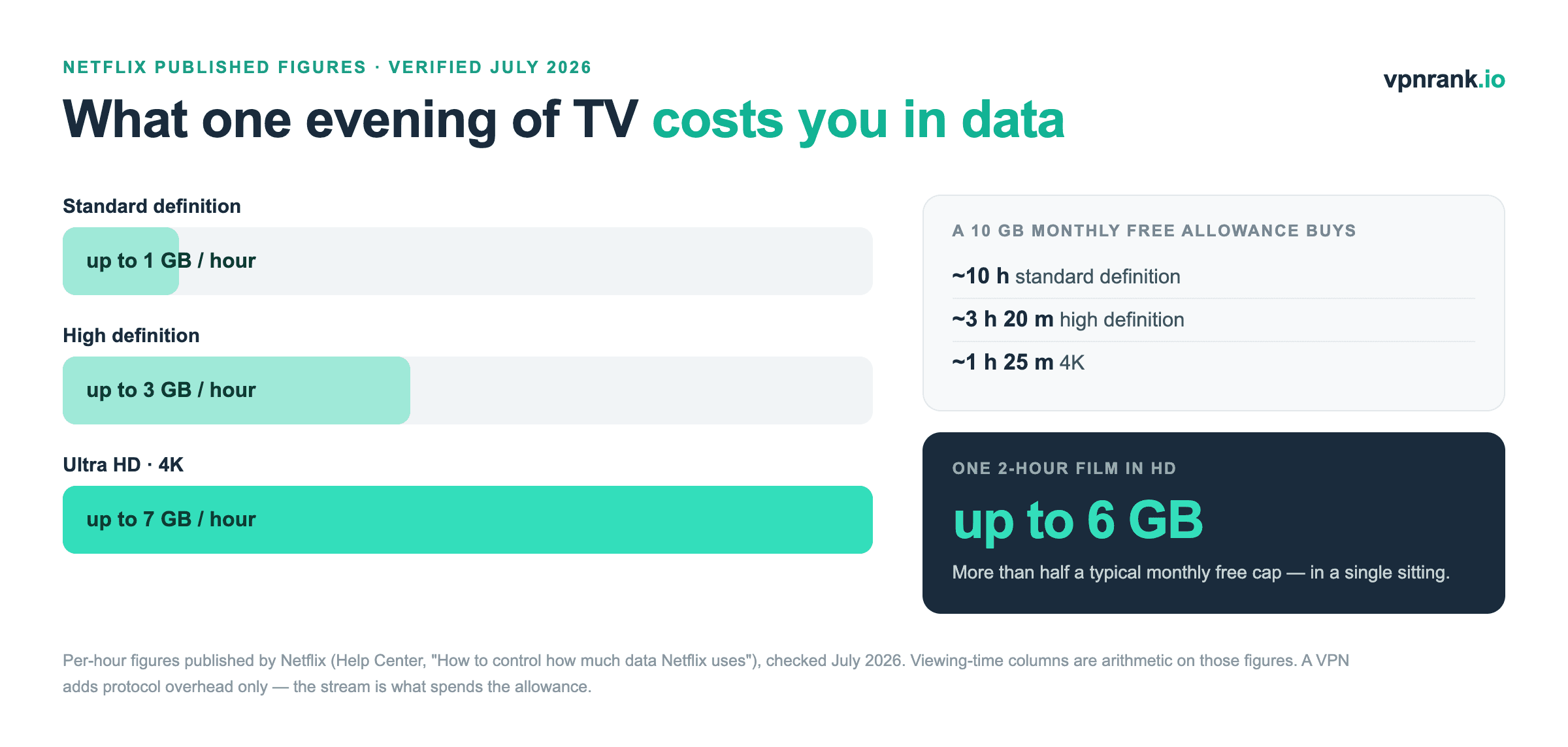
This is the single arithmetic that decides whether a free tier is usable on a TV, and it is not close. Netflix publishes its own data-usage figures per hour of playback: up to 1 GB per hour for standard definition, up to 3 GB per hour for HD, and up to 7 GB per hour for Ultra HD (4K).
| Quality | Data per hour (Netflix figure) | A 2-hour film | What a 10 GB monthly allowance buys |
|---|---|---|---|
| Standard definition | Up to 1 GB | Up to 2 GB | About 10 hours |
| High definition | Up to 3 GB | Up to 6 GB | About 3 hours 20 minutes |
| Ultra HD / 4K | Up to 7 GB | Up to 14 GB | About 1 hour 25 minutes |
A monthly allowance that feels generous on a phone — where the same hour of viewing on a small screen is billed at the lower quality tiers — is a single film on a television. This is why the useful question about a free tier on TV is not "how fast is it?" but "is the data metered at all?", and why an unmetered free tier is worth more than a fast capped one for this specific use.
💡 If your household streams 4K in the evenings, no capped free plan is a realistic answer. A 30-day money-back window gives you a full month of uncapped, full-speed service and costs nothing if you cancel inside it — that is the honest free month on a television.
Signing in with a TV remote: the QR code and pairing-code flows
Typing a long password with a directional pad is the worst part of any TV app, and the providers know it — five of the six documented TV apps offer a way to authenticate from a phone or laptop instead. Knowing which flow your provider uses before you start saves a genuinely miserable ten minutes.
| Provider | Documented sign-in on the TV | What you need in hand |
|---|---|---|
| Proton VPN | Scan a QR code on the TV with your phone; fallback is "Trouble signing in?" for an 8-digit code entered at protonvpn.com/tv | Phone camera, or any second device with a browser |
| ExpressVPN | Activation code, or QR login | Activation code from your account dashboard, or a phone camera |
| NordVPN | A QR code to scan, or a number shown for remote validation | Phone, laptop or PC already signed in |
| Surfshark | "Log in with another device" shows a 6-digit code; or scan the QR with a phone camera | A second device already signed in (Settings → Account → TV login) |
| CyberGhost | Typed username and password; or a 4-digit PIN shown on the TV, entered in the account dashboard's Download Hub | Browser on any device for the PIN route |
| Private Internet Access | Typed credentials — the documented flow uses the p-number username and password | Your PIA username (format p1234567) and password |
Two practical notes that the documentation implies but doesn't spell out. First, the pairing screens expire — Surfshark's guide explicitly says to leave the code window open until the login completes, and the same is true in practice of the others. Second, after sign-in every Android TV device shows the operating system's own VPN-connection permission dialog; it is the standard Android prompt, not something the app is doing to you, and the connection cannot be established until you accept it.
Sideloading a VPN APK on Android TV — when it's reasonable and when it isn't
Sideloading means installing an app from a file rather than from an app store. On Android TV it is a legitimate, documented route in exactly two situations: your device has no Google Play access (CyberGhost documents sideloading for precisely this case), or the provider itself distributes a signed APK from its own domain (ExpressVPN documents an APK download alongside its Play listing).
Outside those two cases, sideloading a "free VPN" onto a television is one of the higher-risk things you can do with a home network — and unlike on a phone, you are unlikely to ever look at the device's running apps again after setup.
- Get the file from the provider's own domain — not from an APK mirror, and not from a link in a streaming forum.
- Check what the installer asks for. A VPN app needs the VPN-service permission and little else; a request to disable Google Play Protect is a hard stop, not an inconvenience.
- Prefer the store build when both exist. The store build updates itself; a sideloaded build silently goes stale, and a stale VPN client is a security problem rather than a neutral one.
⚠️ If a page tells you to disable Play Protect, turn off update checks, or install a "special" build to unlock streaming, close it. That instruction set is the documented profile of malicious TV software, not of a VPN.
The cheap Android TV box problem (and why it belongs in a VPN guide)
Plenty of people arrive at a free VPN for Android TV via a cheap unbranded streaming box, so this warning is directly on-topic. In June 2025 the FBI issued a public service announcement about the BADBOX 2.0 botnet, describing devices that give criminals "numerous backdoors to proxy services" — that is, your household connection resold to strangers, from hardware sitting under your television.
Two details from that announcement matter for anyone shopping for a TV box. Devices can arrive already compromised — the FBI describes malicious software installed before sale — and otherwise-clean devices get compromised during setup by apps installed from unofficial marketplaces. Among the indicators the announcement lists: suspicious marketplaces where apps are downloaded, any requirement to disable Google Play Protect, unbranded or "unlocked" streaming devices, and Android devices that are not Play Protect certified.
- →Buy a certified device. Play Protect certification is the line between a supported Android TV device and an unknown one.
- →Treat "free streaming" preloads as disqualifying. The FBI's own advice is to avoid unofficial marketplaces advertising free streaming content.
- →A VPN does not fix a compromised device. Encrypting the traffic of hardware that already hosts a backdoor protects the backdoor's traffic too — replace the device, don't tunnel it.
This is also the strongest practical argument for using a provider with a real TV app: the app is distributed through a store with review and update machinery attached, on a device that receives firmware updates.
The three routes to a VPN on Android TV that genuinely cost nothing today
Given the documentation conflict at the top of this page, here is what is left that actually works, in the order we would try it.
- A money-back window. Every paid provider in the table above documents one — 30 days for most, 45 days on CyberGhost's 26-month plan (14 days on its 1-month plan). This is the only route that gives you an uncapped, full-speed, remote-navigable TV app for a month at no net cost, provided you cancel inside the window. Set a calendar reminder the day you install.
- Router-level setup. One configuration on the router covers the television and every other device in the house, including sets that can't run apps at all. It needs a compatible router and about half an hour — see our router guide.
- Install and try the free tier anyway. Installing Proton VPN's TV app and attempting a free sign-in costs nothing but the attempt; if the current build refuses the free account, you have lost five minutes and confirmed the setup guide.
What we would not do is chase an unfamiliar free VPN through the TV's Play Store search results. On a phone, a bad free VPN is a bad app you delete. On a television it is a permanent, unattended device on your network that nobody in the household ever opens again.
Related reading: best VPNs for Android TV for the paid picks, free VPN for Firestick if your device is an Amazon one, and the dangers of free VPNs for what the free market actually monetises.
How to Set Up a Free VPN on Android TV
Search the Google Play Store on the TV
From the Android TV home screen, search for your chosen provider. Verify the developer name on the listing matches the company — clones exist. Check the deep-dive table above first: your device's Android version has to meet the minimum the provider states.
Sign in from your phone, not the remote
Open the app and use the phone-assisted sign-in: a QR code (Proton VPN, NordVPN, Surfshark, ExpressVPN) or a short pairing code entered on another device (Proton's 8-digit code, Surfshark's 6-digit code, CyberGhost's 4-digit PIN). Leave the code screen open until the sign-in completes.
Allow the VPN connection
Android TV asks permission to set up a VPN connection. Select OK.
Connect to a server
Pick a location and connect. For lowest latency, choose the nearest available country — on a free tier, that means the nearest of the few free locations.
Verify and stream
Confirm the connected state, then open your streaming app. If speeds feel slow, try another free server — or use a premium VPN's 30-day money-back guarantee to run full-speed WireGuard servers free for a month.
How We Tested Free Android TV VPNs
We tested every free VPN with an Android TV presence on Google TV (Chromecast), Sony Bravia, and Nvidia Shield.
Play Store Install & Remote UX
We install each app from the Google Play Store only — no sideloading — and verify the interface is navigable with the TV remote, including server selection and the kill switch.
Streaming Throughput on Free Tiers
We measure sustained speeds on free servers from a 500 Mbps line. Free tiers run 20-60 Mbps in our tests — enough for HD, marginal for 4K. Paid tiers on the same hardware run 150-300 Mbps.
Data-Cap Reality Check
We stream a 2-hour HD movie and log data consumed (2.1-2.8 GB typical) — the test that disqualifies the common 2GB monthly caps for TV use, and shows why unlimited-data free tiers matter.
Permission & Tracking Review
We review each app's permissions and network behavior. The safe free tiers request only VPN-service permissions; rejected apps phoned home to ad networks.
Free Android TV VPN testing runs quarterly.
Frequently Asked Questions About Free Android TV VPNs
Is there a truly free VPN for Android TV?
Only one provider we track runs a free tier at all: ProtonVPN, whose free plan is unmetered, ad-free and covered by an independently audited no-logs policy. On the Android TV app specifically, Proton's documentation currently conflicts — its free-plan download page lists Android TV among the platforms, while its Android TV setup guide states you need a Proton Account with a paid subscription to get started (both checked July 2026). Beyond Proton, free Android TV VPN results are dominated by ad-funded apps that log viewing data, so the honest list of safe free choices is very short — and a paid provider's 30-day money-back window is the reliable way to get a full-featured TV app at no net cost.
Will a free VPN unblock streaming on Android TV?
For HD streaming of content that isn't region-locked, a free tier is usually adequate on paper — the limit is data, not capability. For unblocking Netflix or Disney+ regions, no: free tiers' IP pools are blocked by the major streaming services, and free server locations are few. Region-switching on Android TV really needs a paid VPN — and with a 30-day money-back guarantee you can test one free for a month before deciding.
Is Google TV the same as Android TV for VPN apps?
Yes, for this purpose. Google TV is the newer interface on the same platform, and Google's own documentation treats them as one app target: developers submit an app to the Play Store that you can then download to your Google TV or Android TV. So a provider that documents an Android TV app also covers Chromecast with Google TV and Google TV televisions. Amazon's Fire TV is the exception — it runs a fork with its own Appstore build.
How much data does streaming use on a VPN with a capped free plan?
The VPN itself adds only protocol overhead; the streaming is what consumes the allowance. Netflix publishes its own figures: up to 1 GB per hour in standard definition, up to 3 GB per hour in HD and up to 7 GB per hour in 4K. A 10 GB monthly allowance is therefore roughly 3 hours 20 minutes of HD — a single film and a couple of episodes. That arithmetic, not speed, is what disqualifies capped free plans for television use.
How do I sign in to a VPN app on a TV without typing my password?
Most TV apps document a phone-assisted flow. Proton VPN shows a QR code, with an 8-digit code at protonvpn.com/tv as the fallback. ExpressVPN accepts an activation code or QR login. NordVPN shows a QR code or a number for remote validation. Surfshark shows a 6-digit code under 'log in with another device', or a QR code. CyberGhost accepts typed credentials or a 4-digit PIN entered in your account dashboard. Private Internet Access documents typed credentials using your p-number username.
Is it safe to sideload a VPN APK on Android TV?
Only from the provider's own domain, and preferably only when your device has no Google Play access — CyberGhost documents sideloading for exactly that case, and ExpressVPN publishes its own APK alongside its Play listing. Anything that asks you to disable Google Play Protect to complete the install should be abandoned: the FBI's June 2025 advisory on the BADBOX 2.0 botnet lists that request, along with unofficial app marketplaces and unbranded streaming devices, among its indicators of compromise.
Can I sideload a free VPN APK on Android TV?
You can, but you shouldn't. Sideloaded free VPN APKs are a major malware vector — there's no Play Store review on sideloaded apps, and research found widespread tracking and malware in free Android VPN apps. One hugely popular free 'unlimited' VPN was even caught reselling its users' bandwidth. Install only from the Google Play Store from named providers.
Does a VPN slow down Android TV?
Some. Free tiers run 20-60 Mbps in our tests — fine for HD, marginal for 4K, and ProtonVPN Free's small pool of free servers can add latency at peak times. Paid tiers on the same device run 150-300 Mbps. WireGuard-based apps are noticeably faster than OpenVPN on Android TV's modest hardware.
Sources & Further Reading
- CSIRO study: Privacy and Security Risks of Android VPN Apps (IMC 2016)
- ProtonVPN free plan details
- Proton VPN: How to use Proton VPN on Android TV (setup guide)
- Proton VPN: free VPN download platforms
- ExpressVPN: VPN for Android TV
- NordVPN Support: Installing and using NordVPN on Android TV or Nvidia Shield
- Surfshark Support: How to set up Surfshark on Android TV
- CyberGhost: VPN for Android TV (supported devices & requirements)
- Private Internet Access Support: Android TV Box install, features and settings
- Netflix Help Center: How to control how much data Netflix uses
- Google TV Help: How Google TV & Android TV work
- FBI IC3 PSA (5 June 2025): Home Internet Connected Devices Facilitate Criminal Activity (BADBOX 2.0)