
Best Free VPN for Chrome in 2026
Updated 1 September 2026- Free Chrome VPN extensions with real encryption
- The key limit: extensions protect only browser traffic, not your whole device
- Safe picks from audited providers — avoid the risky majority

Quick answer
Proton VPN is our #1 pick for this guide
These are the safe free options for Chrome in 2026 — from audited providers, with real encryption and WebRTC leak protection. ProtonVPN Free is the one free browser pick we trust. The essential caveat: a Chrome extension protects only browser traffic, not your whole device, so for real privacy or streaming you need a full VPN app (paid options with 30-day money-back included).
Best alternatives: TotalVPN and Private Internet Access.
Proton VPN Swiss-based VPN with strong privacy focus. Audited no-logs policy and open-source apps. Great for privacy-conscious users.
Proton VPN Swiss-based VPN with strong privacy focus. Audited no-logs policy and open-source apps. Great for privacy-conscious users.

TotalVPN Affordable VPN with strong privacy and reliable speeds. Easy-to-use apps for all major devices. No-logs policy.
TotalVPN Affordable VPN with strong privacy and reliable speeds. Easy-to-use apps for all major devices. No-logs policy.

Private Internet Access High-speed VPN with a large server network and advanced security settings. Ad blocker included and 24/7 live chat support.
Private Internet Access High-speed VPN with a large server network and advanced security settings. Ad blocker included and 24/7 live chat support.
Surfshark Unlimited device connections at a budget-friendly price. Includes ad blocker and strong privacy tools. Great value for money.
Surfshark Unlimited device connections at a budget-friendly price. Includes ad blocker and strong privacy tools. Great value for money.

CyberGhost Fast speeds and strong privacy tools. Simple apps, automatic WiFi protection, and 24/7 live chat support.
CyberGhost Fast speeds and strong privacy tools. Simple apps, automatic WiFi protection, and 24/7 live chat support.

IPVanish Fast speeds with unlimited device connections. Strong no-logs privacy and 24/7 live chat support. Great for families.

IPVanish Fast speeds with unlimited device connections. Strong no-logs privacy and 24/7 live chat support. Great for families.

ExpressVPN Ultra fast & secure. Great for privacy, downloads, and everyday browsing on all your devices. 24/7 live chat support.
ExpressVPN Ultra fast & secure. Great for privacy, downloads, and everyday browsing on all your devices. 24/7 live chat support.

NordVPN Excellent speeds with one of the largest server networks. Strong security features and easy-to-use apps. 24/7 live chat support.
NordVPN Excellent speeds with one of the largest server networks. Strong security features and easy-to-use apps. 24/7 live chat support.
Rankings are based on our independent testing methodology. Each guide applies the criteria described on that page, including relevant performance, privacy, product features, and value data. We may earn affiliate commissions from links on this page, which helps fund our testing — this does not influence our rankings.
2026 Rankings At a Glance
| # | VPN | Overall score | Lowest long-term price | Money-back | Key strength |
|---|---|---|---|---|---|
| 1 | Proton VPN | 9.6/10 | $2.99/mo | 30 days | 15,000+ servers in 120+ countries |
| 2 | TotalVPN | 9.4/10 | $1.59/mo | 30 days | Servers in 50+ countries |
| 3 | Private Internet Access | 9.3/10 | $1.75/mo | 30 days | Servers in 91 countries |
| 4 | Surfshark | 9.2/10 | $1.78/mo | 30 days | 3,200+ servers in 100 countries |
| 5 | CyberGhost | 9.5/10 | $2.03/mo | 45 days | Servers in 100 countries |
| 6 | IPVanish | 9.8/10 | $2.19/mo | 30 days | 3,200+ servers in 112+ countries |
| 7 | ExpressVPN | 9.9/10 | $2.79/mo | 30 days | 3,000+ servers in 105 countries |
| 8 | NordVPN | 9.7/10 | $3.09/mo | 30 days | 7,400+ servers in 118 countries |
Scores follow our testing methodology. Prices reflect the current long-term promotional rate, billed upfront; term length varies by provider.
Why a Chrome VPN Extension Is Different
A free VPN for Chrome usually means a browser extension — and it's important to understand what that does and doesn't do. A Chrome extension encrypts and reroutes only your Chrome browser traffic, not the rest of your device (other apps, system traffic, other browsers stay on your real connection). That makes extensions lightweight and convenient for quick location changes and browser privacy, but they are NOT full VPN protection. Most free Chrome VPN extensions also log data or inject ads, so only a genuinely reputable option is safe.
Safe Free Chrome Extensions
ProtonVPN Free is the one free option we trust for the browser, backed by an independently audited no-logs policy and Swiss privacy law. It genuinely encrypts traffic, shows no ads, and never monetizes your data — and its free tier is unusual in offering unlimited data. Most other free Chrome VPN extensions are ad-funded data collectors — the Chrome Web Store is full of them.
Quick Browser Location Changes
A Chrome extension is convenient for quickly changing your apparent location for browser-only tasks — checking geo-restricted web content, comparing regional prices, or light privacy. Toggle it per-tab without routing your whole device.
The Critical Limit: Browser-Only
A Chrome extension does NOT protect: other apps, system traffic, other browsers, or anything outside Chrome. It also can't stop WebRTC leaks unless specifically designed to. For real privacy or public-WiFi safety, you need a full-device VPN app, not just an extension.
Streaming Limits
Free Chrome extensions rarely unblock streaming — services block their IPs, and many extensions are proxies without the IP pool to keep up. For streaming, a full paid VPN app is needed. Providers like ExpressVPN, NordVPN and Surfshark refund within 30 days, so you can test one risk-free for a month.
What to Look For in a Free Chrome VPN
Most free Chrome VPN extensions are unsafe. The criteria for the few that aren't:
Reputable Provider Behind the Extension
Safe free Chrome protection comes from audited providers — and ProtonVPN Free is the standout, built by the same team behind the paid ProtonVPN plans. Avoid extensions from unknown publishers; the Chrome Web Store has many free VPN extensions that log browsing and sell data.
Real Encryption, Not Just a Proxy
Some 'VPN' extensions are unencrypted proxies that only change your apparent IP without protecting your data. ProtonVPN uses real, independently audited encryption. Check that the extension actually encrypts, not just proxies.
WebRTC Leak Protection
Browser extensions can leak your real IP via WebRTC. The better ones include WebRTC leak protection. Test with a WebRTC leak test page after connecting (see our glossary entry on WebRTC leaks).
Know When You Need the Full App
For anything beyond browser tasks — other apps, public-WiFi safety, streaming, full privacy — install a provider's full desktop app instead of (or alongside) the extension. ProtonVPN Free covers basic browsing, but premium apps from ExpressVPN, NordVPN, Surfshark, CyberGhost and PIA come with a 30-day money-back guarantee if you need more. The extension is a convenience layer, not a security solution.
Free VPN for Chrome: The Complete, Honest Guide
"Free VPN for Chrome" is one of the most misunderstood searches in privacy. Most results are browser extensions that protect far less than people assume — and a worrying share of the free ones make money from the very data they promise to hide. This deep dive answers the real questions behind the search: what a Chrome VPN extension actually protects, whether Chrome has a built-in VPN, how free extensions are funded, how to spot a dangerous one, why your real IP can still leak, and the genuinely safe free route. Every answer leads with the direct verdict, then the reasoning.
Is a Chrome VPN extension the same as a real VPN app?
No. A Chrome VPN extension only reroutes traffic inside the Chrome browser. A full VPN app installed on your device reroutes and encrypts traffic from everything — your browser, email client, cloud backups, messaging apps, game launchers, and background system processes. They solve different problems, and confusing the two is the single biggest mistake people make with free Chrome VPNs.
Technically, most "VPN" extensions aren't even VPNs in the strict sense — they're encrypted browser proxies. That's fine for changing the apparent location of your web browsing, but it means anything outside Chrome keeps using your real IP address in the clear. If you download a torrent client, check email in a desktop app, or a background service phones home, none of that is protected by the extension.
💡 Rule of thumb: an extension protects a tab, an app protects a device. If you only care about masking your location while browsing, an extension is enough. If you want real device-wide privacy, you need an app.
Extension vs proxy vs Smart DNS — what are you actually getting?
A "free Chrome VPN" almost always falls into one of three buckets, and they protect very different things. A full-device VPN app encrypts all traffic and hides your IP system-wide. A browser extension/proxy reroutes only Chrome's traffic. Smart DNS doesn't hide your IP or encrypt anything at all — it just redirects specific streaming lookups to appear in another country. Knowing which one you have tells you exactly what it can and can't do.
| Feature | Full-device VPN app | Browser extension / proxy | Smart DNS |
|---|---|---|---|
| Hides your real IP | Yes, everywhere | Only in Chrome | No |
| Encrypts traffic | Yes, all apps | Browser only | No |
| Protects apps outside Chrome | Yes | No | No |
| Blocks WebRTC/DNS leaks | Usually | Sometimes | No |
| Good for streaming | Best | Rarely (free) | Sometimes |
| Typical free option quality | Limited but real (ProtonVPN Free) | Highly variable | N/A |
Which VPNs actually publish a Chrome extension — and what the store data shows
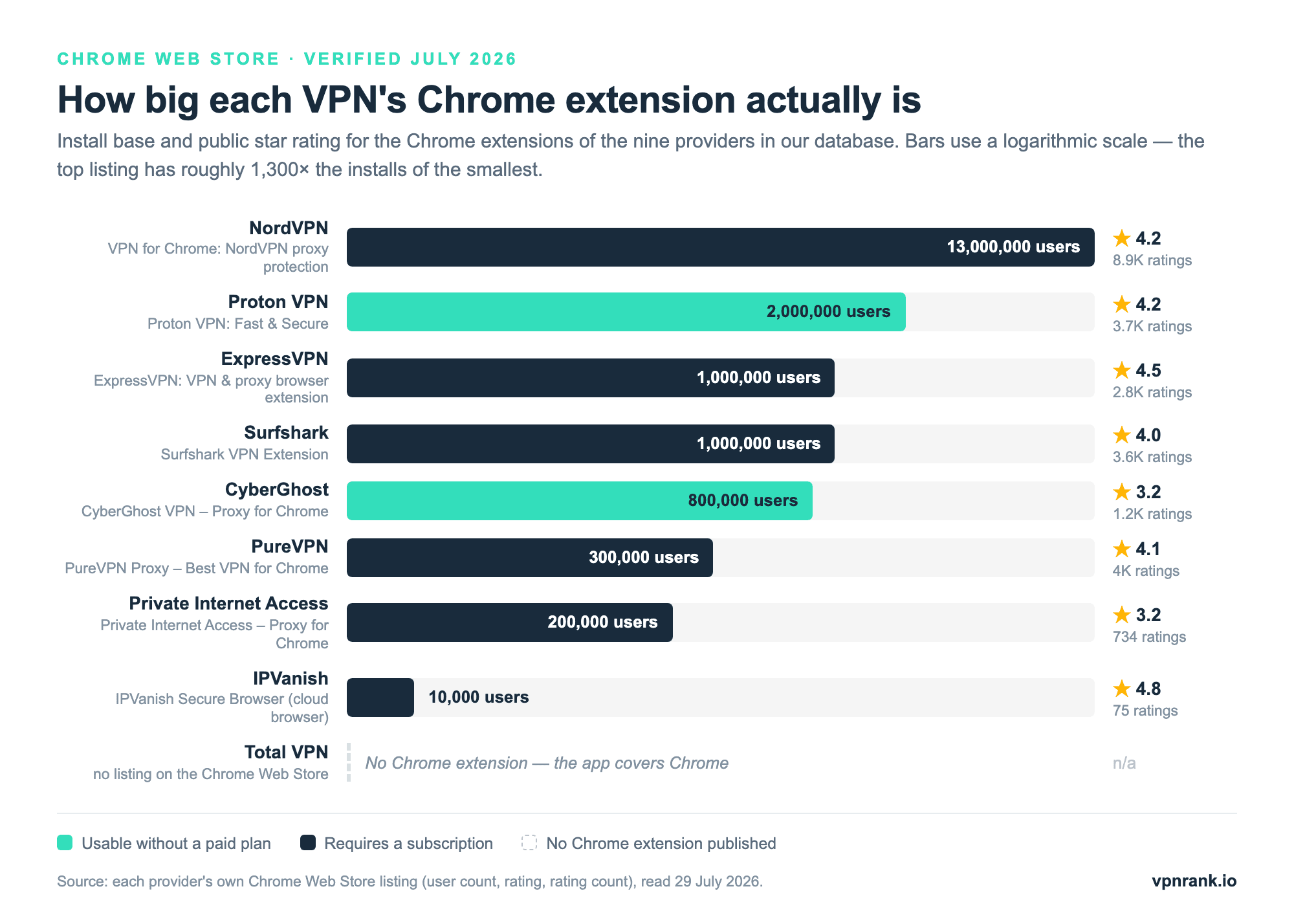
Eight of the nine providers in our database publish a Chrome extension; one doesn't publish one at all. The Chrome Web Store puts four facts on every listing — star rating, number of ratings, install base, and the date of the last update — and those four numbers tell you more about an extension than any marketing page. Below is every listing, read directly from the store in July 2026, with the one column that matters most for this search: whether you can actually use it without paying.
| Provider | Chrome Web Store listing | Rating | Users | Last updated | Usable without a paid plan? |
|---|---|---|---|---|---|
| ProtonVPN | Proton VPN: Fast & Secure | 4.2 ★ (3.7K ratings) | 2,000,000 | 16 Jun 2026 | Yes — free account, servers in 5 countries |
| CyberGhost | CyberGhost VPN – Proxy for Chrome | 3.2 ★ (1.2K ratings) | 800,000 | 23 Sep 2025 | Yes — no account needed, 4 countries |
| NordVPN | VPN for Chrome: NordVPN proxy protection | 4.2 ★ (8.9K ratings) | 13,000,000 | 13 Jul 2026 | No — needs a subscription |
| ExpressVPN | ExpressVPN: VPN & proxy browser extension | 4.5 ★ (2.8K ratings) | 1,000,000 | 21 Jul 2026 | No — needs a subscription |
| Surfshark | Surfshark VPN Extension | 4.0 ★ (3.6K ratings) | 1,000,000 | 17 Jul 2026 | No — needs a subscription |
| PureVPN | PureVPN Proxy – Best VPN for Chrome | 4.1 ★ (4K ratings) | 300,000 | 22 Jul 2026 | No — needs a subscription |
| Private Internet Access | Private Internet Access – Proxy for Chrome | 3.2 ★ (734 ratings) | 200,000 | 7 Jul 2026 | No — needs a subscription |
| IPVanish | IPVanish Secure Browser (a cloud browser, not a proxy extension) | 4.8 ★ (75 ratings) | 10,000 | 19 Feb 2025 | No — needs a subscription |
| TotalVPN | No Chrome extension published | — | — | — | No — the app covers Chrome along with everything else |
Two things in that table are worth pausing on. First, only two of these extensions do anything at all without a paid plan — ProtonVPN's, which needs a free account and connects you to free servers in the Netherlands, Japan, Poland, Romania and the United States, and CyberGhost's free proxy, which asks for no account or email at all and offers four locations (US, Germany, the Netherlands, Romania). Every other listing is a front-end for a subscription: install it without one and it will simply ask you to log in. Second, IPVanish's listing isn't a VPN proxy extension at all — "Secure Browser" opens a virtual browser window running in IPVanish's cloud, which you view as a video feed. It's a different product solving a different problem, and it needs a paid plan too.
The install counts also explain something about this search. One listing holds roughly 13 million of the installs across this whole group — more than all the others combined — which means most people's experience of a "Chrome VPN" is shaped by a single extension that isn't free. If you're here because you don't want to pay, the honest shortlist is two names long, and the rest of this guide is mostly about not getting hurt by the alternatives to them. Where a paid plan is on the table, our VPN price index tracks what each provider actually charges today rather than what its landing page claims.
💡 Check the last-updated date before you install anything. A VPN extension is proxy plumbing sitting inside a browser that changes every six weeks — a listing that hasn't shipped an update in over a year is not being maintained, whoever publishes it.
Does Google Chrome have a built-in VPN?
No. Google Chrome does not include a built-in VPN, and it never has. The confusion comes from three real-but-different features people mix up: Secure DNS, Enhanced Safe Browsing, and Chrome's newer IP Protection in Incognito. None of them is a VPN, and none hides your IP address the way a VPN does.
- →Secure DNS (DNS-over-HTTPS): encrypts your DNS lookups so your network can't easily see which domains you request. It does not hide your IP or encrypt the page traffic itself.
- →Enhanced Safe Browsing: warns you about phishing and malware sites in real time by checking pages against Google's cloud database. It's a security feature, not a privacy or location tool.
- →IP Protection (Incognito): rolling out from 2025, this masks your IP only for known third-party tracker domains (those on Chrome's Masked Domain List), routing them through a two-hop proxy. It keeps your real country/region and does nothing for first-party sites or apps outside Chrome. It is anti-tracking, not a VPN.
There was once a real Google VPN — VPN by Google One — but Google discontinued it in June 2024, citing low usage. Its successor, "VPN by Google" (often called Pixel VPN), survives only as a perk on newer Pixel phones. On the desktop, and inside Chrome specifically, there is no Google VPN in 2026. If you want VPN protection in Chrome, you need a third-party extension or app.
Manifest V3: what Chrome's extension rewrite changed for VPNs
Manifest V3 did not kill VPN extensions — but it did quietly clear out a chunk of the free ones, and it changes what a store listing can tell you. Manifest V3 is the extension platform Chrome moved to over several years, replacing Manifest V2. The API that a VPN extension actually depends on, chrome.proxy, carried over to V3 unchanged: an extension declares the proxy permission and can then set Chrome's proxy configuration — fixed servers, PAC scripts, bypass lists and all. What V3 removed was the blocking form of the webRequest API, which is why ad-blocking and content-filtering extensions had a painful migration and VPN proxies largely didn't.
| Date | What happened |
|---|---|
| January 2022 | Chrome Web Store stopped accepting new public or unlisted Manifest V2 extensions |
| June 2022 | The same cut-off extended to new private Manifest V2 extensions |
| 31 March 2025 | Manifest V2 extensions disabled across all Chrome channels, with an option to re-enable |
| 24 July 2025 | Chrome 138: Manifest V2 disabled everywhere, and users can no longer re-enable |
| 31 August 2026 | All remaining Manifest V2 extensions removed from the Chrome Web Store |
The practical consequence for anyone shopping for a free Chrome VPN in 2026: every extension you can still install is a Manifest V3 extension, because V2 stopped running in Chrome in July 2025. That makes "Manifest V3 compliant" a meaningless selling point — it's the floor, not a feature. It also means a wave of abandoned free proxy extensions silently stopped working somewhere in 2025, and a portion of the one-star reviews you'll find on older listings date from exactly that moment. If a listing's last update predates mid-2025 and it still installs, someone did the migration; if it predates mid-2025 and its recent reviews say it no longer connects, that's an extension nobody is maintaining.
What V3 did not do is make extensions safer to trust. Permissions still work the way they always did: an extension that requests access to read and change your data on all websites can still read every page you open, and a proxy extension can still see the destinations you visit. The migration changed the plumbing, not the trust model — which is why the checks in the next two sections matter more than any manifest version number.
Are free Chrome VPN extensions safe, and how do they make money?
Some are safe; many are not. The core issue is simple: running a VPN network costs real money, so if you aren't paying, the extension needs another revenue source. For a large share of free VPN extensions, that source is your data — browsing history, the sites you visit, and sometimes far more — which is sold to advertisers or data brokers. That's the exact opposite of what a VPN is supposed to do.
This isn't hypothetical. Security researchers have repeatedly documented free VPN extensions with hundreds of thousands of installs that quietly captured screenshots of users' screens, logged every page visited, or exfiltrated content to remote servers — including banking and login pages. A legitimate-looking extension can also turn hostile after an ownership change or a routine update, so a clean reputation last year is no guarantee today.
⚠️ Assume any free VPN extension can read everything you do in Chrome. That's not paranoia — it's how the permissions work. Only trust one whose funding and no-logs policy you can actually verify. See our VPN privacy guide for how to vet a provider.
How to spot a fake or unsafe free Chrome VPN extension
Check the publisher, the permissions, and the reviews — in that order — before you install. A trustworthy free VPN extension is published by a real company with a website and a named legal entity, requests only the permissions it genuinely needs, and has a consistent, human-looking review history. Anything that fails these tests is not worth the risk, no matter how many downloads it shows.
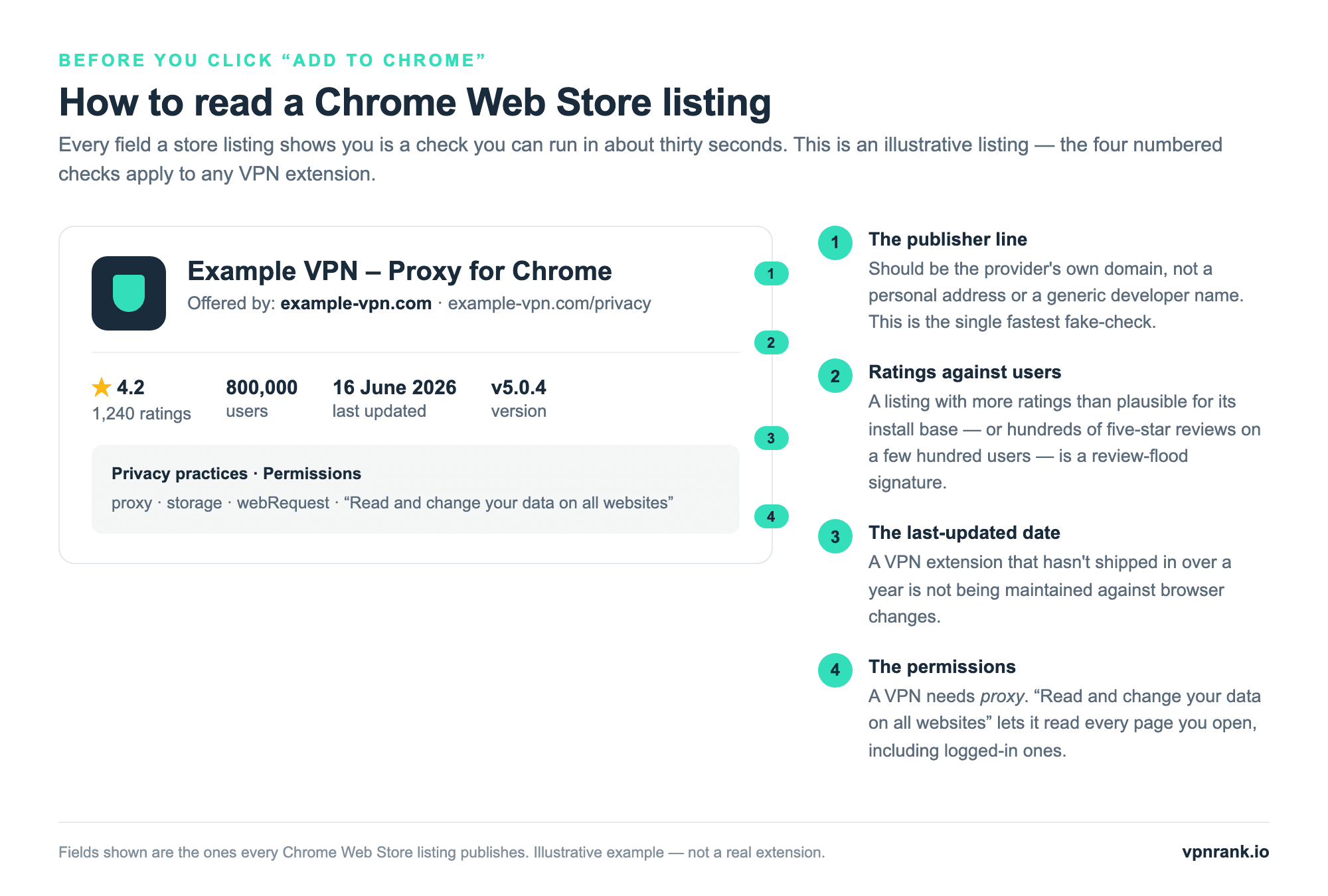
One check deserves singling out because it catches manipulation the other three miss: compare the rating count against the install base. Genuine extensions collect ratings from a small fraction of their users. Across the established listings in the table above, the ratio runs from roughly one rating per 75 installs at the low end to one per 1,500 at the high end — in every case a small minority of users. A listing showing hundreds of five-star ratings against only a few hundred installs inverts that entirely, and an inverted ratio is the clearest fingerprint of a purchased review campaign. Both numbers are printed on the same line of the same page, so the check takes seconds.
- →Publisher is anonymous or generic — no company name, no website, or a developer email on a free mail domain.
- →Over-broad permissions — it asks to "read and change all your data on all websites" (the <all_urls> / scripting permission) when a VPN only needs proxy access. This lets it see and alter every page you open.
- →Vague or missing privacy policy — no explicit statement that browsing data is never logged or sold; watch for policies that quietly reserve the right to share data with "partners."
- →Review red flags — a flood of five-star reviews posted in a short window, generic wording, or many recent one-star reviews mentioning ads, redirects, or accounts being compromised.
- →Unrealistic promises — "unlimited free VPN, unblocks all streaming, fastest servers." Real infrastructure costs money; these claims usually signal a data-for-service trade.
- →No independent audit — trustworthy providers publish third-party no-logs audits; unsafe ones never do.
⚠️ The permissions dialog is your best defence. If a VPN extension wants to "read and change all your data on the websites you visit," it can screenshot pages, read form fields, and inject scripts. Decline unless you fully trust the publisher.
WebRTC leaks: why a Chrome extension can still expose your real IP
Even with a VPN extension switched on, Chrome can still leak your real IP address through WebRTC — a browser technology built for video calls and peer-to-peer connections. WebRTC can query your true local and public IP directly, bypassing a proxy-based extension entirely. That means a website could see the location you're trying to hide, even though the extension shows a "connected" tick.
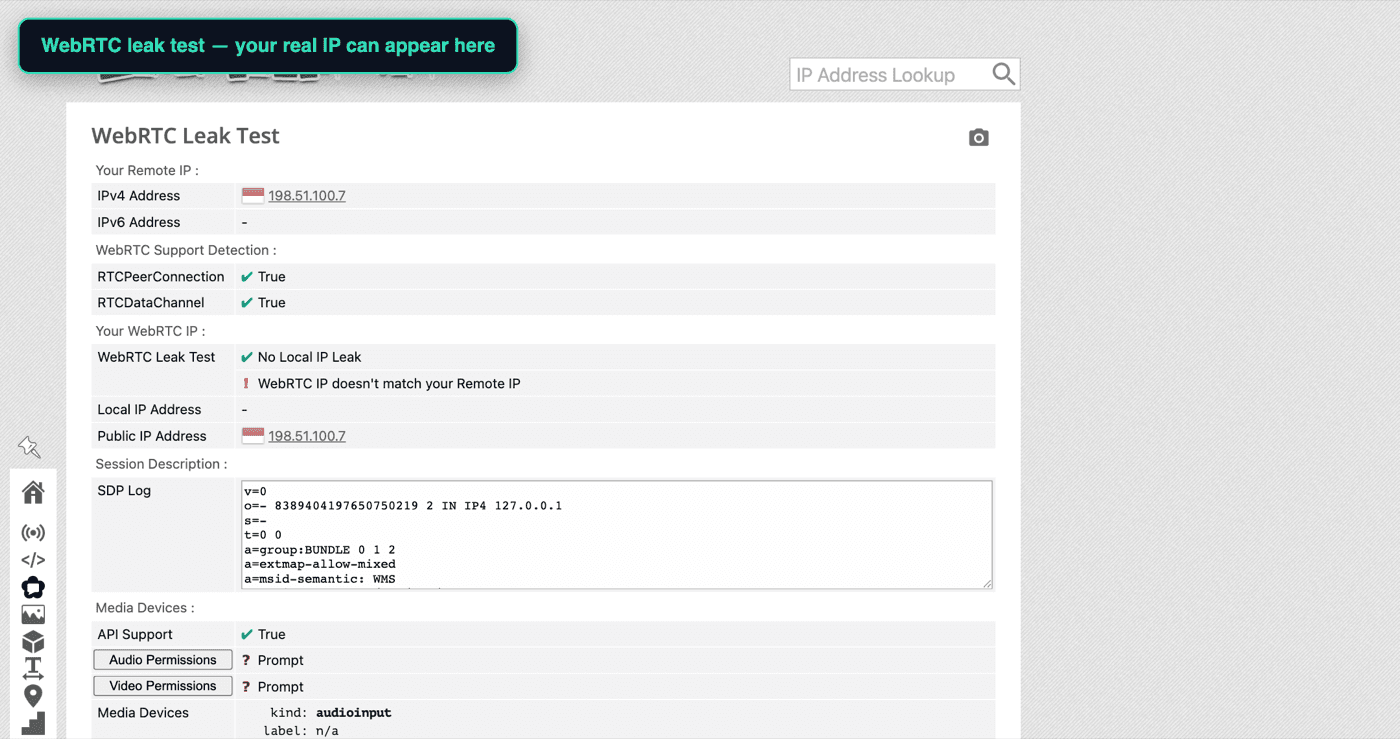
This is a key reason browser extensions are weaker than full apps: many free extensions don't touch WebRTC at all, while a proper full-device VPN app forces WebRTC through its tunnel. The good news is that it takes two minutes to test and fix. Read our WebRTC leak explainer for the full walkthrough — the same principle applies to a DNS leak, where lookups escape to your ISP even while connected.
- Connect your VPN extension (or app) and pick a server in another country.
- Open a free WebRTC leak test such as browserleaks.com/webrtc in Chrome.
- If the "public IP" shown matches your real IP or real city, you have a leak.
- Fix it: disable WebRTC via a reputable WebRTC-blocking extension or Chrome flag, or switch to a full-device VPN app that closes WebRTC and DNS leaks automatically.
💡 A green "connected" icon is not proof of privacy. Always confirm with a WebRTC and DNS leak test — and re-check our speed test tool if the connection feels slow after switching servers.
Can a free Chrome VPN unblock Netflix or other streaming?
Rarely, and never reliably. Streaming services actively detect and block VPN and proxy traffic, and they're especially good at spotting the datacenter IP addresses that nearly all free extensions use. Even when a free Chrome VPN connects, you'll typically hit a proxy error, a stuck loading screen, or SD-quality buffering because free servers are overloaded and too slow for HD video.
There's also a coverage problem: a browser extension only affects the Chrome tab, so a Netflix app on your TV, phone, or console is completely unaffected. If your goal is dependable streaming across devices, a free extension is the wrong tool — you want a proven full-device VPN with a large, frequently rotated IP pool. Our best VPNs for Netflix guide covers which providers currently work and on which platforms.
💡 If streaming is your main reason for wanting a VPN, skip free extensions. Premium apps ship with 30-day money-back guarantees, so you can confirm a service unblocks your library before paying a cent.
The safe free route on Chrome: ProtonVPN Free (and how to verify it works)
If you want a genuinely safe free option for Chrome, use ProtonVPN Free. It's the rare free VPN that doesn't monetise your data: unlimited bandwidth with no data cap, no ads, an independently audited no-logs policy, and Swiss jurisdiction — outside the EU and outside the major surveillance-sharing alliances, so disclosure would require a Swiss court order. That combination is what separates a trustworthy free VPN from a data-harvesting one.
The honest trade-offs: the free tier covers a limited set of server countries (you can't hand-pick a specific city), delivers medium speeds, and allows only a single simultaneous connection — and, like any browser extension, it protects only your Chrome traffic, not your whole device. That's a reasonable compromise for casual private browsing, and it's a world away from an anonymous extension demanding access to every page you open. See where it sits among the best free VPNs overall.
- Install the extension only from the official Proton VPN listing on the Chrome Web Store — confirm the publisher is Proton before adding it.
- Sign in (or create a free Proton account) and connect to an available free-tier country.
- Verify it's actually working: run a WebRTC and DNS leak test and confirm the IP shown is the VPN server's, not yours.
- Confirm your visible location changed by searching "what is my IP" — it should show the server country.
- Remember the scope: this secures Chrome only. Other apps still use your real IP.
When you need a full-device VPN app instead of an extension
Reach for a full-device VPN app whenever protection needs to extend beyond a single Chrome tab. An extension is fine for casual browser location changes, but it can't secure anything else on your machine — so for these use cases you want a proper app, not a free add-on.
- →Public Wi-Fi at airports, cafés, or hotels, where every app on your device is exposed.
- →Protecting traffic from apps outside Chrome — email clients, messaging, cloud sync, torrent clients, games.
- →Reliable streaming across a TV, phone, or console, not just a browser tab.
- →Closing WebRTC and DNS leaks automatically, without manual browser tweaks.
- →A verified no-logs, independently audited provider with 24/7 support and a kill switch.
For that, our database of premium providers — ExpressVPN, NordVPN, Surfshark, CyberGhost, Private Internet Access, IPVanish, PureVPN and more — all ship a Chrome extension and a full app, and all back it with a 30-day money-back guarantee. That means you can install the app, run your own leak and speed tests, confirm it unblocks what you need, and get a full refund if it doesn't. It's the low-risk way to get real device-wide protection instead of gambling on an anonymous free extension. If you'd rather start free and upgrade only if you outgrow it, the current ProtonVPN pricing and deals page shows what the paid tier costs today.
Update log for this page
Chrome Web Store figures, free-tier terms and Chrome's own extension policies all move. Rather than stamping a page with today's date and calling it fresh, here is what actually changed and when.
| Date | Change |
|---|---|
| 29 July 2026 | Added the Chrome Web Store listing table for all nine providers (rating, ratings count, installs, last-updated, free availability), read directly from the store; added the Manifest V3 section with Chrome's published deprecation timeline; added the listing-anatomy graphic and the ratings-to-installs check; added three questions on incognito, no-signup extensions and Chromebooks. |
| 9 July 2026 | Prices and free-tier terms re-verified; WebRTC leak-test walkthrough expanded. |
| 15 June 2026 | Page first published. |
How to Set Up a Free VPN on Chrome
Install from a reputable provider
Add the ProtonVPN extension from the Chrome Web Store. Verify the publisher matches the official company.
Create a free account
Sign in or create a free account. No credit card required for ProtonVPN Free.
Connect to a free server
Pick a free server location and connect. The extension routes only Chrome traffic. Note that free tiers offer a limited set of locations and medium speeds.
Test for leaks
Visit a WebRTC and DNS leak test page to confirm your real IP isn't leaking through the browser.
Use the full app for everything else
For other apps, public WiFi, or streaming, install the provider's full desktop app — the extension alone won't protect them. Premium apps with a 30-day money-back guarantee let you cover your whole device risk-free for a month.
How We Tested Free Chrome VPNs
We tested free Chrome VPN extensions for encryption, leaks, and data handling.
Encryption Verification
We verified each extension genuinely encrypts traffic rather than acting as an unencrypted proxy. Several popular free extensions failed this — they only changed the apparent IP.
WebRTC & DNS Leak Tests
We ran WebRTC and DNS leak tests with each extension active. The reputable option — ProtonVPN — passed; many free extensions leaked the real IP via WebRTC.
Permission & Privacy-Policy Review
We reviewed each extension's requested permissions and privacy policy. Many free Chrome VPN extensions request the ability to read all browsing data and share it with third parties — a disqualifier. One hugely popular free 'unlimited' service was even caught reselling its users' bandwidth as a botnet.
Free Chrome VPN extension testing runs quarterly.
Frequently Asked Questions About Free Chrome VPNs
Is there an unlimited free VPN for Chrome with no sign-up?
There is one from a provider we'd stand behind: CyberGhost's Chrome proxy extension connects without an account or an email address, across four locations (US, Germany, the Netherlands, Romania). Beyond that, treat "no sign-up" as a warning rather than a feature. An extension that asks for nothing has no relationship with you at all — no account to suspend, no subscription to lose — which removes the commercial reason to behave well, and the running costs still have to come from somewhere. ProtonVPN Free takes the opposite approach: it asks for a free account, and in exchange gives you unlimited data on free servers in five countries with an audited no-logs policy. The account is the accountability.
Does a Chrome VPN extension work in Incognito mode?
Not by default. Chrome disables extensions in Incognito windows unless you explicitly allow each one: open chrome://extensions, click Details on the VPN extension, and switch on "Allow in Incognito." Until you do, an Incognito window browses on your real IP address even though the extension shows as connected in normal windows — a genuinely common way people think they're protected when they aren't. It's worth understanding what you're enabling, too: Incognito stops Chrome saving your history locally, while the extension changes the IP address sites see. They're different protections, and neither one is the other.
Does ProtonVPN Free work on a Chromebook?
Yes, and you have two routes. The Chrome extension installs on ChromeOS exactly as it does on desktop Chrome and covers your browser tabs. The better option on most modern Chromebooks is the Android app from the Play Store, which protects the whole device — browser, Android apps, and Linux containers if you use them — rather than only Chrome. Either way the free tier terms are the same: unlimited data, one device at a time, and free servers in five countries. If your Chromebook is managed by a school or employer, note that administrators can block both the extension and the Play Store app.
Do I need a VPN extension if I already have the VPN's desktop app running?
Usually no — the app already protects Chrome along with everything else on your device, so the extension is optional. The main reasons to add the matching extension on top of the app are convenience (quickly switching server location from the toolbar) and browser-specific features some providers offer, such as forcing WebRTC through the tunnel or blocking trackers per tab. Never run two different VPNs' extensions and apps at once, though; conflicting network settings can cause leaks or break your connection.
Is a free VPN Chrome extension enough for public Wi-Fi?
Not really. An extension only encrypts what happens inside Chrome, so on public Wi-Fi every other app — your email client, messaging apps, cloud backups, and background system services — is still exposed on the same untrusted network. For genuine protection on airport or café Wi-Fi you want a full-device VPN app that encrypts all traffic, not a browser-only extension. If you only ever browse in a single Chrome tab, a trustworthy extension helps, but it's a partial measure at best.
Why is my free Chrome VPN so slow?
Free VPN servers are shared by huge numbers of users on limited infrastructure, so congestion is the norm — expect slower speeds than your normal connection, especially at peak times. Distance to the server, an overloaded free-tier location, and the extra encryption overhead all add latency. Reputable free tiers like ProtonVPN Free keep speeds usable for browsing but still can't match a premium app on a nearby server. If speed matters, test your connection with a speed-test tool and consider a paid app on a money-back trial rather than pushing a free server past what it can handle.
Will a Chrome VPN extension hide my activity from my employer or school?
Only partly, and often not at all. On a managed device, network administrators can enforce policies, install monitoring software, or block VPN extensions outright — and any activity outside Chrome remains visible. A browser extension also can't hide anything captured by device-level monitoring that your organization may have installed. Treat work and school devices as monitored by default; a VPN extension is not a reliable way around that, and installing one may violate acceptable-use policies.
Does a Chrome VPN extension protect my whole computer?
No — this is the key limitation. A Chrome extension encrypts only your Chrome browser traffic. Other apps, other browsers, and system traffic stay on your real connection. For full-device protection (and public-WiFi safety), you need the provider's full VPN app, not just the extension.
What's the best free VPN extension for Chrome?
ProtonVPN Free is the safest free option for Chrome, backed by an independently audited no-logs policy, real encryption, and unusually generous unlimited data. Most other free Chrome VPN extensions log browsing data or are unencrypted proxies — stick to the reputable one, or use a premium VPN's 30-day money-back guarantee to test a full app for free.
Will a free Chrome VPN unblock Netflix?
Rarely. Streaming services block free extensions' IPs, and many extensions are proxies without the infrastructure to keep up. For streaming, you need a full paid VPN app with maintained streaming servers, not a free browser extension. Premium providers like ExpressVPN, NordVPN and Surfshark refund within 30 days, so you can stream on a full app risk-free for a month.
Are free Chrome VPN extensions safe?
Most aren't. Many in the Chrome Web Store log browsing data, sell it, or are unencrypted proxies — and some have been caught injecting ads or bundling trackers. The safe exception is an extension from an audited provider — ProtonVPN Free. Always check the publisher and that the extension genuinely encrypts.