
Best VPN for MLB.TV Blackouts in 2026
Updated 1 September 2026- Fast & secure servers in USA, UK, Canada & 100+ countries
- Keep your online activity private from your ISP & advertisers
- Use your favorite apps & services securely from anywhere

Quick answer
ExpressVPN is our #1 pick for this guide
We test VPNs with MLB.TV weekly during the baseball season, measuring streaming speed, privacy protection, and multi-device performance. These are the top MLB.TV VPNs for 2026.

ExpressVPN Ultra fast & secure. Great for privacy, downloads, and everyday browsing on all your devices. 24/7 live chat support.
ExpressVPN Ultra fast & secure. Great for privacy, downloads, and everyday browsing on all your devices. 24/7 live chat support.

IPVanish Fast speeds with unlimited device connections. Strong no-logs privacy and 24/7 live chat support. Great for families.

IPVanish Fast speeds with unlimited device connections. Strong no-logs privacy and 24/7 live chat support. Great for families.

NordVPN Excellent speeds with one of the largest server networks. Strong security features and easy-to-use apps. 24/7 live chat support.
NordVPN Excellent speeds with one of the largest server networks. Strong security features and easy-to-use apps. 24/7 live chat support.
Proton VPN Swiss-based VPN with strong privacy focus. Audited no-logs policy and open-source apps. Great for privacy-conscious users.
Proton VPN Swiss-based VPN with strong privacy focus. Audited no-logs policy and open-source apps. Great for privacy-conscious users.

CyberGhost Fast speeds and strong privacy tools. Simple apps, automatic WiFi protection, and 24/7 live chat support.
CyberGhost Fast speeds and strong privacy tools. Simple apps, automatic WiFi protection, and 24/7 live chat support.
Private Internet Access High-speed VPN with a large server network and advanced security settings. Ad blocker included and 24/7 live chat support.
Private Internet Access High-speed VPN with a large server network and advanced security settings. Ad blocker included and 24/7 live chat support.

Surfshark Unlimited device connections at a budget-friendly price. Includes ad blocker and strong privacy tools. Great value for money.
Surfshark Unlimited device connections at a budget-friendly price. Includes ad blocker and strong privacy tools. Great value for money.

TotalVPN Affordable VPN with strong privacy and reliable speeds. Easy-to-use apps for all major devices. No-logs policy.
TotalVPN Affordable VPN with strong privacy and reliable speeds. Easy-to-use apps for all major devices. No-logs policy.
Rankings are based on our independent testing methodology. Each guide applies the criteria described on that page, including relevant performance, privacy, product features, and value data. We may earn affiliate commissions from links on this page, which helps fund our testing — this does not influence our rankings.
2026 Rankings At a Glance
| # | VPN | Download speed | Lowest long-term price | Money-back | Key strength |
|---|---|---|---|---|---|
| 1 | ExpressVPN | 478 Mbps | $2.79/mo | 30 days | 3,000+ servers in 105 countries |
| 2 | IPVanish | 468 Mbps | $2.19/mo | 30 days | 3,200+ servers in 112+ countries |
| 3 | NordVPN | 462 Mbps | $3.09/mo | 30 days | 7,400+ servers in 118 countries |
| 4 | Proton VPN | 445 Mbps | $2.99/mo | 30 days | 15,000+ servers in 120+ countries |
| 5 | CyberGhost | 438 Mbps | $2.03/mo | 45 days | Servers in 100 countries |
| 6 | Private Internet Access | 430 Mbps | $1.75/mo | 30 days | Servers in 91 countries |
| 7 | Surfshark | 421 Mbps | $1.78/mo | 30 days | 3,200+ servers in 100 countries |
| 8 | TotalVPN | 415 Mbps | $1.59/mo | 30 days | Servers in 50+ countries |
Download figures use our wired 1 Gbps US East reference test. See the full benchmark and regional results. Prices reflect the current long-term promotional rate, billed upfront; term length varies by provider.
Why You Need a VPN for MLB.TV
MLB.TV is the go-to platform for live baseball, but ISP throttling, public Wi-Fi risks, and slow connections can ruin your experience. A VPN keeps your stream fast, private, and buffer-free so you never miss a pitch.
Stop ISP Throttling During Games
Many ISPs slow down video streaming during peak hours, especially live sports. A VPN encrypts your traffic so your ISP cannot detect or throttle your MLB.TV stream, keeping your picture smooth and buffer-free all nine innings.
Protect Your Privacy While Streaming
When you stream MLB.TV, your ISP and advertisers can track every game you watch. A VPN hides your activity behind strong encryption, so your viewing habits stay private and your personal data stays secure.
Enjoy Buffer-Free 4K Baseball
The best VPNs for MLB.TV deliver speeds fast enough for 4K streaming with zero buffering. Our top picks maintain over 500 Mbps, so you get crystal-clear picture quality for every pitch, hit, and home run.
Stream Securely on Any Network
Watching baseball at a hotel, airport, or coffee shop? Public Wi-Fi puts your accounts and payment info at risk. A VPN secures your connection on any network so you can enjoy MLB.TV safely wherever you are.
What to Look for in an MLB.TV VPN
Streaming live baseball demands speed, reliability, and strong security. These features are essential for the best MLB.TV experience:
High-Speed US Servers
Live baseball requires fast, reliable connections with minimal buffering. NordVPN offers servers in 15+ US cities optimized for streaming, delivering the speed you need for smooth HD and 4K picture quality throughout every game.
Strong Encryption & DDoS Protection
A good MLB.TV VPN uses AES-256 encryption and includes DDoS protection for sports streaming. This keeps your connection stable and secure, preventing interruptions from network attacks during live games.
Smart TV & Mobile App Compatibility
MLB.TV runs on phones, tablets, smart TVs, Fire Stick, Roku, and gaming consoles. Your VPN needs apps for these platforms or router-level setup to cover devices that cannot install VPN apps directly.
Reliable Multi-Device Support
Baseball fans often stream on multiple screens at once. The best VPNs support 6 or more devices on a single plan, so you can protect your phone, laptop, and smart TV without switching connections.
MLB.TV Blackouts in 2026: What ESPN's Takeover Changed and Where a VPN Actually Applies
The 2026 season rewired baseball's broadcast map more than any season in twenty years. ESPN now sells and distributes MLB.TV itself. MLB's own in-house media division produces the local telecasts for roughly half the league after two regional sports networks collapsed under their owner. Twenty-two of the thirty clubs now sell a blackout-free in-market stream directly on MLB.com. Almost every "MLB.TV blackout VPN" guide online is still describing the 2024 landscape. This section is a reading of the current arrangements — package listings, rights announcements and MLB's own published blackout wording, all checked on 6 August 2026 — and it exists to answer one question honestly: which of the things blocking your game can a VPN change, and which ones can it not touch at all.
There are three MLB.TV blackouts, and a VPN is only relevant to one
Almost all the confusion around MLB.TV comes from treating "blacked out" as one thing. It is three, and they behave completely differently. Only the first is decided by where MLB thinks you are — which is the only variable a VPN changes.
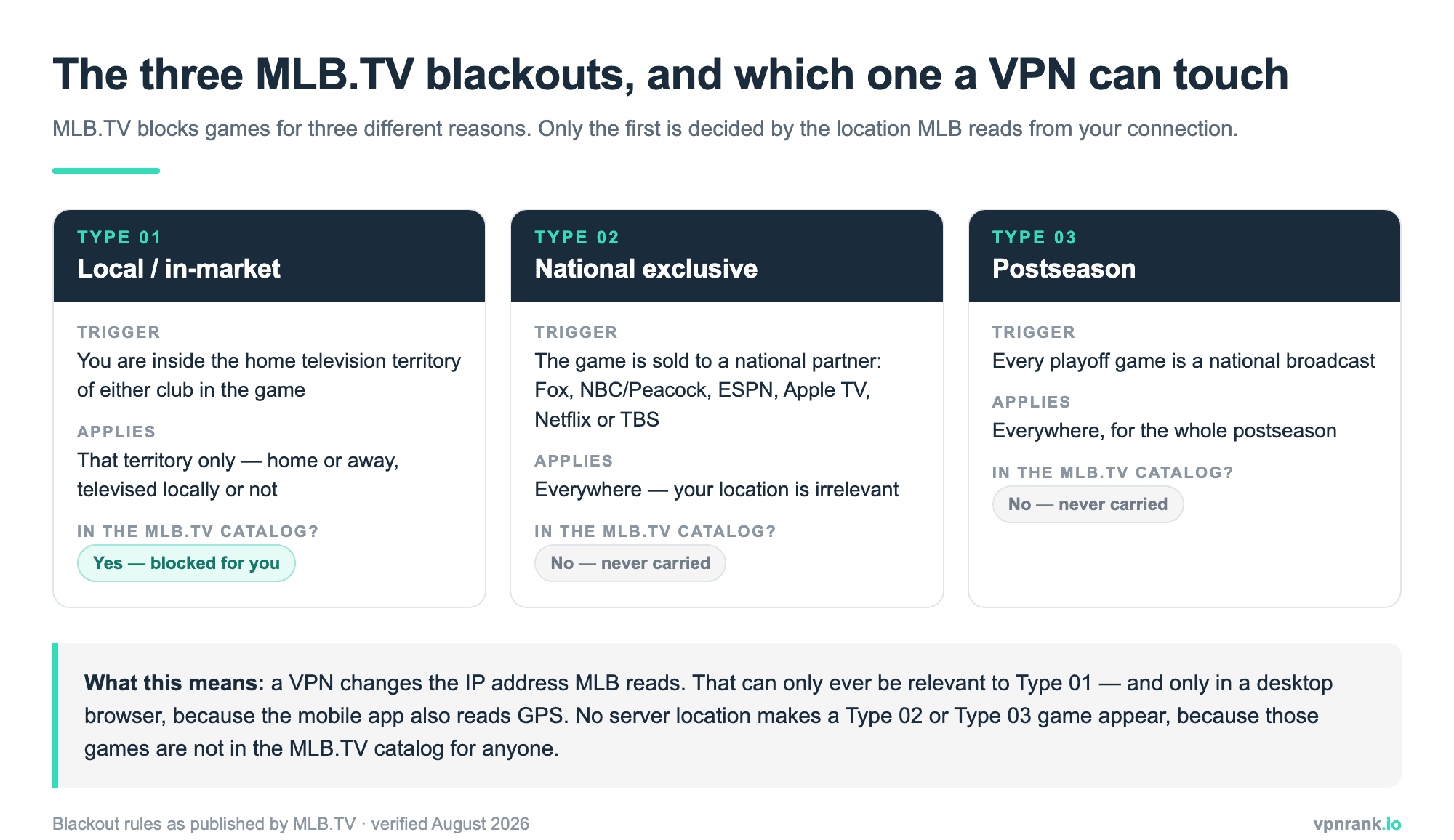
| Blackout type | What triggers it | Where it applies | Is the game in the MLB.TV catalog? |
|---|---|---|---|
| Local / in-market | You are inside the home television territory of either club playing | That territory only | Yes — the game exists, it is withheld from you |
| National exclusive | The game was sold to a national partner for that window | Everywhere, for everyone | No — MLB.TV never carries it |
| Postseason | All playoff games are national broadcasts | Everywhere, all postseason | No — MLB.TV never carries it |
MLB's own wording on the local blackout is unusually blunt, and it is worth reading closely: home television territory blackout restrictions apply regardless of whether a club is home or away, and regardless of whether or not the game is actually televised in that territory. In other words, the blackout is not compensation for a local broadcast you could otherwise watch — it applies even when nobody is showing the game near you. MLB also notes that a US club's territory restrictions can extend outside the United States.
⚠️ No server location can produce a national-exclusive game. If Fox, NBC, ESPN, Apple TV, Netflix or TBS holds a window, the game is not in the MLB.TV library for any subscriber anywhere — not for a fan in Berlin, not for a fan in Boise. Any guide that tells you to "connect to a different US city" to watch a Saturday Fox game or a playoff game is describing something that cannot happen. You need that platform's own subscription.
Who controls your team's local telecast in 2026 — and the blackout-free way in
The local blackout only exists to protect somebody's regional broadcast rights. Knowing who holds those rights for your club in 2026 tells you whether there is a legitimate, blackout-free way to watch it — which for a fan inside the home territory is a far better answer than any VPN.
The regional sports network model kept collapsing through 2025 and into 2026. MLB responded by building its own production operation: MLB's league-run local media division named fourteen clubs in its 2026 broadcast announcement — the Brewers, Cardinals, Diamondbacks, Guardians, Mariners, Marlins, Nationals, Padres, Rays, Reds, Rockies, Royals, Tigers and Twins — and the Angels moved across in February 2026 after their RSN operator stopped making scheduled payments. That is half the league whose local telecast is now produced and distributed by the league itself rather than by a regional network.
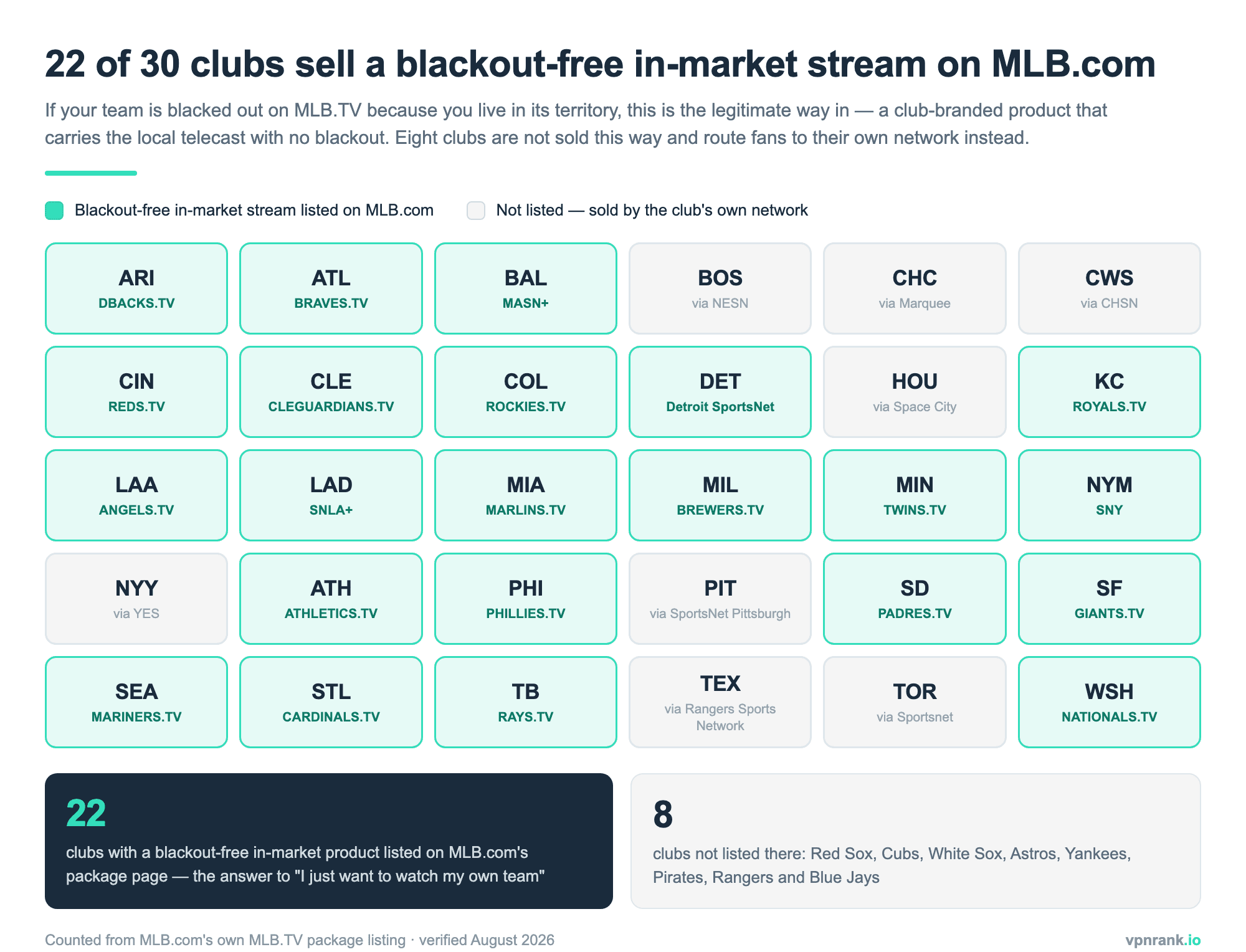
The practical consequence is the single most useful fact on this page: 22 of the 30 clubs now sell a blackout-free in-market stream through MLB.com. If you live in your team's territory and your team is one of those 22, the thing you actually want is not a VPN and not the out-of-market package — it is your club's own product, which carries the local telecast with no blackout at all.
| Club | Blackout-free in-market product on MLB.com | Local telecast produced by |
|---|---|---|
| Arizona Diamondbacks | DBACKS.TV | MLB league-run local media |
| Atlanta Braves | BRAVES.TV | Club-owned network |
| Baltimore Orioles | MASN+ | Club-affiliated RSN |
| Boston Red Sox | Not listed — via NESN | Club-affiliated RSN |
| Chicago Cubs | Not listed — via Marquee | Club-owned network |
| Chicago White Sox | Not listed — via CHSN | Club-affiliated network |
| Cincinnati Reds | REDS.TV | MLB league-run local media |
| Cleveland Guardians | CLEGUARDIANS.TV | MLB league-run local media |
| Colorado Rockies | ROCKIES.TV | MLB league-run local media |
| Detroit Tigers | Detroit SportsNet | MLB league-run local media |
| Houston Astros | Not listed — via Space City Home Network | Club-affiliated network |
| Kansas City Royals | ROYALS.TV | MLB league-run local media |
| Los Angeles Angels | ANGELS.TV | MLB league-run local media (from Feb 2026) |
| Los Angeles Dodgers | SNLA+ | Club-affiliated RSN |
| Miami Marlins | MARLINS.TV | MLB league-run local media |
| Milwaukee Brewers | BREWERS.TV | MLB league-run local media |
| Minnesota Twins | TWINS.TV | MLB league-run local media |
| New York Mets | SNY | Club-affiliated RSN |
| New York Yankees | Not listed — via YES Network | Club-affiliated RSN |
| Athletics | ATHLETICS.TV | Regional network |
| Philadelphia Phillies | PHILLIES.TV | Regional network |
| Pittsburgh Pirates | Not listed — via SportsNet Pittsburgh | Club-affiliated RSN |
| San Diego Padres | PADRES.TV | MLB league-run local media |
| San Francisco Giants | GIANTS.TV | Regional network |
| Seattle Mariners | MARINERS.TV | MLB league-run local media |
| St. Louis Cardinals | CARDINALS.TV | MLB league-run local media |
| Tampa Bay Rays | RAYS.TV | MLB league-run local media |
| Texas Rangers | Not listed — via Rangers Sports Network | Club-owned network |
| Toronto Blue Jays | Not listed — via Sportsnet | Club-affiliated network |
| Washington Nationals | NATIONALS.TV | MLB league-run local media |
The eight clubs without an MLB.com listing are not unreachable — their networks sell direct subscriptions of their own — but you buy those from the network rather than from MLB, and terms vary. Note also that a blackout territory has nothing to do with distance. Iowa sits inside six clubs' territories at once (Brewers, Cardinals, Cubs, Royals, Twins and White Sox) despite having no MLB stadium in the state, and Las Vegas is covered by six more. Check your own postcode against MLB's blackout tool before you buy anything.
The 2026 national packages: the games MLB.TV never has
MLB restructured its national deals for 2026 into three-year agreements. The headline change for anyone reading a VPN guide is that ESPN now sells and distributes MLB.TV itself — the out-of-market package is bought through ESPN, either standalone or as an add-on to ESPN's top streaming tier. The old assumption that MLB.TV is a self-contained MLB product no longer holds.
| National partner | What it carries in 2026 | Available on MLB.TV? |
|---|---|---|
| ESPN | A 30-game national package, plus distribution of MLB.TV itself | National games: no. MLB.TV: sold through ESPN |
| Fox / FS1 | Around 85 regular-season games, the All-Star Game and postseason coverage | No |
| NBC / Peacock | 60-plus games, more than 40 of them Peacock exclusives, including Sunday Night Baseball | No |
| TBS | A weekly Tuesday game | No |
| Apple TV | Friday night baseball | No |
| Netflix | Season-opening game, the Home Run Derby and event games | No |
Read that right-hand column again, because it is the reason so many people conclude their VPN is "broken". On a Sunday night or a Saturday afternoon, a large share of the schedule is national and simply absent from MLB.TV. Nothing is malfunctioning and no server list will fix it. The same structural point applies to the other US sports packages — we cover the equivalent windows in our NBA League Pass guide and NFL guide, and the broader picture in our sports streaming guide.
Which server location actually matters, situation by situation
Because the local blackout keys off the two clubs in a specific game rather than off "the US" as a whole, the useful question is never "which is the best US server" but "whose territory am I currently sitting in". This table maps the four situations people actually arrive in.
| Your situation | What MLB is checking | What actually changes the outcome |
|---|---|---|
| You are in your own team's territory and want their game | Whether your location falls inside that club's home television territory | The blackout-free in-market product for your club, if it has one — this is what those 22 products exist for. A VPN is the wrong tool here. |
| You are travelling in the US and hit a new local blackout | The territory you are physically in now, for either club in the game | A desktop browser connected to a location outside both clubs' territories. Somewhere geographically distant from both markets, not simply "a US server". |
| You are outside the US with an MLB.TV subscription | Your IP address, plus GPS if you are in the mobile app | Nothing needs changing for most out-of-market games. Note MLB's warning that a US club's territory restrictions may extend beyond the United States. |
| The game is a national exclusive or a playoff game | Nothing about you — the game is not in the catalog | Only a subscription to the platform holding that window. No server location helps. |
💡 Distance from both clubs is what matters, not the number of US cities your VPN lists. A server in a city that happens to sit inside one of the two clubs' territories leaves you exactly where you started. Before you connect, check which two clubs are playing and pick a location well away from both markets.
IP in the browser, GPS in the app — why the same VPN works on a laptop and fails on a phone
This is the detail that separates a realistic guide from an optimistic one. MLB states that blackout restrictions are based on geography and apply according to your physical location, which may be determined using various available factors, including IP address. That phrasing — "various available factors" — is doing a lot of work, and the difference between devices is where you feel it.
- →Desktop browser: location is read from your IP address. This is the only environment where changing your apparent location is straightforward, which is why every honest MLB.TV workaround guide ends up recommending a laptop.
- →iOS and Android apps: the app asks for device location services and reads GPS as well as IP. A VPN changes the IP and leaves the GPS untouched, so the two disagree and the app trusts the GPS.
- →Mismatch signals: beyond IP and GPS, cached cookies, browser storage and DNS settings can still carry your real location. If they contradict the IP, that inconsistency is itself a signal.
- →Mock-location detection: Android exposes a developer setting for mock GPS, and streaming apps commonly check for it. One of the eight providers we cover, Surfshark, publishes an Android GPS override setting that matches your device's reported GPS to your chosen server; MLB's apps can flag mock locations, so treat this as unreliable for blackouts rather than a fix.
The practical rule that follows: if you are going to use a VPN with MLB.TV at all, use it in a desktop web browser. On a phone, tablet or streaming stick, you are fighting a location check a VPN was never designed to answer. The same asymmetry shows up on other sports platforms — see our YouTube TV guide, which enforces location in a comparable way.
What MLB.TV costs in 2026 after the ESPN handover
Pricing moved along with distribution. MLB.TV's full-season out-of-market package listed at $149.99 for 2026, with a discounted rate for subscribers to ESPN's top streaming tier, and MLB cut the seasonal price again mid-season in May 2026 — the closer you get to October, the less a full-season pass costs, so check the live figure before buying.
| Package | 2026 price at launch | Note |
|---|---|---|
| MLB.TV, full season (all out-of-market games) | $149.99 | Auto-renewing subscribers kept this rate without any ESPN involvement |
| MLB.TV, full season, for ESPN Unlimited subscribers | $134.99 | A $15 discount tied to ESPN's top streaming tier |
| Single-team package | Priced per club | Cheaper than the full package; the club determines the price |
One thing that has not changed: none of these packages removes a blackout. Every tier of MLB.TV carries the same restrictions, and paying more does not buy your local team. That is worth stating plainly because the pricing page and the blackout page are two clicks apart and a lot of people only read the first. If your goal is your own club, go back to the table above and check whether it is one of the 22 with an in-market product.
⚠️ Where we stand on this. Using a VPN to disguise your location and watch content outside the territory it is licensed for can breach MLB.TV's terms of service. We are not going to pretend otherwise, and we do not recommend buying a subscription at another country's price. A VPN is a legitimate privacy and anti-throttling tool, and that use is entirely defensible; defeating a blackout is a different thing, and the risk is yours. Commissioner Rob Manfred has said publicly that MLB wants out of the blackout business, but has framed that as a goal for the rights cycle after 2028 — so nothing about 2026 changes on that account.
How to Watch MLB.TV with a VPN
Choose a fast, secure VPN
Pick NordVPN (our #1 for MLB.TV), ExpressVPN, or Surfshark. All three offer high-speed US servers, strong encryption, and apps for every major streaming device.
Install the VPN on your device
Download the VPN on your phone, laptop, Fire Stick, or smart TV. For gaming consoles, configure the VPN on your router.
Connect to a fast US server
Open the VPN app and select a US server. Choose one close to your location for the best speed, or use the app’s recommended server feature for the fastest connection.
Open MLB.TV and start watching
Launch the MLB.TV app or visit mlb.tv. Your connection is now encrypted, private, and optimized for smooth, buffer-free streaming.
Enjoy secure, high-quality baseball
Watch every game with fast speeds and full privacy. The VPN runs quietly in the background, protecting your connection without affecting your stream quality.
How We Test VPNs for MLB.TV
We test VPNs with MLB.TV during the regular season, measuring speed, security, streaming quality, and device compatibility.
Speed & Throttle Prevention
We measure download speeds before and after connecting to each VPN while streaming MLB.TV. Top picks show less than 5% speed loss and completely prevent ISP throttling during peak viewing hours.
Live Game Stream Quality
We test live game streams for resolution (720p to 4K), latency, and buffering events during 3-hour game sessions. Top VPNs deliver smooth HD baseball with under 15 seconds delay.
Security & Privacy Checks
We verify that each VPN properly encrypts traffic, passes DNS leak tests, and keeps no logs of your streaming activity. Your baseball viewing habits should remain completely private.
Cross-Device Compatibility
We test MLB.TV streaming through each VPN on web browsers, iOS, Android, Fire Stick, and smart TVs to confirm reliable performance across all platforms.
MLB.TV VPN tests are conducted weekly during the regular season (April-October).
Frequently Asked Questions
Does ESPN selling MLB.TV in 2026 change the blackouts?
No. ESPN took over the sale and distribution of MLB.TV for the 2026 season under a reworked three-year rights deal, so new subscribers now buy the out-of-market package through ESPN rather than directly from MLB, and subscribers to ESPN's top streaming tier get a discounted seasonal rate. What did not change is the blackout structure: the out-of-market package still enforces home television territory restrictions exactly as before, and national exclusive games are still absent from the catalog. If you were hoping the handover would end blackouts, it did not. Existing auto-renewing subscribers were kept on their previous rate and did not need an ESPN account at all.
Which MLB teams offer a blackout-free in-market stream in 2026?
Twenty-two of the thirty clubs sell a blackout-free in-market product through MLB.com's own package listing, and it is by far the best answer if the team you want is your local one. They are the Diamondbacks (DBACKS.TV), Braves (BRAVES.TV), Orioles (MASN+), Reds (REDS.TV), Guardians (CLEGUARDIANS.TV), Rockies (ROCKIES.TV), Tigers (Detroit SportsNet), Royals (ROYALS.TV), Angels (ANGELS.TV), Dodgers (SNLA+), Marlins (MARLINS.TV), Brewers (BREWERS.TV), Twins (TWINS.TV), Mets (SNY), Athletics (ATHLETICS.TV), Phillies (PHILLIES.TV), Padres (PADRES.TV), Giants (GIANTS.TV), Mariners (MARINERS.TV), Cardinals (CARDINALS.TV), Rays (RAYS.TV) and Nationals (NATIONALS.TV). The eight not listed there are the Red Sox, Cubs, White Sox, Astros, Yankees, Pirates, Rangers and Blue Jays, whose networks sell their own direct subscriptions instead. Verified against MLB.com in August 2026.
Why is a game missing from MLB.TV even though I am not in either team's market?
Because it is a national exclusive, and those games are not in the MLB.TV catalog for anyone. In 2026 the national packages are held by Fox and FS1 (around 85 regular-season games plus the All-Star Game and postseason), NBC and Peacock (60-plus games including Sunday Night Baseball, more than 40 of them Peacock exclusives), ESPN (a 30-game package), TBS (a weekly Tuesday game), Apple TV (Friday night baseball) and Netflix (the season opener, the Home Run Derby and event games). On those nights the game is simply not offered on MLB.TV regardless of where you are or what you connect to, and the whole postseason works the same way. This is the single most common reason people conclude their VPN has stopped working when nothing is actually wrong with it.
Does paying more for MLB.TV remove blackouts?
No. Every tier of MLB.TV carries the same blackout restrictions, so the full-season package, the single-team package and the ESPN-bundled version are all subject to identical rules. Spending more does not buy access to your local club, and it does not add national exclusive games. The only paid product that legitimately removes a local blackout is your club's own in-market stream, which 22 of the 30 clubs sell on MLB.com. It is worth knowing this before you subscribe, because MLB's pricing page and its blackout page are separate and it is easy to buy the wrong thing.
Which MLB teams are blacked out in 2026?
Every one of the 30 MLB clubs still has a home-market blackout on MLB.TV in 2026, because MLB.TV only carries out-of-market games and continues to honor local broadcast deals. Big-market teams stay blacked out in their home regions because their games air on owned or affiliated regional sports networks, including the Yankees (YES), Dodgers (SportsNet LA), Red Sox (NESN), Cubs (Marquee), and Mets (SNY). Blackout zones can also reach far beyond a team's city: Iowa residents are blacked out by six teams hundreds of miles away (Brewers, Cardinals, Cubs, Royals, Twins, and White Sox), and Las Vegas is blacked out by six more (Diamondbacks, Angels, Dodgers, Athletics, Padres, and Giants). Use MLB's zip-code blackout tool to see exactly which teams are blocked at your address before you subscribe.
How do I watch my local team on MLB.TV with a VPN?
You generally cannot watch your local team's regional broadcast on MLB.TV itself, because that game is blacked out and simply is not in the MLB.TV catalog from within the home territory. The legitimate path in 2026 is an in-market direct-to-consumer service instead: roughly 21 to 22 clubs now offer blackout-free local streaming for subscribers inside the home territory, through team-branded products like Padres.TV, Mariners.TV, Guardians.TV, and Braves.TV, plus MLB's in-market local option at about twenty dollars a month per team. A VPN helps most when you travel outside your home market and want to keep watching out-of-market games on MLB.TV without hitting a new regional block. Always confirm your team's specific service and availability with MLB's zip-code tool, since names and coverage shift year to year.
Does the MLB app detect my location with GPS?
Yes. In 2026 the MLB app on iOS and Android uses your device's GPS and location services to enforce blackouts, not just your IP address, which makes a VPN far less effective on a phone or tablet. On Android the app can even flag a mock or fake GPS location, so spoofing tools are unreliable and can break the app. The more VPN-friendly route is a desktop web browser, where MLB checks your IP address rather than GPS. If you rely on a VPN, plan to watch through a laptop or desktop browser rather than the mobile app.
Can a VPN remove MLB.TV blackouts?
A VPN does not delete blackouts, but it changes the IP address MLB sees, which is how some viewers reach out-of-market games on a desktop browser. It is not a magic switch: the MLB mobile app's GPS checks defeat most VPNs, and accessing content outside the territory it is licensed for can break MLB.TV's terms of service. We do not promise a VPN will unblock any specific game, and we never recommend buying a subscription at another country's price to dodge rules. Treat a VPN as a privacy and anti-throttling tool first, and verify what is actually available to you with MLB's zip-code blackout tool.
How do I watch nationally televised (ESPN/Apple/Peacock) games abroad?
National exclusive games are not on MLB.TV at all in 2026, so a separate service is needed for each. ESPN exclusively airs a 30-game regular-season package (with some games on ABC), Apple TV carries Friday Night Baseball (around $12.99 a month, with no local blackouts), and NBC and Peacock host Sunday Night Baseball, with Netflix holding a separate Opening Night game. To watch these from abroad you would use that platform's own app, and a VPN connected to a US server can help reach a US-licensed service, though doing so may conflict with the platform's terms. Prices are time-sensitive, so verify the current cost of any service before subscribing.
Is using a VPN against MLB.TV terms?
Using a VPN to disguise your location and watch content outside the territory it is licensed for can violate MLB.TV's terms of service, and we want to be honest about that rather than pretend it is risk-free. A VPN is a legitimate privacy tool, and running one to protect your connection or stop ISP throttling is a normal, defensible use. The gray area is specifically using it to defeat blackouts or buy at another country's price, which can break the agreement you accepted. Commissioner Rob Manfred has publicly said MLB wants to get out of the blackout business, but he has framed that as a goal for the next national rights cycle after the 2028 season, so blackouts are still firmly in place for 2026. Read the current terms and use a VPN responsibly.
Why do I need a VPN for MLB.TV?
A VPN protects your privacy while streaming, prevents your ISP from throttling your connection during live games, and secures your data on public Wi-Fi. This means faster, smoother, and more private baseball streaming on MLB.TV.
Will a VPN improve my MLB.TV streaming quality?
Yes, if your ISP throttles video traffic. Many ISPs slow down streaming during peak hours. A VPN encrypts your traffic so your ISP cannot detect or throttle your MLB.TV stream, often resulting in better picture quality and fewer buffering issues.
Which VPN is fastest for MLB.TV?
NordVPN is our top pick for MLB.TV, with servers in 15+ US cities optimized for streaming. It consistently delivers speeds above 500 Mbps, which is more than enough for buffer-free 4K baseball. ExpressVPN and Surfshark are also excellent choices.
Does MLB.TV work with a VPN on Fire Stick?
Yes. Install NordVPN or Surfshark from the Amazon Appstore on your Fire Stick, connect to a fast US server, then open the MLB.TV app. The VPN runs in the background and keeps your stream private and buffer-free.
Is it safe to stream MLB.TV on public Wi-Fi with a VPN?
Yes. A VPN encrypts all your traffic, protecting your MLB.TV login, payment details, and personal data from hackers on public networks. This makes it safe to stream baseball at hotels, airports, sports bars, or anywhere with shared Wi-Fi.
Sources & Further Reading
- MLB.com — MLB.TV out-of-market packages and blackout restrictions
- MLB.com — every MLB.TV package, including the club in-market products
- MLB.com — 2026 broadcast information for the clubs produced by MLB's local media division
- MLB.com — reduced MLB.TV seasonal price announced in May 2026
- Front Office Sports — ESPN takes over MLB.TV as the new rights deal begins
- SportsPro — MLB takes over local broadcasts for the Angels and Tigers, February 2026
- Sports Media Watch — how MLB TV viewing changed in 2026
- PCWorld — the 2026 MLB streaming landscape after the ESPN deal
- Surfshark support — what the Android GPS override feature is