
Best VPN for Firefox in 2026
Updated 1 September 2026- Fast & secure servers in USA, UK, Canada & 100+ countries
- Keep your online activity private from your ISP & advertisers
- Use your favorite apps & services securely from anywhere

Quick answer
ExpressVPN is our #1 pick for this guide
We test every Firefox VPN add-on for leak protection, page load impact, and compatibility with Firefox’s unique privacy features like Multi-Account Containers. These are the best VPN add-ons for Firefox in 2026.

ExpressVPN Ultra fast & secure. Great for privacy, downloads, and everyday browsing on all your devices. 24/7 live chat support.
ExpressVPN Ultra fast & secure. Great for privacy, downloads, and everyday browsing on all your devices. 24/7 live chat support.

IPVanish Fast speeds with unlimited device connections. Strong no-logs privacy and 24/7 live chat support. Great for families.

IPVanish Fast speeds with unlimited device connections. Strong no-logs privacy and 24/7 live chat support. Great for families.

NordVPN Excellent speeds with one of the largest server networks. Strong security features and easy-to-use apps. 24/7 live chat support.
NordVPN Excellent speeds with one of the largest server networks. Strong security features and easy-to-use apps. 24/7 live chat support.

Proton VPN Swiss-based VPN with strong privacy focus. Audited no-logs policy and open-source apps. Great for privacy-conscious users.
Proton VPN Swiss-based VPN with strong privacy focus. Audited no-logs policy and open-source apps. Great for privacy-conscious users.

CyberGhost Fast speeds and strong privacy tools. Simple apps, automatic WiFi protection, and 24/7 live chat support.
CyberGhost Fast speeds and strong privacy tools. Simple apps, automatic WiFi protection, and 24/7 live chat support.

TotalVPN Affordable VPN with strong privacy and reliable speeds. Easy-to-use apps for all major devices. No-logs policy.
TotalVPN Affordable VPN with strong privacy and reliable speeds. Easy-to-use apps for all major devices. No-logs policy.

Private Internet Access High-speed VPN with a large server network and advanced security settings. Ad blocker included and 24/7 live chat support.
Private Internet Access High-speed VPN with a large server network and advanced security settings. Ad blocker included and 24/7 live chat support.

Surfshark Unlimited device connections at a budget-friendly price. Includes ad blocker and strong privacy tools. Great value for money.
Surfshark Unlimited device connections at a budget-friendly price. Includes ad blocker and strong privacy tools. Great value for money.
Rankings are based on our independent testing methodology. Each guide applies the criteria described on that page, including relevant performance, privacy, product features, and value data. We may earn affiliate commissions from links on this page, which helps fund our testing — this does not influence our rankings.
2026 Rankings At a Glance
| # | VPN | Overall score | Lowest long-term price | Money-back | Key strength |
|---|---|---|---|---|---|
| 1 | ExpressVPN | 9.9/10 | $2.79/mo | 30 days | 3,000+ servers in 105 countries |
| 2 | IPVanish | 9.8/10 | $2.19/mo | 30 days | 3,200+ servers in 112+ countries |
| 3 | NordVPN | 9.7/10 | $3.09/mo | 30 days | 7,400+ servers in 118 countries |
| 4 | Proton VPN | 9.6/10 | $2.99/mo | 30 days | 15,000+ servers in 120+ countries |
| 5 | CyberGhost | 9.5/10 | $2.03/mo | 45 days | Servers in 100 countries |
| 6 | TotalVPN | 9.4/10 | $1.59/mo | 30 days | Servers in 50+ countries |
| 7 | Private Internet Access | 9.3/10 | $1.75/mo | 30 days | Servers in 91 countries |
| 8 | Surfshark | 9.2/10 | $1.78/mo | 30 days | 3,200+ servers in 100 countries |
Scores follow our testing methodology. Prices reflect the current long-term promotional rate, billed upfront; term length varies by provider.
Why You Need a VPN Add-on for Firefox
Firefox is the browser of choice for privacy-conscious users, with built-in Enhanced Tracking Protection and Total Cookie Protection. A VPN add-on extends this privacy foundation by encrypting your traffic and masking your IP from every website you visit.
Complete Firefox Privacy
Firefox blocks third-party cookies and trackers by default, but your ISP still sees every site you visit. A VPN add-on encrypts all browser traffic and hides your IP, closing the biggest gap in Firefox's built-in privacy protections.
Eliminate WebRTC Leaks
Firefox's WebRTC implementation can expose your real IP address to websites even with a VPN active. The best Firefox VPN add-ons automatically disable WebRTC leaks without affecting video calling functionality in services like Zoom or Google Meet.
Fast, Private Web Browsing
Enjoy fast, encrypted connections for web-based streaming services, news sites, and social media directly in Firefox. VPN add-ons keep your browser traffic private without slowing your day-to-day browsing.
Pair with Firefox Containers
Firefox's Multi-Account Containers let you isolate browsing contexts. Pair this with a VPN add-on to use different VPN settings in different containers — keeping work and personal browsing fully separated and encrypted.
What to Look for in a Firefox VPN Add-on
Firefox's privacy-first architecture creates opportunities for deeper VPN integration than other browsers. Here is what matters:
HTTPS Proxy Encryption
The best Firefox VPN add-ons use HTTPS proxy tunnels (not SOCKS5) for genuine encryption. NordVPN and Surfshark Firefox extensions use TLS 1.3 encryption, matching the security of their desktop apps for browser traffic.
Container Integration
Some VPN add-ons support Firefox Multi-Account Containers, allowing per-container VPN locations. This means you can route work browsing through one country and personal browsing through another, simultaneously.
Lightweight Performance
Firefox VPN add-ons should add minimal memory overhead (under 50 MB) and less than 100ms to page load times. Well-optimized add-ons from NordVPN and ExpressVPN consume 20-30 MB — barely noticeable alongside regular browsing.
Selective Tunneling
Allowlist specific websites to exclude them from the VPN tunnel for banking, local news, or corporate intranets. This prevents login issues on sites that flag VPN IP addresses while keeping everything else encrypted.
Firefox VPN Add-ons: What the Mozilla Add-ons Store Actually Shows
Almost every "best VPN for Firefox" list is a ranking of brands. This section is a reading of the store. Every provider that ships a Firefox add-on has a public listing on addons.mozilla.org, and that listing publishes four things a marketing page never will: how many people use it daily, what the public rating is, when it was last updated, and — inside the manifest — exactly which browser permissions it asks for. We read all of it for the nine providers in our database on 31 July 2026, including the one that publishes no Firefox add-on at all. Then we go through the thing Firefox users actually search for after installing: whether their real IP still leaks through WebRTC, and what to do about it.
Which VPNs actually publish a Firefox add-on?
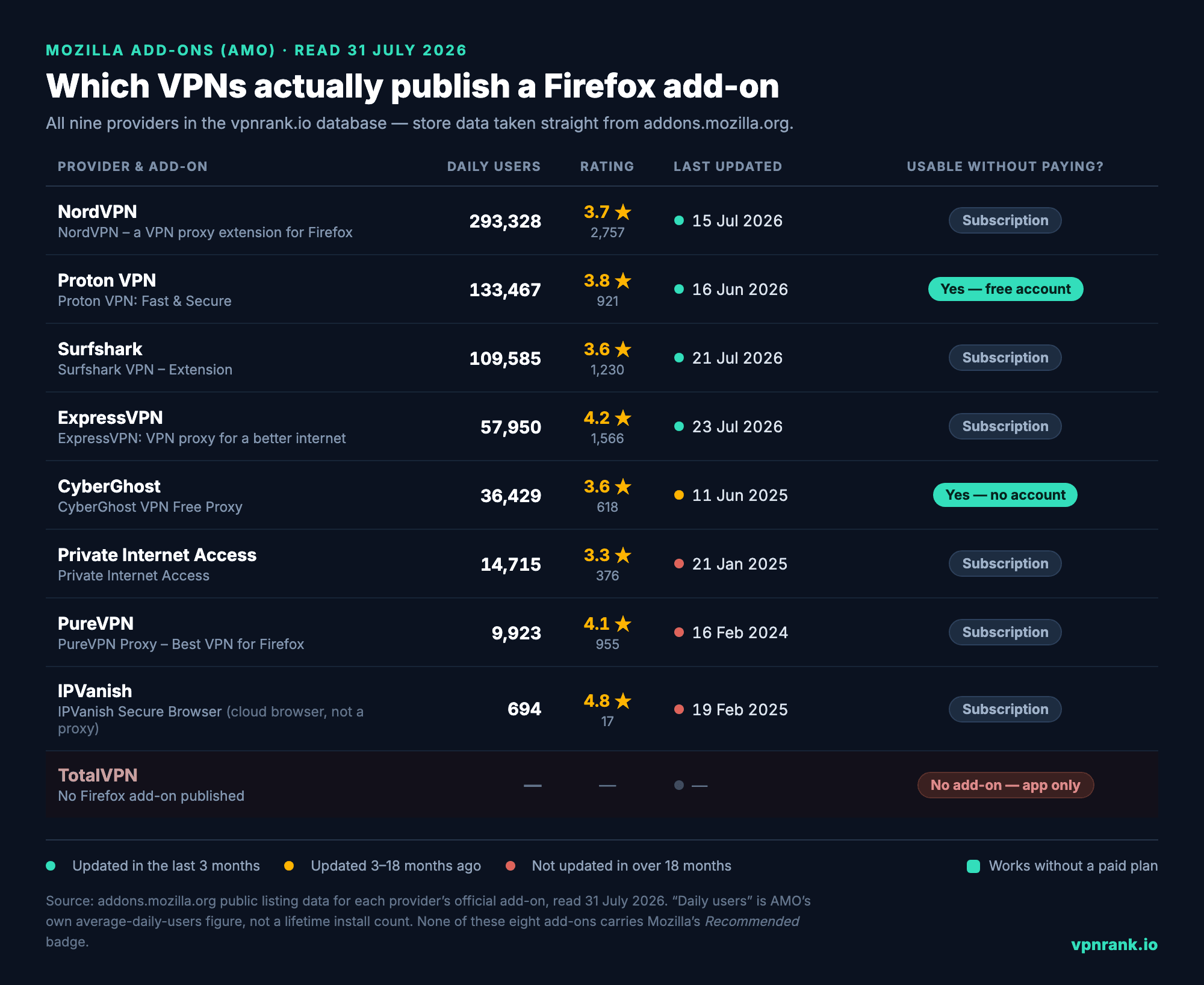
Eight of the nine providers in our database publish an official Firefox add-on. One — TotalVPN — publishes none, and we could find no listing under its name on addons.mozilla.org. That is not a criticism so much as a design decision: its coverage of Firefox comes from the desktop app, which protects the whole device rather than one browser. But if you specifically wanted a toolbar button in Firefox, it is worth knowing before you go looking for it.
| Provider | Firefox add-on listing | Rating | Daily users | Last updated | Usable without a paid plan? |
|---|---|---|---|---|---|
| NordVPN | NordVPN – a VPN proxy extension for Firefox | 3.7 ★ (2,757 ratings) | 293,328 | 15 Jul 2026 | No — needs a subscription |
| Proton VPN | Proton VPN: Fast & Secure | 3.8 ★ (921 ratings) | 133,467 | 16 Jun 2026 | Yes — works on the free plan |
| Surfshark | Surfshark VPN – Extension | 3.6 ★ (1,230 ratings) | 109,585 | 21 Jul 2026 | No — needs a subscription |
| ExpressVPN | ExpressVPN: VPN proxy for a better internet | 4.2 ★ (1,566 ratings) | 57,950 | 23 Jul 2026 | No — needs a subscription |
| CyberGhost | CyberGhost VPN Free Proxy | 3.6 ★ (618 ratings) | 36,429 | 11 Jun 2025 | Yes — the listing states it is free to use |
| Private Internet Access | Private Internet Access | 3.3 ★ (376 ratings) | 14,715 | 21 Jan 2025 | No — needs a subscription |
| PureVPN | PureVPN Proxy – Best VPN for Firefox | 4.1 ★ (955 ratings) | 9,923 | 16 Feb 2024 | No — needs a subscription |
| IPVanish | IPVanish Secure Browser (a cloud browser, not a proxy add-on) | 4.8 ★ (17 ratings) | 694 | 19 Feb 2025 | No — needs a subscription |
| TotalVPN | No Firefox add-on published | — | — | — | No — the app covers Firefox along with everything else |
Three things in that table are worth slowing down for. First, the scale: those eight add-ons come to roughly 656,000 daily users between them, and one of them accounts for about 45% of that. For comparison, the same providers' Chrome extensions are counted in the millions. Firefox VPN add-ons are a genuinely smaller world, which is part of why several of them get less engineering attention than their Chrome siblings.
Second, only two of the eight do anything without a paid plan. Proton VPN's add-on works on the free plan — the company confirmed in its own documentation that the extension is available to everyone with a Proton account, including Proton VPN Free — and CyberGhost's listing describes its proxy plugin as free to use. Every other listing here is a front door to a subscription: install it without one and it will simply ask you to sign in. If you arrived at this page hoping to avoid paying, the honest shortlist is two names long. Our guide to free VPNs covers what that actually buys you, and the VPN price index tracks what each provider charges today if you decide a paid plan is worth it.
Third, one listing in that table is not a VPN proxy add-on at all. IPVanish Secure Browser opens a browser session running in IPVanish's cloud rather than routing your Firefox traffic through a proxy — a different product solving a different problem. We confirmed this from the manifest rather than the marketing: it is the only listing here that does not request Firefox's proxy permission, which a proxy add-on cannot function without.
💡 Searching addons.mozilla.org for "vpn" returns over 450 extensions. Eight of them are published by the providers in our database. The overwhelming majority of what you will find in that search comes from publishers nobody has heard of — which makes the store's own metadata (publisher name, rating volume, last-updated date) the fastest filter you have.
The maintenance gap: when each add-on was last updated
This is the column most Firefox VPN round-ups leave out, and it may be the most useful one on the page. A VPN add-on is proxy plumbing living inside a browser that ships a new version roughly every four weeks. Firefox changes; the add-on has to keep up. The Last updated date on a listing is the only free, public, provider-independent signal you get about whether anyone is still doing that work.
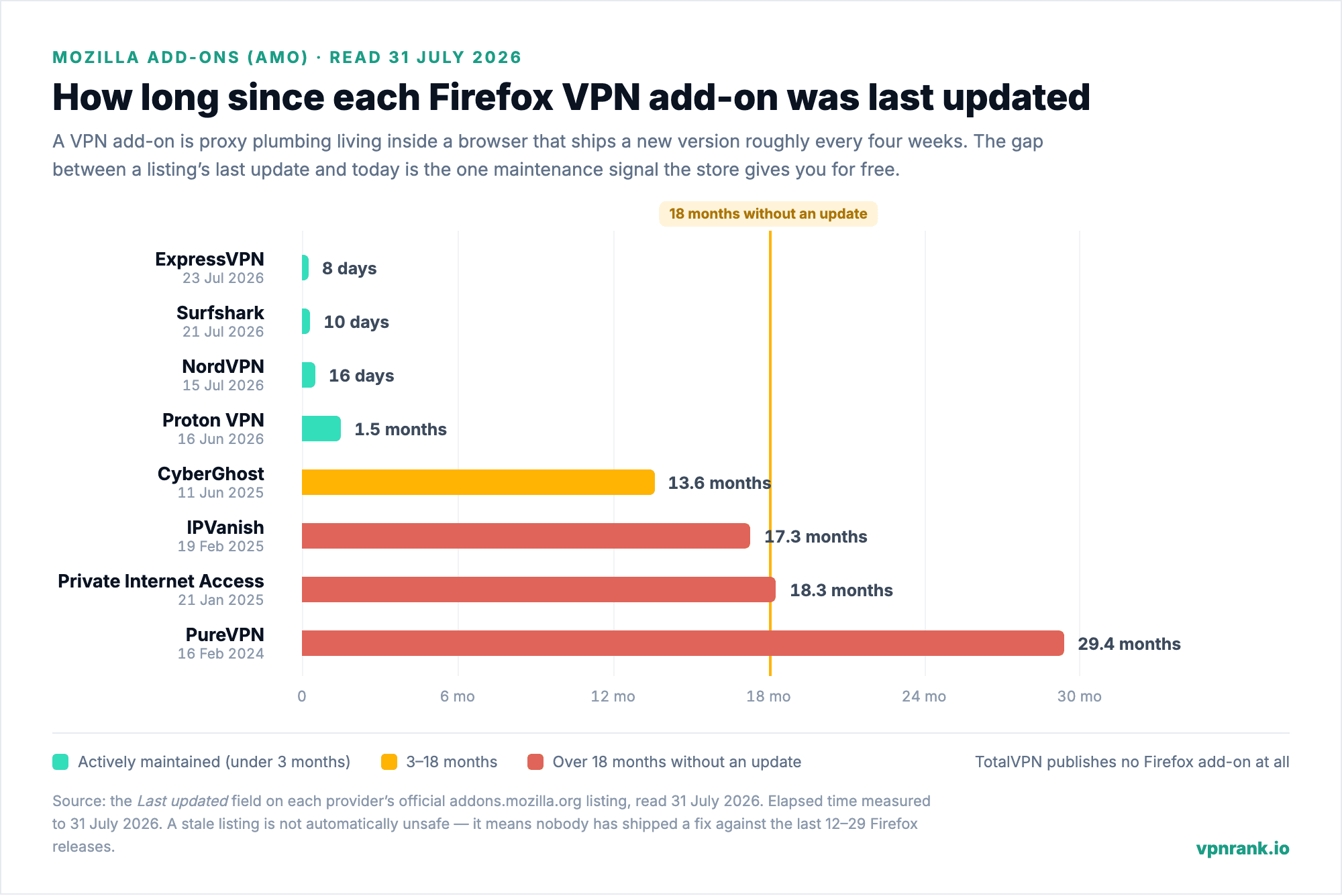
The split is stark. Four add-ons — ExpressVPN's, Surfshark's, NordVPN's and Proton VPN's — were all updated within the last six weeks. The other four were not. CyberGhost's was last updated in June 2025, IPVanish's in February 2025, Private Internet Access's in January 2025, and PureVPN's in February 2024, which is a little over 29 months ago. In Firefox release terms, PureVPN's add-on has not shipped a change against roughly the last two dozen versions of the browser it runs inside.
A stale listing is not automatically dangerous, and it does not mean the add-on has stopped working. Proxy code is relatively stable, and a well-built add-on can sit untouched for a long time without breaking. But it does tell you something real about where a provider is spending its effort. It is also visible in the listing text itself: CyberGhost's add-on description still references Flash content and a Google social network that shut down in 2019 — copy that has clearly not been revisited in years, whatever the code underneath is doing.
⚠️ Check the Last updated date on any VPN add-on before you install it — including ones we list here. It sits directly under the install button on every addons.mozilla.org listing, it costs you five seconds, and it is the single fastest way to tell an actively maintained add-on from an abandoned one.
What these add-ons ask permission to do — and what Mozilla has vouched for
Every Firefox add-on declares its permissions in a manifest, and that manifest is public. It is the closest thing to a contract you get: whatever the marketing says, the manifest is what the add-on is technically allowed to do once installed. Here is what each of these listings declares, read on 31 July 2026.
| Provider | Requests the proxy permission? | Can change WebRTC settings? | Notable extras declared |
|---|---|---|---|
| NordVPN | Yes, required | Yes | Access to all sites, DNS lookups, request filtering, downloads, plus specific access to YouTube domains |
| Proton VPN | Optional — you grant it, not the installer | Yes | Access to all http/https, ws/wss and ftp addresses; account pages on proton.me |
| Surfshark | Yes, required | Yes | Access to all sites, plus explicit access to Google search result pages across roughly 190 Google country domains |
| ExpressVPN | Yes, required | Yes | Access to all sites, cookies, and native messaging (talking to the desktop app) |
| CyberGhost | Yes, required | Yes | Access to all sites, cookies, browsing data, navigation events |
| Private Internet Access | Yes, required | Yes | Access to all sites, cookies, downloads |
| PureVPN | Yes, required | Yes | Access to all http/https addresses, plus extension management and identity |
| IPVanish | No — it is a cloud browser, not a proxy | No | Access to all sites, navigation events, context menus |
| TotalVPN | — | — | No Firefox add-on published |
Two entries stand out. Proton VPN is the only one that makes proxy an optional permission rather than a required one, meaning Firefox asks you to grant it rather than handing it over at install time. That is a small but real difference in how much the add-on can do before you have said yes to anything. At the other end, Surfshark's manifest declares access to Google search result pages on around 190 Google country domains — every google.co.uk, google.de, google.com.br and so on. That is an unusually specific request for a VPN add-on, and while there are legitimate reasons an extension might touch search pages, it is the kind of thing worth knowing you have agreed to.
There is also something none of them have. Mozilla runs a vetting programme that puts a Recommended badge on add-ons that have passed a manual technical and policy review, and a By Firefox badge on ones Mozilla publishes itself. Not one of these eight VPN add-ons carries either badge. We checked the same field against Mozilla's own Multi-Account Containers add-on, which does carry a badge, so this is a real absence rather than a gap in the data. It does not mean these add-ons are unsafe — the VPN category as a whole sits outside the recommended programme — but it does mean the store is not vouching for any of them, and neither should a list that tells you otherwise.
WebRTC leaks in Firefox: what is actually true in 2026
This is the question Firefox users ask most after installing a VPN add-on, and most of the advice floating around is a decade out of date. The short version: Firefox already protects your local network address by default, but it does not hide your real public IP from WebRTC on its own. That is the gap a VPN is supposed to close, and it is worth understanding precisely, because the standard advice — "disable WebRTC" — breaks video calling for a problem you may not have.
WebRTC is the browser technology behind in-browser video calls and voice chat. To connect two people directly it has to work out what addresses each end can be reached on, and that discovery process is what can expose an IP address to a website. There are two different addresses at stake, and they are not equally exposed.
- →Your local (LAN) address — something like 192.168.1.14. Firefox has obfuscated these behind randomised mDNS hostnames by default for years; the preference that controls it,
media.peerconnection.ice.obfuscate_host_addresses, ships set totrue. This one is already handled. - →Your real public IP — the address your ISP gave you, the one that identifies your household. This is the one that matters, and Firefox does not mask it by default. If a browser add-on reroutes your page traffic but leaves WebRTC alone, a website can still learn your real IP through it.
That is why the privacy permission in the table above matters more than it looks. It is what lets an add-on change Firefox's WebRTC handling on your behalf — either switching WebRTC off entirely or, better, telling Firefox to route WebRTC's address discovery through the proxy instead of leaking around it. Seven of the eight add-ons declare it. And at least one provider is explicit about it in its own store listing: NordVPN's Firefox listing states that the extension prevents WebRTC leaks by controlling hidden WebRTC privacy settings, which is exactly this mechanism described in marketing language.
⚠️ At least one provider says the opposite, in its own words. CyberGhost's Firefox listing tells you plainly that its free proxy plugin "does not protect you from webRTC leaks" and recommends the full desktop app for complete protection. That is a publisher disclosing a real limitation on its own store page — and it is a limitation almost every "best free VPN for Firefox" article omits. If you use that add-on, apply the manual fix below.
You can also fix this yourself in about a minute, without any add-on. Firefox exposes the relevant switches in about:config, and unlike Chromium browsers it lets you change WebRTC's behaviour without uninstalling anything. Here are the preferences that actually matter, with the values Firefox ships by default — all four confirmed against Firefox's own source in July 2026.
| Preference | Firefox default | What changing it does | Breaks video calls? |
|---|---|---|---|
media.peerconnection.ice.obfuscate_host_addresses | true | Already on. Hides your local network address behind a randomised hostname. Leave it alone. | No — leave as is |
media.peerconnection.ice.default_address_only | false | Set to true to advertise only your default network route instead of every interface. Useful when a VPN tunnel and your physical adapter are both active. | No |
media.peerconnection.ice.no_host | false | Set to true to stop Firefox offering host candidates from your network interfaces at all. Stricter than the setting above. | Rarely — can affect local-network calls |
media.peerconnection.enabled | true | Set to false to switch WebRTC off completely. The blunt instrument, and the one most guides recommend first. | Yes — browser video calls stop working |
So the sensible order of operations is the reverse of the usual advice. Start with the targeted settings, and only reach for the switch that disables WebRTC if you genuinely never make browser-based calls:
- Connect your VPN — add-on or app — the way you normally would.
- Check whether you actually have a leak before changing anything. Our WebRTC leak test shows you what a website can see through WebRTC right now; if the address shown is your VPN's and not your own, there is nothing to fix.
- If your real IP is showing, type
about:configin the address bar and accept the warning. - Search for
media.peerconnection.ice.default_address_onlyand set it totrue. Re-run the leak test. - Still leaking? Set
media.peerconnection.ice.no_hosttotrueas well, and test again. - Only if you have no use for in-browser video calls at all, set
media.peerconnection.enabledtofalse. This ends WebRTC leaks permanently because it ends WebRTC.
💡 Worth remembering what a leak test can and cannot tell you: it checks Firefox. If your add-on is only routing browser traffic, everything outside Firefox — your email client, your torrent client, background system services — is still using your real IP no matter how clean the test comes back. That gap is the whole argument for running the app rather than the add-on. See our Windows guide, Mac guide or Linux guide for the device-wide route.
Why a Firefox VPN add-on is not just the Chrome one recompiled
It is easy to assume the Firefox and Chrome versions of a VPN extension are the same software with a different icon. They are not, and the reason is architectural. Firefox and Chrome both expose an extension API called proxy, but Mozilla's documentation is blunt that the two are completely different designs and mutually incompatible — Firefox's version is only reachable through the browser namespace precisely because it cannot pretend to be Chrome's.
The practical difference is where the decision gets made. Chrome's API is essentially a configuration you hand to the browser: here is my proxy, use it. Firefox's includes proxy.onRequest, an event that fires per request and runs inside the add-on's own background script, with access to the rest of the WebExtensions toolkit while it decides. The add-on can look at each individual request and answer the question "should this one go through the tunnel, and if so which one?" in code.
That is what makes genuinely per-site and per-context routing possible in Firefox in a way it is not in Chrome. It is also the technical foundation under the container workflow Firefox users like — routing one browsing context through one location while another goes direct — because a per-request hook is exactly what you need to implement it. Mozilla's own Multi-Account Containers add-on, which has around 386,000 daily users and a 4.6-star rating from more than 8,000 reviews, does not itself request the proxy permission; the routing has to come from the VPN add-on's side.
The takeaway for choosing: a provider that has genuinely built for Firefox has written Firefox-specific code, not ported Chrome's. The maintenance chart above is a reasonable proxy for who has. And if you want the same comparison for the other side of the browser split, we did the identical exercise on the Chrome Web Store listings in our free VPN for Chrome guide and our Chrome VPN guide.
How to read all of this when you are actually choosing
Put the store data together and the decision collapses into three questions, in this order.
- Do you need protection beyond the browser? If anything outside Firefox matters — email clients, cloud sync, torrents, games, anything at all that is not a tab — an add-on cannot help you and the add-on comparison is the wrong comparison. Install the app instead.
- Are you willing to pay? If not, the field narrows to two of the nine providers: Proton VPN's add-on on its free plan, and CyberGhost's free proxy plugin (with the WebRTC caveat its own listing discloses). Everything else will ask you to sign in.
- Is somebody still maintaining it? Four of these eight add-ons were updated within the last six weeks and four have not been touched in over a year. That is a fact you can re-check yourself in five seconds on any listing, and it will still be true after this page goes stale.
What none of this tells you is which service is fastest or unblocks what you want to watch — those depend on the underlying network, not the add-on. For that side of the decision, our fastest VPN comparison and the price index are the more useful pages. What the store data does settle is the narrower question this page exists to answer: which providers have actually built something for Firefox, and which ones are pointing you at a listing nobody has opened in two years.
How to Set Up a VPN Add-on in Firefox
Visit Firefox Add-ons
Navigate to addons.mozilla.org and search for your VPN provider (NordVPN, ExpressVPN, or Surfshark). Only install add-ons from verified publishers listed on the official Mozilla Add-ons site.
Install the add-on
Click “Add to Firefox” and review the requested permissions. Reputable VPN add-ons require minimal permissions — reject any that ask for browsing history access.
Sign in to your account
Click the VPN icon in your Firefox toolbar and log in with your credentials. The add-on requires an active VPN subscription to function.
Select a server and connect
Choose your desired server location and click Connect. Your browser traffic is now encrypted through the VPN tunnel. The toolbar icon will indicate an active connection.
Configure privacy settings
Enable WebRTC leak blocking in the add-on settings. For advanced privacy, pair the add-on with Firefox Multi-Account Containers to isolate different browsing contexts.
How We Test VPN Firefox Add-ons
We test every Firefox VPN add-on on the latest Firefox release (Stable and ESR) across Windows, macOS, and Linux.
Leak Protection Verification
We test for WebRTC, DNS, and IP leaks using browserleaks.com, ipleak.net, and our own test pages. Firefox-specific WebRTC behavior is tested separately as it differs from Chromium browsers.
Page Load Performance
We measure page load times on 50 popular websites with the add-on active vs. inactive. Top Firefox VPN add-ons add less than 80ms average overhead, compared to 200ms+ for poorly optimized ones.
Privacy Practices Audit
We review each add-on's permissions, data collection practices, and Mozilla Add-ons store reviews. We verify that no add-on injects scripts, collects browsing data, or phones home to analytics servers.
Container Compatibility
We test VPN add-on behavior with Firefox Multi-Account Containers, testing whether VPN state persists correctly across containers and whether per-container location selection works reliably.
All Firefox add-on tests are re-run monthly on the latest Firefox Stable and ESR releases.
Frequently Asked Questions
Is a VPN extension as secure as a full VPN app?
No. A Firefox VPN add-on encrypts only browser traffic, leaving other applications unprotected. For full-device encryption, use the desktop VPN app alongside the extension. The add-on is best for quick browser-level protection on shared or public computers.
Does a VPN extension protect all browser traffic?
Yes, within Firefox. A properly built VPN add-on encrypts all traffic inside the browser — every tab, web app, and embedded media. NordVPN and Surfshark Firefox add-ons use TLS 1.3 encryption for genuine privacy, not just a simple proxy.
How do I fix WebRTC leaks in Firefox?
Firefox allows disabling WebRTC natively. Type about:config in the address bar, search for media.peerconnection.enabled, and set it to false. Alternatively, NordVPN, ExpressVPN, and Surfshark add-ons automatically block WebRTC leaks without manual configuration.
Can I use a free VPN extension for Firefox?
We recommend caution with free Firefox VPN add-ons. Many collect browsing data to fund their service. If you want a free option, Mozilla’s own Firefox VPN (paid) is trustworthy, or use Proton VPN’s free tier. Avoid unknown free add-ons that request excessive permissions.
Do VPN add-ons work with Firefox Multi-Account Containers?
Some do. NordVPN's Firefox add-on works alongside Multi-Account Containers, allowing you to isolate VPN-protected browsing in specific containers. This lets you keep work, banking, and personal browsing fully separated and encrypted in different containers — a unique Firefox advantage.