How to Get Around MLB.TV Blackouts With a VPN in 2026
Why your team's games vanish from a service you pay for, the exact server locations that bring them back, and the fine print MLB doesn't advertise

vpnrank.io is reader-supported: we may earn a commission if you buy through links in this article. This never affects our rankings.
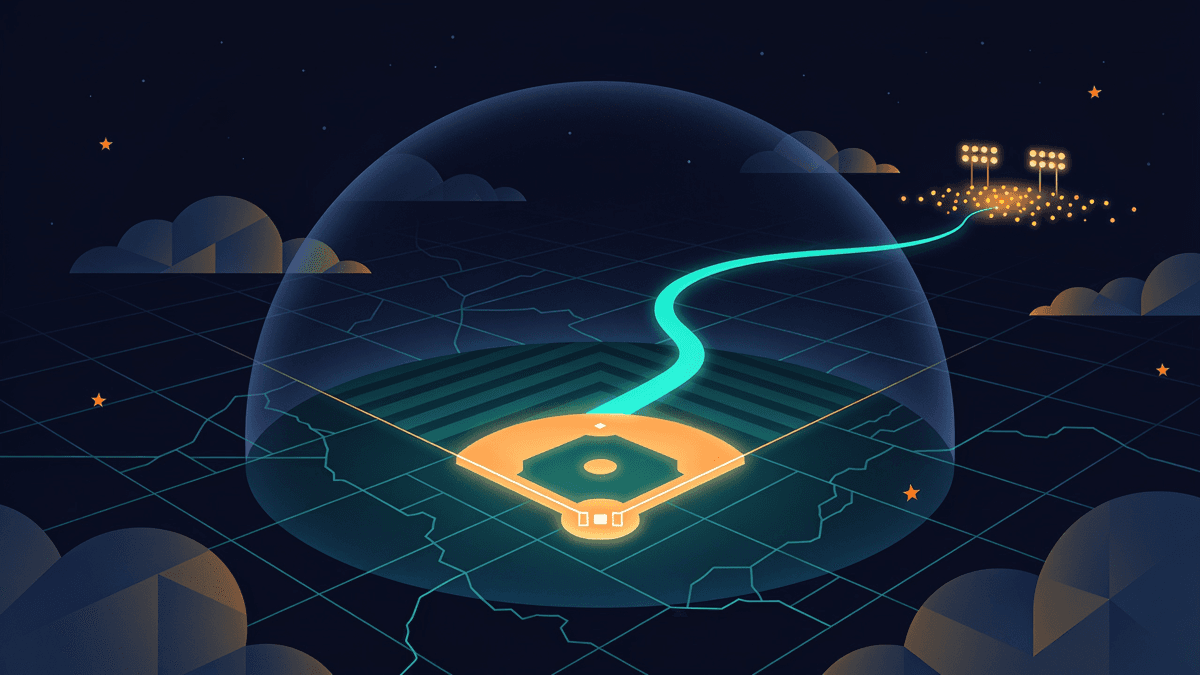
MLB.TV blackouts are a rights problem, not a technical one. The service reads your location from your IP address and blocks any game a local or national broadcaster holds exclusively. Connect to a VPN server outside the blackout territory and the stream usually comes straight back. Here is the full 2026 picture: rules, steps, server picks and honest caveats.
Why MLB.TV blackouts still exist in 2026
Blackouts survive because MLB sells the same game to different buyers in different places. Your team's local broadcast rights belong to a regional network or the club's own streaming service; national windows belong to partners like Fox, NBC, Netflix and Apple. MLB.TV only owns what is left over: out-of-market games.
MLB.TV has always been an out-of-market product. Every club claims a defined home television territory, and within that territory a rights holder — historically a regional sports network (RSN), increasingly the league itself — pays for exclusivity. When you open MLB.TV inside that footprint, the service is contractually obliged to block the live video feed, even though you are a paying subscriber. The same logic applies nationally: when Fox buys an exclusive Saturday window, no other outlet in the United States may show those games, MLB.TV included.
The territories themselves are the maddening part. They were drawn decades ago around claimed markets rather than actual broadcast reach, which is why Iowa sits inside the blackout zones of six teams — the Cubs, White Sox, Cardinals, Royals, Twins and Brewers — despite every one of those ballparks being a multi-hour drive away. Las Vegas is likewise claimed by six clubs — the Diamondbacks, Athletics, Angels, Dodgers, Padres and Giants — and Hawaii, some 2,500 miles offshore, is blacked out for all five California-based teams, while Alaska sits inside the Mariners' territory. Worse, holding a territory has never required actually delivering the broadcast there: plenty of fans have historically been unable to watch their so-called local team on cable or on MLB.TV.
Change is genuinely happening. The collapse of Diamond Sports Group let MLB take over production and distribution for a growing list of clubs, and in 2026 the league sells an in-market, direct-to-consumer streaming subscription for 22 of the 30 teams, with no blackout inside the home territory. Commissioner Rob Manfred has called ending blackouts "business objective number one" and expects the league to be out of the blackout business when the next national agreements begin after the 2028 season. But that future has not arrived for the out-of-market MLB.TV package you probably own: in 2026 it still enforces both local and national blackouts, exactly as before.
Which games actually get blacked out
Two separate rules produce the dreaded grey screen. Local blackouts hide your home team's games inside its television territory, all season long. National blackouts hide specific games that a national partner bought exclusively — and those apply everywhere in the United States, even if the two teams involved play 3,000 miles away from you.
Local-market blackouts
If your IP address places you inside a club's home territory, every live game involving that club disappears from MLB.TV — home and away, marquee matchup or Tuesday afternoon getaway game. It does not matter whether you can actually receive the local broadcast, whether you subscribe to the regional network, or whether the club even has reliable TV carriage in your county. The territory map, not reality, decides.
- One location, six blackouts: Iowa (Cubs, White Sox, Cardinals, Royals, Twins, Brewers) and Las Vegas (six clubs) are the classic worst cases; Hawaii loses all five California-based teams despite sitting 2,500 miles out in the Pacific.
- Coverage without carriage: territories extend far beyond where local broadcasts are dependably available, so some fans can neither stream the game nor watch it on TV.
- Both teams count: a game is blacked out if either club claims your location, so a Cubs–Cardinals matchup is untouchable across most of the Midwest.
Not sure which zones you are in? MLB publishes a blackout locator that maps your zip code to the clubs claiming it, and the purchase flow shows the same list before you pay. It is worth running before you subscribe: fans in single-team markets like Seattle or Phoenix face one local blackout, while a fan in central Iowa is technically buying a service that hides six teams' entire seasons. Knowing your exact restrictions also tells you precisely which VPN server geography you need — or whether you need one at all.
National exclusive windows in 2026
MLB's new three-year deals with ESPN, NBCUniversal and Netflix took effect this season, joining the existing Fox and Apple packages. Games sold exclusively to a national partner are pulled from MLB.TV across the entire United States for the duration of the broadcast, even for out-of-market subscribers:
- Netflix: Opening Night — the Yankees at the Giants on March 25, 2026 — plus the Home Run Derby from Citizens Bank Park on July 13 and one special event game a year, starting with the 2026 Field of Dreams Game.
- NBC and Peacock: Sunday Night Baseball, the Sunday Leadoff game and the entire Wild Card round; NBC opened its 2026 coverage on Opening Day, March 26, with Pirates–Mets in the afternoon and the Diamondbacks at the World Series champion Dodgers in primetime.
- Fox and FS1: Baseball Night in America — 24 exclusive Saturday primetime windows spread across the season, pausing only around the World Cup in early summer.
- Apple TV: Friday Night Baseball doubleheaders for 25 weeks. These never appear on MLB.TV at all, but they stream in about 60 countries and regions on Apple's own service with no local blackouts.
- ESPN: a new 30-game exclusive package — mostly Monday, Wednesday and Thursday nights, plus a few afternoon games on ABC — alongside ESPN's new role as the US distributor of MLB.TV itself.
Two mercies soften the blow. Blacked-out games land in your MLB.TV archive roughly 90 minutes after the final out, so you can watch the full replay the same evening. And live radio audio for every game — including blacked-out ones — remains part of your subscription, a lifesaver when you just need to follow the action in real time.
The Canada quirk
Canadian subscribers face the most extreme territory in baseball: the Blue Jays claim the entire country. Every live Jays game is blacked out on MLB.TV from Vancouver to St. John's, because Sportsnet holds national exclusivity. For a Canadian fan, a VPN server in the United States turns Toronto back into an out-of-market team — which is precisely why this workaround is so popular north of the border.
How MLB.TV pinpoints your location
Blackouts are enforced by geolocation, and MLB uses different methods on different devices. Understanding them tells you exactly where the VPN trick works cleanly, where it needs extra care, and why your phone — of all your screens — is the hardest device to convince.
In a desktop or laptop browser, and on most smart-TV and streaming-stick apps, MLB.TV checks the IP address of your connection each time you start a stream. This is the easy case: a VPN replaces your visible IP with the server's, and the blackout logic follows the new address.
The iOS and Android apps are stricter. They query your device's GPS and other location services, which report your physical position regardless of what your IP address claims. Android's mock-location trick is detected and blocked, so a VPN alone frequently fails inside the mobile apps. The practical answer is to watch in the phone's web browser with location permission denied, or to use a laptop, Fire TV or Android TV device instead.
One 2026 wrinkle: US subscriptions now run through ESPN, and streams play in both the MLB app and the ESPN app once accounts are linked. The blackout rules are identical in both, so switching apps does not switch the rules. What does matter is leak protection: if your VPN lets your real address slip out through a DNS leak or a WebRTC leak, MLB.TV sees through the disguise and re-applies the blackout.
The VPN fix, step by step
The workaround itself takes about ten minutes to set up. The essence: pay for MLB.TV like a normal customer, then make the service believe you are watching from a city outside the blackout territory. Here is the exact sequence we use when testing it ourselves.
- 1Subscribe to MLB.TV normally. In the US that now means signing up through ESPN, with a one-month ESPN Unlimited trial bundled in; internationally you still buy directly from MLB.com. Use your real payment details — nothing about this step needs disguising.
- 2Pick a VPN with a deep US server network. You want servers in many US cities, verified leak protection and enough throughput for smooth 60fps live video. Our guide to the best VPNs for sports streaming ranks providers specifically on live-sport performance.
- 3Install it on the right device. A desktop browser, Fire TV Stick or Android TV box is ideal. For Apple TV boxes and consoles that cannot run VPN apps, installing the VPN on a compatible router covers every device in the house at once.
- 4Connect to a server outside the blackout region. The next section covers the best picks by team; the short version is the nearest big city that neither team in tonight's game claims as home territory.
- 5Clear cookies and cached site data, or use a fresh private window. MLB.TV can hold on to a previously detected location for the session, and stale data is the single most common reason a correct VPN setup still shows the blackout screen.
- 6Log in and start the stream. If the setup is right, the game plays exactly as it would for any out-of-market viewer, in full quality, with no blackout notice.
- 7Still blocked? Switch to a different city, run a leak test to confirm your DNS and WebRTC traffic exits through the VPN, and make sure your browser's location permission for MLB.com is denied.
- 8Tune for speed. Live baseball needs a stable 8–10 Mbps for HD; choose the nearest qualifying city and a modern protocol like WireGuard. Our VPN speed test data shows exactly how much throughput each provider costs you.
On a phone, skip the MLB app entirely: open the game in the mobile browser with the VPN connected and location permission refused, or cast from a laptop. The apps' GPS checks are the one place where this workaround reliably fails, and no server change will fix a hardware location report.
Best VPN server locations for your team
Server choice is a simple geometry problem: you want the closest city that sits outside the home territory of both clubs in the game you are watching. Closer means lower latency and steadier video; outside the territories means no blackout. These picks hold up in testing:
- Yankees or Mets fans in the tri-state area: Chicago, Atlanta or Miami servers put you comfortably outside the New York footprint while staying fast.
- Dodgers, Angels or Padres fans in Southern California — or blacked-out Las Vegas: Dallas, Houston or Denver all work: near enough for good speed, and none claimed by a California club.
- Cubs or White Sox fans in Chicago and the Midwest: New York or Denver. Avoid St. Louis, Kansas City, Minneapolis and Milwaukee, which sit inside overlapping territories.
- Iowa's six-team dead zone: go coastal — New York, Los Angeles or Miami — and switch by matchup so you never land inside an opponent's market.
- Blue Jays fans anywhere in Canada: any US server ends the nationwide blackout, since Toronto becomes an out-of-market club the moment your IP address is American.
- Nationally exclusive games (Fox, NBC, Netflix windows): these are blocked US-wide, so only a server outside the US and Canada — Mexico City and London are common picks — even has a chance, and only for games MLB.TV's international feed actually carries. Apple TV's Friday games are never on MLB.TV anywhere; watch those on Apple's service, which itself works in about 60 countries.
Before you open MLB.TV, sanity-check the disguise: load an IP-lookup site and confirm it reports the city you connected to, not your real one. If the lookup shows the right city but MLB.TV still blocks you, the problem is almost always cached session data or a leak rather than the server itself. And if two candidate cities are equally safe, pick the nearer one and check the provider's per-server load before first pitch. Remember the both-teams rule, too: a Denver server is perfect all season — right up until the night your club hosts the Rockies.
The honest part: terms of service, legality and risk
We will not pretend this is a grey-free zone. Using a VPN to dodge blackouts is not a crime, but it does break MLB.TV's contract terms, and the service agreement spells out specific penalties. You should know exactly what you are accepting before you connect.
Legally, no US law prohibits watching a service you pay for through a VPN, and this is not piracy: you are a paying subscriber viewing licensed streams the service already delivers, just from an address the contract says you should not use. The realistic exposure is civil — a breach of the terms you accepted at signup — not criminal.
Those terms do have teeth on paper. MLB.TV's service agreement states that circumventing a blackout restriction subjects your subscription to immediate termination and a charge of one hundred dollars ($100.00), and it reserves the right to pursue further legal action on top. In years of coverage by VPN testing publications, documented enforcement of that clause against ordinary viewers has been essentially nonexistent — but the contractual right exists, and a terminated account means forfeiting whatever you paid for the season.
Our practical advice: keep everything else about your account honest — real name, real billing details, no chargebacks if something goes wrong — and treat the VPN as a private viewing choice rather than something to resell or build a business on. A reputable provider with audited leak protection also keeps the arrangement genuinely private; free VPNs with leaky apps are the fastest route to being flagged.
MLB.TV pricing in 2026 — and what international fans pay
The 2026 season rewired how MLB.TV is sold. In the United States it now runs through ESPN under a three-year deal, with new pricing, a bundled ESPN Unlimited trial and a mid-season price cut. Internationally, nothing moved — and the international product is quietly the better one.
US pricing opened at $149.99 for the season or $29.99 per month, with ESPN Unlimited subscribers paying a discounted $134.99. In May 2026, ESPN cut the seasonal price to $139.99 for the rest of the year, with Unlimited members paying $124.99. New subscribers get a one-month ESPN Unlimited trial bundled in, and you can drop the trial without losing MLB.TV access. Once accounts are linked, streams play in both the ESPN app and the MLB app.
There are legitimate free routes too. T-Mobile revived its annual giveaway for 2026: from March 24 to March 31, eligible T-Mobile, Metro and Home Internet customers could claim a full free season of MLB.TV — normally $149.99 — through the T-Life app. The promotion has returned every spring for years, so it is worth a calendar reminder before Opening Day 2027.
Outside the United States, MLB.TV is still sold directly through MLB.com — the ESPN storefront is US-only. The bigger difference is structural: US local-territory blackouts simply do not apply to a genuinely international account, which is why an expat in London or Tokyo can watch the Cubs at Wrigley live while a paying fan in Des Moines cannot. Exclusive national windows and Canada's Blue Jays rule still bite, but the day-to-day product abroad is much closer to what every fan wishes MLB.TV were at home.
One caution on region-shopping: buying a subscription through a VPN in the hope of a cheaper foreign price is where accounts genuinely get tangled — payment-method and account-region mismatches cause failed purchases and support headaches. The VPN's real value here is blackout relief on a subscription you bought honestly, not price arbitrage.
Alternatives if you'd rather not use a VPN
A VPN is not the only exit. Depending on which blackout is biting — local or national — 2026 offers more legitimate ways around it than any season in memory, from the new in-market streaming services to simply waiting ninety minutes for the full replay to appear.
- In-market streaming: MLB now sells a direct, blackout-free stream of local games for 22 clubs inside their home territories. MLB-produced services run $19.99 per month or $99.99 for the season — bundling one with MLB.TV costs $39.99 per month or $199.99 for the season, roughly 20 percent off — while RSN-run options such as SNY (Mets, $24.99 per month), SNLA+ (Dodgers, $29.99 per month) and MASN+ (Orioles) set their own prices.
- The national partner's own app: Sunday Night Baseball lives on NBC and Peacock, Saturday showcases on Fox — free over the air in most markets — Friday doubleheaders on Apple TV, and specials on Netflix. Fragmented, yes, but every missing game has a legal home.
- Wait 90 minutes: every blacked-out game reaches your MLB.TV archive shortly after it ends, with condensed-game cuts if you only want the highlights stitched together.
- Live audio: radio broadcasts of every game, blacked-out ones included, come with your MLB.TV subscription.
- A pay-TV or RSN subscription: the traditional route still works wherever the regional network still exists.
- Check before you buy: our free Can I Watch finder tells you which service carries a given game or competition from your country, and our streaming VPN guides cover the other platforms in your rotation.
The realistic 2026 stack for a die-hard fan is MLB.TV plus Peacock plus whatever their local club sells — call it $30–45 a month in season. The VPN route persists precisely because many fans resent paying twice for games they feel they already bought once.
Bottom line
MLB.TV blackouts in 2026 remain a contracts map, enforced by IP address on most devices and by GPS inside the mobile apps. A VPN server in the nearest city outside your team's territory restores local games; national exclusives are harder, and Apple's Friday games are out of reach on MLB.TV entirely. It breaks MLB's terms — a $100 clause that has, in practice, gone unenforced — so go in with open eyes.
Do it properly: a fast, leak-tested provider, the right server geometry, the browser instead of the app on your phone, and a legitimately purchased subscription underneath it all. Baseball's blackout era really is winding down — the commissioner calls ending it the league's top business objective — but until the map is redrawn, this is the workaround that actually works.
Frequently asked questions
Is it illegal to bypass MLB.TV blackouts with a VPN?
No US law criminalizes watching a paid streaming subscription through a VPN, and it is not piracy — you are viewing streams you pay for. It does violate MLB.TV's terms of service, which allow account termination and a $100 charge for circumventing blackouts. Testing publications have not documented that clause being enforced against ordinary viewers, but the contractual risk is real and it sits with you.
Why is my team blacked out when I live hours from the stadium?
Blackout territories are based on markets claimed decades ago, not actual broadcast reach. Clubs assert rights over entire states and regions, which is why Iowa falls inside six teams' zones — Cubs, White Sox, Cardinals, Royals, Twins and Brewers — and Las Vegas inside six as well. If your IP address sits anywhere in a claimed territory, MLB.TV must black out that club's live games.
Does a VPN work in the MLB app on my phone?
Usually not. The iOS and Android apps check your device's GPS and location services, which report your physical position regardless of your VPN's IP address, and Android mock-location tools are detected. Watch in your phone's web browser with location permission denied, or use a laptop, Fire TV, Android TV device or a VPN-equipped router, where blackout checks rely on IP address alone.
Which VPN server location should I pick for MLB.TV?
The nearest major city outside the home territory of both teams in the game. New York fans do well with Chicago or Atlanta; Southern California fans with Dallas or Denver; Iowa and Las Vegas fans should head for the coasts. For Canada's nationwide Blue Jays blackout, any US server works. Closer servers mean lower latency and smoother live video.
Can a VPN unlock Fox, NBC or Apple TV exclusive games on MLB.TV?
Sometimes, but not reliably. National exclusives are blocked across the whole United States, so only a server outside the US and Canada has a chance, and only when MLB.TV's international feed carries the game. Apple TV's Friday Night Baseball never appears on MLB.TV at all — watch it on Apple's service, available in about 60 countries. Every blacked-out game reaches your archive roughly 90 minutes after it ends.
How much does MLB.TV cost in 2026?
The season opened at $149.99 (or $29.99 per month), sold through ESPN in the US, with ESPN Unlimited subscribers paying $134.99. A May 2026 mid-season cut dropped the seasonal price to $139.99, or $124.99 for Unlimited members. International fans still buy directly from MLB.com. T-Mobile customers could also claim a free full season through the T-Life app during a late-March promotional window.
Are there MLB.TV blackouts outside the United States?
Far fewer. US local-territory blackouts do not apply to international viewers, so out-of-market restrictions largely disappear abroad. The big exception is Canada, where the Blue Jays claim the whole country and every live Jays game is blacked out on MLB.TV in favor of Sportsnet. Globally exclusive streams, such as Netflix's Opening Night, remain off MLB.TV regardless of location.
The best VPNs of 2026, ranked
Now you know how — here are the VPNs we recommend, independently tested and ranked for speed, streaming, privacy and value. Any of them works for everything in this guide.

ExpressVPN Ultra fast & secure. Great for privacy, downloads, and everyday browsing on all your devices. 24/7 live chat support.
ExpressVPN Ultra fast & secure. Great for privacy, downloads, and everyday browsing on all your devices. 24/7 live chat support.

IPVanish Fast speeds with unlimited device connections. Strong no-logs privacy and 24/7 live chat support. Great for families.

IPVanish Fast speeds with unlimited device connections. Strong no-logs privacy and 24/7 live chat support. Great for families.

NordVPN Excellent speeds with one of the largest server networks. Strong security features and easy-to-use apps. 24/7 live chat support.
NordVPN Excellent speeds with one of the largest server networks. Strong security features and easy-to-use apps. 24/7 live chat support.
Proton VPN Swiss-based VPN with strong privacy focus. Audited no-logs policy and open-source apps. Great for privacy-conscious users.
Proton VPN Swiss-based VPN with strong privacy focus. Audited no-logs policy and open-source apps. Great for privacy-conscious users.

CyberGhost Fast speeds and strong privacy tools. Simple apps, automatic WiFi protection, and 24/7 live chat support.
CyberGhost Fast speeds and strong privacy tools. Simple apps, automatic WiFi protection, and 24/7 live chat support.

TotalVPN Affordable VPN with strong privacy and reliable speeds. Easy-to-use apps for all major devices. No-logs policy.
TotalVPN Affordable VPN with strong privacy and reliable speeds. Easy-to-use apps for all major devices. No-logs policy.
Private Internet Access High-speed VPN with a large server network and advanced security settings. Ad blocker included and 24/7 live chat support.
Private Internet Access High-speed VPN with a large server network and advanced security settings. Ad blocker included and 24/7 live chat support.

Surfshark Unlimited device connections at a budget-friendly price. Includes ad blocker and strong privacy tools. Great value for money.
Surfshark Unlimited device connections at a budget-friendly price. Includes ad blocker and strong privacy tools. Great value for money.
Rankings are based on our independent testing methodology. Each guide applies the criteria described on that page, including relevant performance, privacy, product features, and value data. We may earn affiliate commissions from links on this page, which helps fund our testing — this does not influence our rankings.