Is It Legal to Use a VPN? A Country-by-Country Guide for 2026
In most of the world a VPN is a perfectly legal privacy tool. A small group of countries restrict, license or ban it — and one principle explains almost every rule. Here's the full picture, country by country.

vpnrank.io is reader-supported: we may earn a commission if you buy through links in this article. This never affects our rankings.
Yes — using a VPN is legal in the overwhelming majority of countries, including the United States, the United Kingdom, the entire European Union, Canada and Australia. A small group of governments restrict, license or ban VPNs, and even there the crucial distinction is between the tool itself and what you do with it. This guide covers both, country by country.
The one principle that explains almost every VPN law
Before any country-by-country detail, hold on to a single idea, because it resolves most confusion about VPN legality: a VPN is a neutral privacy and networking tool, and the law almost never treats the tool as the crime. What the law cares about is the underlying activity. If something is illegal without a VPN, it stays illegal with one — the encryption changes nothing about the legality of the act.
That is why VPNs are legal in nearly every democracy. They are used every day by remote workers connecting to corporate networks, by journalists protecting sources, by travellers securing hotel Wi-Fi, and by ordinary people who simply don't want their internet provider logging every site they visit. Banks, hospitals and governments run VPNs as core infrastructure. Banning the tool outright would break far more than it fixed.
The exceptions are countries that treat unfiltered access to the internet itself as a threat. There, the objection is not to encryption but to what a VPN lets citizens reach: blocked news, foreign social media, encrypted messaging, uncensored search. Those governments respond in one of three ways — restricting VPNs to a licensed, monitored whitelist, banning them outright, or leaving the tool technically legal while criminalising the things people use it to see. Keep that framework in mind and the rest of this guide falls into place.
The four legal categories, explained
Every country sits in one of four buckets. Getting the category right matters more than memorising individual fines, because it tells you what kind of risk — if any — you're actually dealing with. The lines can blur, and a country can shift categories quickly when a new law passes, but this is the map that holds up best across 2026.
- 1Fully legal: no restrictions on personal VPN use. This is most of the world — the Americas, virtually all of Europe, most of Africa, Japan, South Korea, Australia and beyond.
- 2Legal but regulated: VPNs are allowed, but the government imposes conditions — data-retention rules on providers, blocks on specific apps, or rules about what you may access. India and, in a softer sense, the UK sit here.
- 3Restricted / licensed only: only government-approved VPNs are permitted; unapproved ones are blocked and their use can carry penalties. China, Russia, Iran, Oman and the UAE (for certain uses) fall in this band.
- 4Effectively banned: unauthorised VPNs are outlawed for ordinary citizens or their supply is criminalised, sometimes with prison terms. North Korea, Belarus, Turkmenistan, Iraq and, since 2025, Myanmar sit here.
One caveat runs through all four: legality of the tool never launders the activity. Even in a fully-legal country, using a VPN to pirate films, hack systems, harass someone or buy illegal goods remains a crime. We'll return to that near the end, because it's where most people actually get the law wrong.
Legal status and real-world blocking are two different maps
Almost every country-by-country VPN guide, including the categories above, answers one question: what does the law say? That leaves the more practical question untouched — can you actually reach a VPN from inside the country? Those two maps overlap far less than people assume, and mistaking one for the other is how travellers end up stranded with an app that will not connect, or nervous in a country where nothing is blocked at all.
We can check the second map directly, because we run one. Our internet censorship index pulls measurements from OONI, the Open Observatory of Network Interference, whose volunteers run network tests from inside their own countries. The chart below shows, for each country, the measured status in August 2026 of the eight VPN-provider websites the index tracks. It deliberately reports counts rather than provider names.
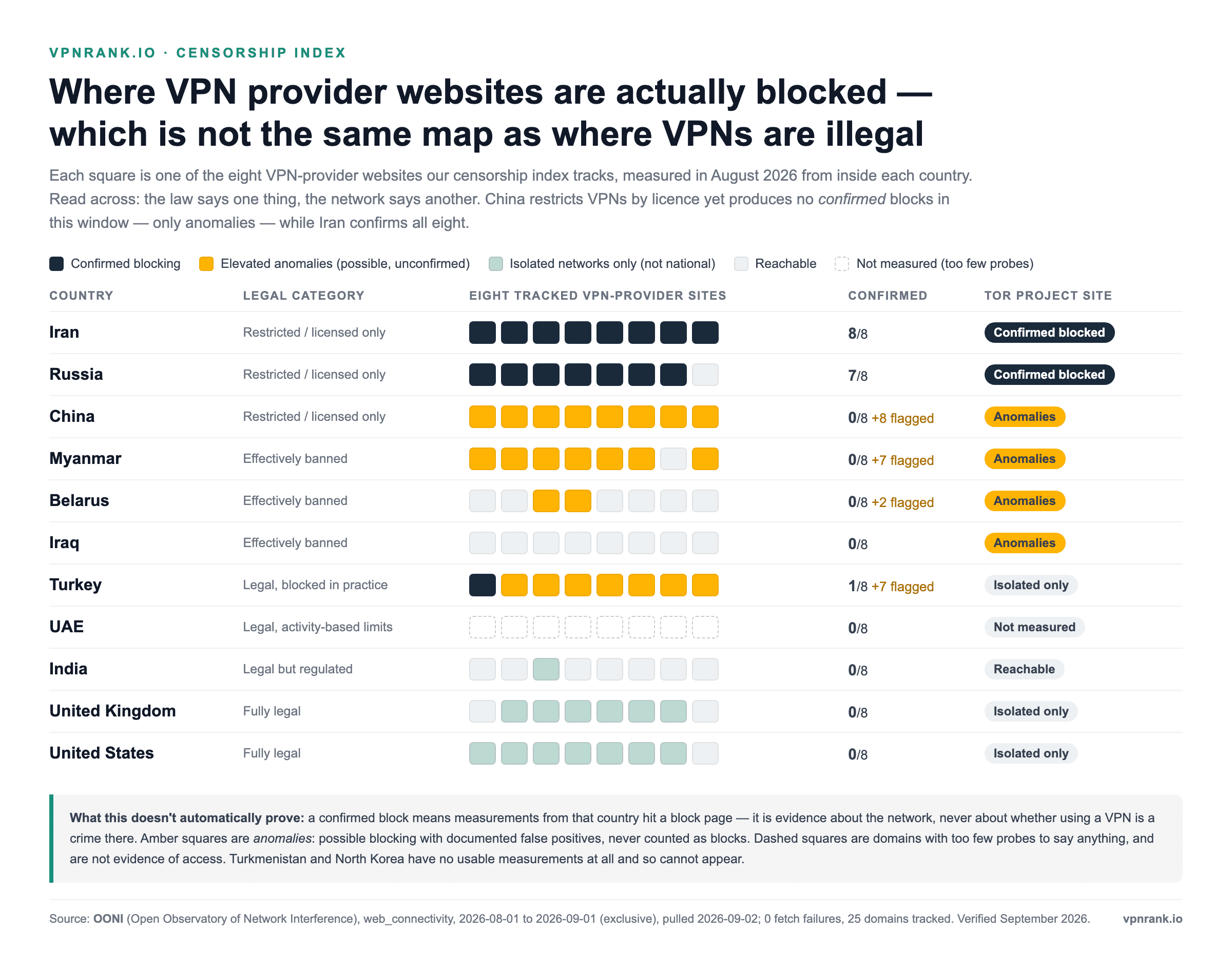
Three rows in that chart do most of the work. Iran is the case where law and network agree completely: unlicensed VPN use is prohibited, and all eight provider sites were confirmed blocked across 1,669 measurements — which is why our guide to using a VPN in Iran leads on installing before you arrive. China is the case where they appear to disagree and do not: China's licensing regime is one of the strictest anywhere, yet zero of the eight sites registered a confirmed block. All eight were flagged with elevated anomalies instead. That is a measurement artefact with a specific cause — the Great Firewall works largely through DNS tampering and connection resets, which do not return the block page that OONI requires before it will confirm a block. Reading that zero as "China does not block VPNs" would invert the truth.
Iraq is the genuinely surprising one, and it runs the other way. Iraq appears on almost every published list of countries where VPNs are banned, including in the section below. Yet across 396 measurements in August 2026, all eight VPN-provider websites were reachable, with no confirmed blocks and no elevated anomalies. Iraq's history of internet restriction is real, but it has largely taken the form of nationwide shutdowns during exams and unrest rather than standing VPN blocking — a distinction we measure separately in our work on outages versus blocking — and in this window, the network was open. A country's reputation in listicles is not a measurement.
| Country | Legal instrument, and its date | Measured in August 2026 (8 VPN-provider sites) | What the status doesn't automatically prove |
|---|---|---|---|
| Iran | Supreme Council of Cyberspace resolution published 19 February 2024 prohibits use of unlicensed VPNs | 8 of 8 confirmed blocked (1,669 measurements) | A policy body's prohibition is not the same as a penal-code offence — legal analysts noted at the time that it stopped short of criminalising use |
| Russia | Use is not itself an offence. Advertising circumvention tools banned from March 2024; from 1 September 2025, fines of 3,000–5,000 roubles for deliberately searching for "extremist" material | 7 of 8 confirmed blocked (14,410 measurements) | The fine attaches to what is on the state's register of extremist material, not to the VPN — the register is the operative document, and it changes |
| China | MIIT notice of January 2017 on cleaning up the internet access service market requires approval for cross-border lines including VPNs; MIIT stated in July 2017 that there is no ban on individuals | 0 of 8 confirmed; 8 of 8 flagged with elevated anomalies (730 measurements) | Zero confirmed is not access: DNS tampering and TCP resets do not produce the block page needed to confirm a block |
| Myanmar | Cybersecurity Law enacted 1 January 2025 — 1 to 6 months' imprisonment and/or fines of 1m–10m kyats | 0 of 8 confirmed; 7 of 8 flagged (472 measurements) | The penalty is written around establishing or providing an unauthorised VPN service, which is not the same as the act of using one |
| Turkey | No statute bans VPN use; blocking is executed under Law No. 5651 | 1 of 8 confirmed; 7 of 8 flagged (1,239 measurements) | Lawful and obstructed at once — legality tells you nothing about whether the connection will hold |
| Iraq | No standing VPN statute verified for this update; restriction has historically come via nationwide shutdowns | 0 of 8 confirmed — all eight reachable (396 measurements) | One clean month is not a guarantee: shutdown-driven regimes can close the whole network at short notice |
| UAE | Legal. Federal Law No. 12 of 2016 penalises using a VPN or false IP address to commit or conceal a crime | Not measured — only 68 measurements across all eight sites, below the reporting threshold | Thin probe coverage is not evidence of access. We cannot say the UAE does or does not block these sites in this window |
| India | Legal. CERT-In directions of 28 April 2022, under s.70B(6) of the IT Act 2000, require five-year retention of subscriber data | 0 of 8 confirmed (2,047 measurements) | The obligation binds providers, not users — it changes what is logged about you, not whether you may connect |
| United Kingdom | Legal. The Children's Wellbeing and Schools Act 2026 (c. 21), Royal Assent 29 April 2026, contains no VPN provision | 0 of 8 confirmed; 6 of 8 isolated networks only (3,223 measurements) | Isolated blocks are school, workplace and parental filters — they are never evidence that a country blocks a site |
| United States | Legal. No federal restriction on personal VPN use | 0 of 8 confirmed; 7 of 8 isolated networks only (13,255 measurements) | Same caveat: a filtered campus network is not a national block |
Two categories in that table carry a warning that is easy to skip. Elevated anomalies mean possible blocking with documented false positives; they are a flag, never a finding, and we never add them to confirmed counts. Not measured means too few volunteers ran tests there to say anything at all — it must never be read as "reachable", which is exactly the mistake that makes thinly-measured countries look free. The UAE row is the clearest example: 68 measurements across eight websites is not a result, and reporting it as a zero would be an invention.
It cuts the other way too. Our own August data flagged Germany with a confirmed-looking pattern across most tracked VPN sites, which would be an extraordinary claim about an EU member state. The index marks that country as a suspected filtered-network artefact — a cluster of measurements from a school or corporate network that filters traffic, not a national policy — and so we do not report it as censorship, and it does not appear in the chart above. Any measurement-based claim about a country needs that check before it is published.
Practical ruleCheck the law to know your exposure; check the network to know whether the app will work. Iraq shows a country can be listed as banned and be wide open; China shows a country can register zero confirmed blocks and be the hardest place on earth to connect from. Never plan a trip on one map alone — and download and test your VPN before you cross the border, because the provider's own website is often the first thing blocked.
Where VPNs are fully legal: the US, UK, EU and most of the world
In the large majority of countries there is simply no law against using a VPN, and in several the practice is actively endorsed by security agencies. If you live in North America, Western Europe or most of the developed world, you can install and run any VPN you like without a second thought about the tool's legality.
United States
VPNs are completely legal in the United States, with no federal restriction on personal use. Privacy and security professionals — including the FBI, whose public guidance advises using a VPN on untrusted public Wi-Fi — routinely recommend them as a sensible privacy measure. The only legal exposure comes from what you do while connected, not from connecting.
United Kingdom and the European Union
VPNs are legal throughout the UK and all 27 EU member states. Far from discouraging them, EU data-protection law under the GDPR treats privacy tools as a legitimate way for individuals to control their personal data. Germany, France, Italy, Spain and every other member state permit personal VPN use. Britain is worth a closer look in 2026 because of the Online Safety Act, which we cover in its own section below.
Canada, Australia and beyond
Canada and Australia both allow personal and business VPN use without restriction; VPNs are widely used in each for privacy and corporate security. The same is true across most of Latin America, Japan, South Korea, New Zealand and much of Africa. If a country isn't named in the restricted or banned sections further down, you can generally assume the tool itself is legal — though it's always worth a quick check before you travel to somewhere with a heavily censored internet.
If your interest is squarely privacy — no logs, jurisdiction, audits — our editors' plain-English breakdown of what actually makes a VPN private is the companion read to this legal guide.
Legal tool, illegal act: what a VPN never makes OK
This is the single most misunderstood part of VPN law, and it's worth stating bluntly: a VPN hides your IP address, not your accountability. Masking your traffic doesn't change the legal status of anything you do. If an act is a crime without a VPN, it remains exactly as criminal with one — you've simply added encryption, not immunity.
- Piracy and copyright infringement. Torrenting or streaming copyrighted films, shows, music or software without a licence is illegal whether or not a VPN is running. In the US this engages the DMCA; most countries have equivalents.
- Hacking and unauthorised access. Breaking into systems, stealing data or disrupting networks is a crime, and using a VPN to hide while doing it is itself often an aggravating factor.
- Harassment, stalking and threats. Cyberbullying, doxxing and threatening messages remain prosecutable; anonymity tools don't create a legal shield.
- Buying or selling illegal goods. Weapons, drugs, stolen data and other contraband are illegal to trade regardless of how the connection is routed.
- Fraud and financial crime. Using a VPN to fake a location for fraud, sanctions evasion or money laundering compounds rather than excuses the offence.
There's also a softer, non-criminal category: things that break a service's terms of use without breaking any law. Using a VPN to watch another country's Netflix catalogue, for example, violates the streaming service's terms and can get your session blocked or your account restricted — but it is not a crime, and no one is being arrested for it. We keep those two ideas cleanly separated in our streaming coverage, and if unblocking is your goal you can check any given service in our Can I Watch tool or read the practical guide to the best VPNs for streaming.
China: legal for approved use, blocked and penalised otherwise
China is the country most people think of first, and its position is more nuanced than a flat ban. The government does not outlaw VPNs entirely; it operates a licensing system. State-approved VPNs are legal and used every day by international businesses. Everything outside that whitelist — the consumer VPNs most travellers rely on — sits in a heavily policed grey zone.
In practice, the famous Great Firewall actively detects and blocks unlicensed VPN traffic, and individuals have received administrative penalties (fines and formal warnings) for using unauthorised VPNs to reach blocked platforms. Enforcement has focused far more on providers and on people spreading banned content than on ordinary users, and foreign visitors continue to use obfuscated VPNs — but the tool is not freely permitted, and the technical blocking is constant and sophisticated.
The practical takeaway for anyone travelling there: install and configure a VPN with strong obfuscated servers before you arrive, because the app stores and provider websites you'd need are themselves often blocked once you're inside the country. We keep a dedicated, regularly-updated guide to the VPNs that still work in China with setup notes for exactly this reason.
Russia: the tool isn't the crime, but the fines are real
Russia has spent several years tightening the screws, and its 2025 laws are among the most consequential VPN developments anywhere. The important nuance — one that many summaries get wrong — is that Russia has not made the mere act of using a VPN a criminal offence. Officials confirmed during the 2025 legislative debate that using a VPN in itself is not an offence. What is now penalised is a widening ring of activity around it.
Two threads matter. First, since March 2024 it has been illegal to advertise or promote VPNs and other censorship-circumvention tools, with substantial fines for websites and companies that do. Second, a law signed in July 2025 and in force from 1 September 2025 introduced administrative fines — 3,000 to 5,000 roubles — for deliberately searching for material on the state's register of 'extremist' content, including when a VPN is used to reach it. The penalty attaches to the search, not to the connection; using a VPN to commit an offence can, however, count as an aggravating factor.
On top of the legal changes, the regulator has forced roughly a hundred VPN apps out of the Russian Apple App Store since 2024 and continues to block providers at the network level. The result is a country where a VPN is technically not illegal to run, yet is increasingly hard to obtain, risky to use for accessing certain content, and impossible to promote. Our Russia VPN guide tracks which services still function and how to install them before travel.
Iran: unauthorised VPNs prohibited, licences required
Iran has restricted VPNs for years, and it moved decisively in early 2024. In February 2024 the country's Supreme Council of Cyberspace prohibited the use of VPNs without an official licence, building on an earlier crackdown that had already targeted the sale and distribution of circumvention tools. To legally reach filtered sites and foreign social media, an individual is now supposed to obtain a special permit.
Legal scholars have noted an important subtlety: because of how Iranian law defines crimes, that prohibition is not the same as full criminalisation of use, and the decree stopped short of writing 'using a VPN' into the penal code — a step reserved for parliament. In everyday terms, though, the direction is unmistakable: unauthorised VPNs are officially forbidden, providers are targeted, and the state has repeatedly escalated technical blocking. Anyone in Iran relying on a VPN is operating against explicit government policy even where the criminal exposure is contested.
UAE and Dubai: legal for business, risky for blocked calls
The United Arab Emirates is the classic 'depends what you do with it' case, and it trips up a lot of visitors to Dubai and Abu Dhabi. Using a VPN is not illegal in itself. In fact, corporate use is explicitly protected — after the 2016 update to the cybercrime law, the telecoms regulator confirmed that companies, institutions and banks may lawfully use VPNs to reach internal networks. Remote workers and businesses are on solid ground.
The exposure comes from the activity. Federal Law No. 12 of 2016, which amended the 2012 cybercrime decree, penalises using a VPN or a false IP address to commit a crime or to conceal one — with fines that can run from 500,000 up to 2 million dirhams, and possible imprisonment. In a country that blocks most VoIP calling on apps like WhatsApp, Skype and FaceTime, the most common flashpoint is using a VPN to make those blocked calls, which can be read as circumventing the regulator's controls.
The safe interpretation for residents and tourists: a VPN for privacy, security or corporate access is fine; a VPN specifically to do something the UAE prohibits — unlicensed VoIP, gambling, accessing banned content — is where the legal risk lives. The regulator maintains a list of approved calling apps for legitimate use. Our UAE VPN guide spells out the practical do's and don'ts in more detail.
Turkey: legal on paper, blocked in practice
Turkey shows how a government can suppress VPNs without formally banning them. Using a VPN is legal in Turkey, and there are no known cases of anyone being prosecuted simply for running one. What the state does instead is block access at the network level: since 2016 authorities have periodically restricted VPN and Tor traffic, and ISPs throttle or block many popular providers on the regulator's instructions.
This sits inside one of the more extensive website-filtering regimes in the OECD — hundreds of thousands of domains have been blocked under Law No. 5651, which lets the authority block sites without a prior court order, and a 2022 disinformation law widened those powers further. The upshot for a traveller or resident is that the tool is lawful but often technically obstructed, so a reliable service with obfuscation is what actually matters. See our Turkey VPN guide for the providers that currently get through.
Where VPNs are effectively banned
A short list of countries goes beyond restriction to outright prohibition for ordinary citizens, typically as part of near-total internet control. Penalties range from confiscation and fines to imprisonment, and enforcement is uneven but real. If you are travelling to any of these, assume a personal VPN is not permitted and research the specific situation before you go.
- North Korea. Among the most restrictive internet environments on earth; VPNs are prohibited for citizens, who in any case have almost no access to the global internet. Penalties are opaque but severe.
- Turkmenistan. Banned VPNs in 2019 and enforces the policy aggressively, reportedly even requiring citizens to swear on the Quran not to use them; most international sites are blocked outright.
- Belarus. Outlawed VPNs and the Tor network back in 2015, with enforcement intensifying after the 2020 protests and further blocking as recently as 2024.
- Iraq. Imposed a VPN ban in 2014 during the fight against ISIS that has remained in place, enforced through ISPs.
- Myanmar. Under the military junta's Cybersecurity Law that took effect on 1 January 2025, installing or providing an unauthorised VPN carries penalties of imprisonment of up to six months and fines — a notable 2025 escalation aimed squarely at VPN supply and setup.
- Oman. Permits only VPNs authorised by the Sultanate; unapproved personal use is forbidden, and its rules against unauthorised encryption make the whole space a grey area.
These lists move. A single new cybersecurity law can push a country from 'restricted' into 'banned' overnight, as Myanmar's did in early 2025, so treat any country-by-country snapshot — including this one — as a starting point rather than legal advice, and verify the current position before relying on it.
The middle ground: regulated, not banned (India and the UK)
Between 'fully legal' and 'restricted' sits a growing category of countries where VPNs remain lawful but the government has attached strings. These are democracies, not autocracies, and the debate is about privacy versus policy rather than dissent — but the rules still change what a VPN experience looks like on the ground.
India: legal, but heavy data-retention rules on providers
Using a VPN is legal in India. What changed is the burden on providers: under the CERT-In directive that took effect in June 2022, VPN companies operating in India must collect and retain extensive customer data — names, addresses, IP allocations, usage periods — for five years, alongside a strict six-hour breach-reporting rule. Rather than comply, several major providers (including ExpressVPN, NordVPN and Surfshark) pulled their physical Indian servers and now offer Indian IPs via virtual servers hosted abroad. Users are not penalised; the friction landed on the industry.
United Kingdom: legal, and surging under the Online Safety Act
The UK deserves a 2026 spotlight. VPNs are unambiguously legal there — and demand exploded in July 2025, when the Online Safety Act's age-verification requirements took effect on 25 July. Some providers reported sign-up spikes of well over 1,000% within hours — Proton VPN cited an hourly jump of more than 1,400% — as adults reached for VPNs to avoid uploading ID to age-gated sites. Crucially, the Act does not criminalise individual VPN use; it places duties on platforms, and it bars those platforms from encouraging VPNs to dodge verification. Using a VPN as a UK adult remains lawful, even as the policy conversation around it intensifies.
The UK's 2026 VPN ban was proposed, passed by the Lords — and is absent from the final Act
Because a lot of coverage still says otherwise, this one is worth settling with the statute in hand. During the passage of the Children's Wellbeing and Schools Bill, the House of Lords agreed Amendment 92 at report stage on 21 January 2026, by 207 votes to 159. The amendment would have required the Secretary of State to make regulations prohibiting the provision of consumer VPN services to under-18s in the UK — a "child VPN prohibition" — and would have let those regulations require VPN providers to apply age assurance that is highly effective at determining whether a user is a child. Business and institutional VPNs were carved out.
It did not survive. The Commons disagreed with the amendment on 9 March 2026 by 321 votes to 106, and after several rounds of ping-pong between the two Houses through April, the bill received Royal Assent on 29 April 2026 as the Children's Wellbeing and Schools Act 2026 (c. 21). We searched the full enacted text of that Act: it contains no instance of "VPN", no instance of "virtual private network", and no instance of "age assurance". The child VPN prohibition is not in the law. As of this update, no UK regulation restricts adults or children from using a VPN, and none is in force awaiting commencement.
The reason to record this precisely is that the proposal was real, and the direction of travel is real: the same age-verification logic that drove the July 2025 sign-up surge is what put VPNs in front of legislators in the first place, and a future bill could revive the idea. But "the Lords voted for it" and "it is the law" are separated here by a Commons defeat and an Act that does not mention the technology. If you see a claim that the UK has banned VPNs for minors, it is describing a rejected amendment, not the statute book.
Business and remote-work use: legal almost everywhere
It's worth separating out corporate VPN use, because it enjoys the widest legal protection of any category — including in several countries that restrict consumer VPNs. A business VPN that lets employees reach an internal network securely is treated as ordinary infrastructure, not circumvention, and is a compliance expectation in many regulated industries.
Even the UAE, which polices consumer use, explicitly permits companies, institutions and banks to run VPNs for internal access. China's whitelist exists precisely so that international businesses can operate. Oman's exceptions are carved out for authorised corporate services. The pattern is consistent: governments that worry about citizens reaching blocked content generally still want commerce to function, so legitimate enterprise use is carved out.
The nuances for corporate deployments — split tunnelling, dedicated IPs, jurisdiction of the provider, and logging obligations like India's — matter more for compliance than for legality. If your use case is work-from-anywhere rather than streaming or privacy, our guide to VPNs for remote work covers what actually differs. And whatever the use case, checking the current per-month cost across providers in our live VPN Price Index is a sensible first step before you commit.
How to stay on the right side of the law
For the vast majority of people in the vast majority of places, there is nothing to do — a VPN is a legal privacy tool and that's the end of it. If you travel, or you're unsure about your own country, a short checklist keeps you comfortably within the lines without overthinking it.
- 1Check the destination before you travel, especially to China, Russia, Iran, the Gulf, Turkey or anywhere with a heavily censored internet — categories shift when new laws pass.
- 2Install and set up the app before you arrive in a restrictive country; provider websites and app stores are often blocked once you're inside.
- 3Choose a provider with a genuine, audited no-logs policy so there's little to hand over even if a jurisdiction demands data.
- 4Keep your actual activity lawful. The tool's legality never covers piracy, hacking, harassment or fraud.
- 5Understand the difference between a crime and a terms-of-service breach. Region-shifting a streaming catalogue is the latter, not the former.
- 6When in doubt, don't rely on a blog for legal certainty — including this one. Verify the current, local position from an official or legal source.
Want a VPN that's audited, no-logs and works even where access is restricted? See our editors' current top-rated providers, tested for privacy, speed and reliability.
See our top-ranked VPNs →The bottom line
For most of the world, the answer is simple and reassuring: yes, using a VPN is legal, and it's a mainstream privacy and security tool endorsed by everyone from corporate IT departments to security agencies. The exceptions are a minority of countries that restrict VPNs to a licensed whitelist — China, Russia, Iran, Oman, the UAE for certain uses — or ban them outright, like North Korea, Turkmenistan, Belarus, Iraq and, since 2025, Myanmar.
Wherever you are, the principle that cuts through the noise is the same: the law targets the activity, not the tool. A VPN can't make an illegal act legal, and in free countries it doesn't need to — protecting your privacy was never the crime. Check your destination, keep what you do lawful, pick a provider you can actually trust, and a VPN remains exactly what it's meant to be: a legal, sensible layer of privacy in an increasingly monitored world. To choose one, start with our overall best VPN rankings.
Keep reading
Frequently asked questions
Is it illegal to use a VPN?
In most countries, no — using a VPN is completely legal, including in the US, UK, EU, Canada and Australia. A minority of countries restrict VPNs to government-approved providers (China, Russia, Iran, the UAE for some uses) or ban them for citizens (North Korea, Belarus, Turkmenistan, Iraq, Myanmar). Even where the tool is legal, illegal activity done through a VPN stays illegal.
Can I get in trouble for using a VPN in the US or UK?
No. VPNs are fully legal in both the United States and the United Kingdom, and security professionals routinely recommend them. The UK's 2025 Online Safety Act placed duties on platforms, not VPN users, so using a VPN as an adult remains lawful. The only trouble comes from illegal activity you carry out while connected, which a VPN does not make legal.
Why do people say VPNs are illegal in China then?
China doesn't ban VPNs outright — it licenses them. State-approved VPNs are legal and used by businesses, while the consumer VPNs most travellers rely on are unlicensed, actively blocked by the Great Firewall, and can attract administrative penalties. The nuance is 'restricted and unapproved', not 'banned entirely'. Install one with obfuscation before you arrive, since provider sites are usually blocked inside the country.
Is it legal to use a VPN in Dubai and the UAE?
Using a VPN is legal in the UAE, and corporate use is explicitly protected. The risk lies in the activity: the 2016 cybercrime law penalises using a VPN to commit or hide a crime, with fines up to 2 million dirhams. The common flashpoint is using a VPN to make blocked VoIP calls on apps like WhatsApp. A VPN for privacy or work is fine; a VPN to do something banned is not.
Does using a VPN make illegal downloads or piracy legal?
No. A VPN hides your IP address, not your accountability. Torrenting or streaming copyrighted material without a licence is illegal whether or not a VPN is running — in the US it engages the DMCA, and most countries have equivalents. The same applies to hacking, harassment, fraud and buying illegal goods. If an act is a crime without a VPN, it stays a crime with one.
Is using a VPN to change my Netflix region illegal?
No, it's not a crime. Watching another country's Netflix catalogue with a VPN breaks the streaming service's terms of use, which can lead to being blocked or having your session restricted, but it isn't against the law and no one is being prosecuted for it. That's a terms-of-service issue, not a legal one — a distinction worth keeping clear when you read scary headlines about VPNs and streaming.
Which countries have banned VPNs completely?
As of 2026, VPNs are effectively banned for ordinary citizens in North Korea, Turkmenistan, Belarus, Iraq and Oman (which allows only Sultanate-approved services). Myanmar joined this group when its military government's Cybersecurity Law took effect on 1 January 2025, penalising unauthorised VPN installation and provision with fines and up to six months' imprisonment. These lists can change quickly, so verify before travelling.
Is it legal to use a VPN for work and business?
Almost universally, yes — business VPN use enjoys the widest legal protection of any category. Even countries that restrict consumer VPNs, such as the UAE and China, carve out exceptions for companies to reach internal networks securely. Corporate VPNs are treated as ordinary infrastructure and are a compliance expectation in regulated industries. The main considerations are provider jurisdiction and any local logging rules, not legality.
The best VPNs of 2026, ranked
Now you know how — here are the VPNs we recommend, independently tested and ranked for speed, streaming, privacy and value. Any of them works for everything in this guide.

ExpressVPN Ultra fast & secure. Great for privacy, downloads, and everyday browsing on all your devices. 24/7 live chat support.
ExpressVPN Ultra fast & secure. Great for privacy, downloads, and everyday browsing on all your devices. 24/7 live chat support.

IPVanish Fast speeds with unlimited device connections. Strong no-logs privacy and 24/7 live chat support. Great for families.

IPVanish Fast speeds with unlimited device connections. Strong no-logs privacy and 24/7 live chat support. Great for families.

NordVPN Excellent speeds with one of the largest server networks. Strong security features and easy-to-use apps. 24/7 live chat support.
NordVPN Excellent speeds with one of the largest server networks. Strong security features and easy-to-use apps. 24/7 live chat support.

Proton VPN Swiss-based VPN with strong privacy focus. Audited no-logs policy and open-source apps. Great for privacy-conscious users.
Proton VPN Swiss-based VPN with strong privacy focus. Audited no-logs policy and open-source apps. Great for privacy-conscious users.

CyberGhost Fast speeds and strong privacy tools. Simple apps, automatic WiFi protection, and 24/7 live chat support.
CyberGhost Fast speeds and strong privacy tools. Simple apps, automatic WiFi protection, and 24/7 live chat support.

TotalVPN Affordable VPN with strong privacy and reliable speeds. Easy-to-use apps for all major devices. No-logs policy.
TotalVPN Affordable VPN with strong privacy and reliable speeds. Easy-to-use apps for all major devices. No-logs policy.

Private Internet Access High-speed VPN with a large server network and advanced security settings. Ad blocker included and 24/7 live chat support.
Private Internet Access High-speed VPN with a large server network and advanced security settings. Ad blocker included and 24/7 live chat support.

Surfshark Unlimited device connections at a budget-friendly price. Includes ad blocker and strong privacy tools. Great value for money.
Surfshark Unlimited device connections at a budget-friendly price. Includes ad blocker and strong privacy tools. Great value for money.
Rankings are based on our independent testing methodology. Each guide applies the criteria described on that page, including relevant performance, privacy, product features, and value data. We may earn affiliate commissions from links on this page, which helps fund our testing — this does not influence our rankings.