VPN Encryption Explained in Plain English: AES-256, ChaCha20, and What "Military-Grade" Really Means
A jargon-free tour of the ciphers, handshakes, and marketing buzzwords behind the padlock on your VPN app.

vpnrank.io is reader-supported: we may earn a commission if you buy through links in this article. This never affects our rankings.
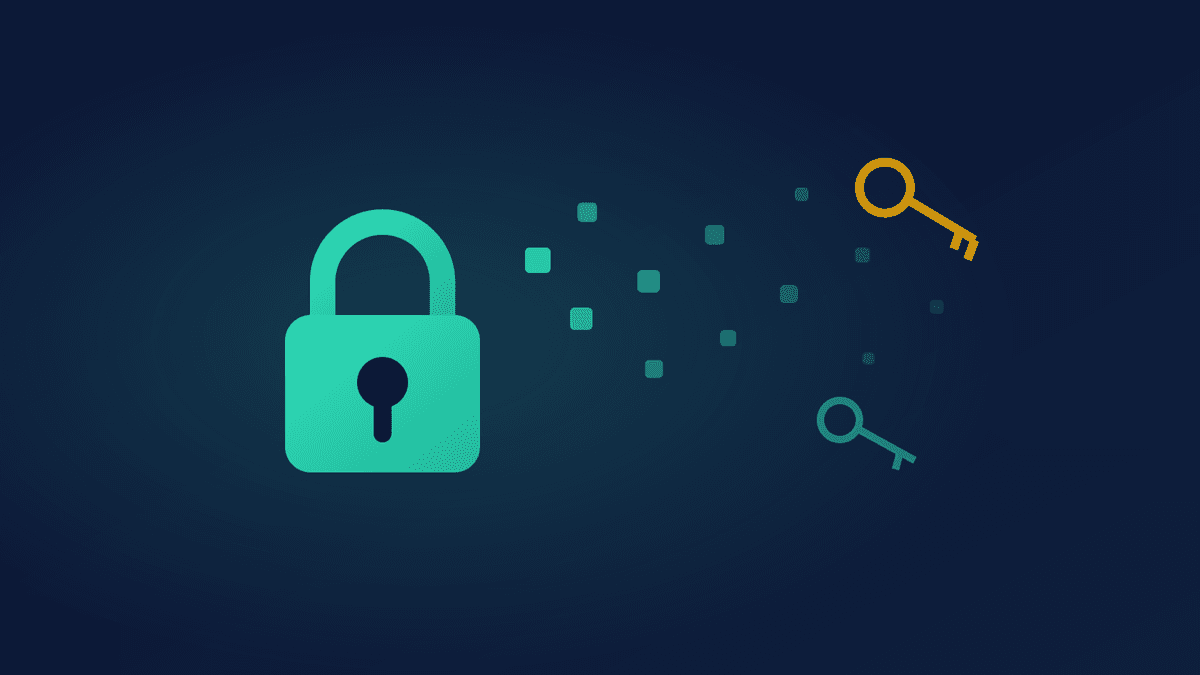
VPN encryption is the process of scrambling your internet traffic into unreadable code before it leaves your device, then unscrambling it at the VPN server using a secret key that only the two ends share. In practice that means a cipher (usually AES-256 or ChaCha20) does the scrambling, and a handshake sets up the keys.
What encryption actually does to your traffic
Encryption sounds mystical, but the idea is old and simple: take readable information and transform it, using a secret and a repeatable set of rules, into something that looks like random noise. Anyone who intercepts the noise without the secret sees gibberish. Your VPN does this to every packet you send.
Think of it as a locked box on a conveyor belt. You put your web request — the address you're visiting, the data you're sending — inside the box, lock it, and send it down the belt to the VPN server. Everyone along the way (your internet provider, the coffee-shop Wi-Fi, a network snoop) can see a box going by, but not what's inside. The server has the matching key, opens the box, forwards your request to the wider internet, then locks the reply back up for the return trip.
Two things make this trustworthy rather than just clever. First, the transformation must be practically impossible to reverse without the key — not merely hard, but so astronomically expensive that no computer on Earth could brute-force it in a human lifetime. Second, the two ends need to agree on a key without ever shipping that key across the open network where it could be copied. The cipher handles the first job; the handshake handles the second. Everything else in this article is detail on those two ideas.
AES-256: the workhorse cipher
AES — the Advanced Encryption Standard — is the cipher you'll see named most often in VPN apps, usually as AES-256. It was standardised by the U.S. National Institute of Standards and Technology in 2001 after a public competition, and more than two decades of relentless analysis have turned up no practical way to break it when it's implemented correctly.
The "256" is the key length in bits. A key is just a very large number, and 256 bits gives you 2 to the power of 256 possible keys — a figure so large it dwarfs the number of atoms in the observable universe. Trying every possible key (a "brute-force" attack) is not slow; it is physically impossible with any technology we can foresee. That is why AES-256 is used to protect information the U.S. government classifies as top secret.
A few things worth knowing so the label doesn't mislead you:
- AES-128 versus AES-256: both are considered unbreakable in practice. The longer key is a comfort margin, not a fix for a known weakness in the shorter one.
- AES is a block cipher: it encrypts data in fixed-size chunks. Most VPNs pair it with a mode called GCM (so you'll see AES-256-GCM), which we'll explain in the section on AEAD below.
- AES runs fastest on modern phones and laptops because the processor has dedicated hardware instructions for it. Without that hardware acceleration, it's slower — which is exactly where ChaCha20 comes in.
If you want the practical, brand-by-brand view of which providers use which ciphers and how that shakes out for everyday use, our editorial team keeps that in the VPN privacy guide rather than here — this post is about understanding the words, not ranking the products.
ChaCha20: the mobile-friendly rival
ChaCha20 is the other cipher you'll meet, especially on phones and inside the WireGuard protocol. Designed by cryptographer Daniel J. Bernstein, it's a stream cipher rather than a block cipher, and it was built to be fast in plain software — no special processor instructions required to hit good speeds.
That software-friendliness is the whole point. On a laptop with AES hardware acceleration, AES-256 is usually the speed winner. But on devices without that acceleration — many phones, cheap tablets, embedded gadgets, some routers — ChaCha20 pulls ahead and does it while drawing less power. Independent tests have measured ChaCha20 using meaningfully less battery than software-based AES on mobile, which matters a lot for an always-on VPN connection.
Security-wise, there's no meaningful gap to worry about. Both ciphers are held to be equally strong by current cryptographic analysis; ChaCha20 additionally has a clean, constant-time design that resists a category of side-channel attacks that poorly written AES code can be vulnerable to. The choice between them is about hardware and speed, not about one being safe and the other risky.
In real products you rarely pick the cipher by hand. WireGuard uses ChaCha20-Poly1305 exclusively — it's the only option in its fixed cryptographic suite. OpenVPN (version 2.6 and later) offers both ChaCha20-Poly1305 and AES-GCM and negotiates the best fit. If your VPN performance feels sluggish on one device but fine on another, the cipher-versus-hardware mismatch is often why; our VPN speed test can help you see the difference for yourself.
The handshake: agreeing on a key without shipping it
Here's the puzzle a cipher alone can't solve. To encrypt and decrypt, both your device and the server need the same secret key. But you can't just email the key to the server — anyone watching the connection would grab it. The handshake is the elegant maths that lets two strangers agree on a shared secret over a channel that everyone can see.
The trick is called a Diffie-Hellman key exchange, and modern VPNs use an elliptic-curve version of it (ECDHE). Without the algebra, here's the intuition: each side mixes a private ingredient of its own with a shared public one, exchanges the mixed results, then mixes again. Because of how the maths works, both ends arrive at the identical final secret — but an eavesdropper who saw only the exchanged public parts cannot reconstruct it. The real key is never transmitted; it's computed independently at both ends.
A full VPN handshake typically bundles a few jobs together:
- 1Authentication — proving the server you're talking to is really your VPN provider and not an impostor, usually via a digital certificate.
- 2Key agreement — the Diffie-Hellman exchange that produces the shared session key.
- 3Cipher negotiation — settling on which cipher (AES-256-GCM, ChaCha20-Poly1305) will encrypt the actual traffic.
Once the handshake finishes, the expensive public-key maths is done, and the fast symmetric cipher takes over for the rest of the session. A weak or misconfigured handshake can undermine an otherwise strong cipher, which is one reason the underlying protocol — WireGuard, OpenVPN, IKEv2 — matters as much as the cipher name in the marketing copy.
Perfect forward secrecy: protecting the past
Perfect forward secrecy (PFS) is a property that sounds abstract but solves a very real threat: what happens to all your old traffic if the server's long-term private key is stolen next year? Without PFS, an attacker who recorded your encrypted sessions today and later obtained that key could go back and decrypt everything. PFS makes that impossible.
It works by using ephemeral keys — the extra "E" in ECDHE stands for ephemeral. Instead of deriving every session's encryption from one long-lived master key, each session gets a fresh, temporary key that's generated on the spot and discarded when the session ends. Crucially, there's no mathematical link between the server's permanent private key and any given session key. Steal the permanent key and you still can't rebuild the session keys that already came and went.
This is why security people talk about the "harvest now, decrypt later" threat. Adversaries can and do record encrypted traffic in bulk, betting that future breakthroughs or a stolen key will let them read it. PFS turns that stored archive into permanent noise. WireGuard leans into this by renegotiating keys frequently during a connection — by default it performs a fresh handshake roughly every two minutes — so even within a single session your key keeps rotating.
Want a provider that gets the fundamentals right — modern ciphers, WireGuard-based protocols, and perfect forward secrecy on by default? See how the top options compare.
See our top-ranked VPNs →AEAD: encryption that also catches tampering
Scrambling your data hides it, but hiding isn't the whole story. You also need to know that no one flipped a few bits in transit — swapped, corrupted, or maliciously altered your packets. That's where AEAD comes in: Authenticated Encryption with Associated Data. It's the reason you see ciphers written as AES-256-GCM and ChaCha20-Poly1305 rather than just AES or ChaCha20.
An AEAD cipher does two things in one pass. It encrypts your data, and it produces a short authentication tag — a cryptographic fingerprint of the ciphertext. When the other end decrypts, it recomputes the tag and checks that it matches. If a single bit was changed anywhere along the way, the tag won't match and the packet is rejected. So AEAD gives you confidentiality (nobody can read it) and integrity (nobody can secretly change it) together.
The GCM in AES-256-GCM and the Poly1305 in ChaCha20-Poly1305 are the parts doing that authentication. Bundling both jobs into one operation is also more efficient than the older approach of encrypting and then running a separate HMAC-SHA integrity check, which is part of why modern protocols feel faster. When you're comparing tools on our best VPN roundup, an AEAD cipher is table stakes — every serious provider uses one now.
So what does "military-grade" actually mean?
"Military-grade encryption" is the phrase you'll see plastered across VPN landing pages, and it's worth being clear-eyed about it: the military does not define or certify anything called "military-grade encryption." It's a marketing phrase, and in almost every case it simply means the product uses AES-256.
That's not a lie, exactly. The U.S. government really does use AES-256 to protect top-secret information, so a VPN advertising it is using genuinely strong, standards-based cryptography. The problem is that the phrase implies exclusivity and official endorsement that isn't there. Security researchers have long called it a gimmick, and it's the same species of language as "military-grade durability" — evocative, unregulated, and not a certification of anything.
How to read the badge sensibly:
- "Military-grade" almost always just means AES-256 — a good thing, but not a special or exclusive thing.
- It does not mean the product was tested, approved, or certified by any armed force or government body.
- A provider using ChaCha20 instead of (or alongside) AES-256 isn't weaker just because it skips the buzzword — modern WireGuard setups often lead with ChaCha20.
- The cipher is only one link in the chain. The protocol, the handshake, PFS, a real no-logs policy, and leak protection matter just as much.
In other words, don't buy a VPN because it says "military-grade" and don't skip one because it doesn't. Look at the whole stack. If a provider is transparent about using AES-256-GCM or ChaCha20-Poly1305 with a modern protocol and forward secrecy, you have everything the buzzword was gesturing at — and you can verify it rather than trust the adjective.
Where strong encryption still isn't enough
Encryption protects the contents of your traffic, but it doesn't protect against everything, and understanding the gap keeps your expectations honest. The strongest cipher in the world won't help if your device leaks your real location or DNS requests around the encrypted tunnel.
The two classic leaks to know about are DNS leaks and WebRTC leaks. A DNS leak happens when your device's requests to look up website addresses slip out to your internet provider's servers instead of going through the encrypted tunnel — so the traffic is encrypted, but the record of which sites you visited isn't hidden. A WebRTC leak is a browser feature that can expose your true IP address even with a VPN running. Good VPN apps plug both, but they're a reminder that encryption is necessary, not sufficient.
The other everyday reason people care about encryption is that it's what makes a VPN able to route your connection through another region safely — the mechanism behind streaming access, secure travel browsing, and reaching services from wherever you are. If that's your angle, our editorial hub on VPNs for streaming and the can I watch checker pick up where the cryptography leaves off. And if you simply want to confirm a service protects you properly before committing, the privacy fundamentals in the privacy guide are the right next stop.
The short version
You don't need a cryptography degree to make a sensible VPN decision — you need to recognise a handful of words and know they signal competence rather than marketing. Here's the whole article compressed into what actually matters when you're reading a provider's specs.
- AES-256 and ChaCha20 are both excellent ciphers; ChaCha20 tends to win on phones and hardware without AES acceleration.
- The handshake (ECDHE) lets both ends agree on a key without ever sending it, and perfect forward secrecy makes sure a future key theft can't unlock your past traffic.
- AEAD ciphers like AES-256-GCM and ChaCha20-Poly1305 encrypt and tamper-check in one step — insist on one.
- "Military-grade" is marketing for AES-256; it's fine, but it's not a certification and not a reason to choose or reject anything.
- Encryption is one link — protocol, PFS, leak protection and a genuine no-logs policy complete the chain.
Frequently asked questions
Is AES-256 better than ChaCha20 for a VPN?
Neither is meaningfully more secure — both are considered unbreakable in practice by current cryptographic analysis. The real difference is performance. AES-256 is usually fastest on devices with hardware acceleration (most modern laptops), while ChaCha20 is faster and more battery-efficient on phones and hardware without that acceleration. Most apps pick the right one automatically.
What does "military-grade encryption" actually mean?
It's a marketing phrase, not an official standard. No military defines or certifies "military-grade encryption." In almost every case it simply means the product uses AES-256, the cipher the U.S. government uses for top-secret data. That's genuinely strong, but the phrase doesn't imply any government testing or certification, so treat it as flavour, not proof.
What is a VPN handshake?
The handshake is the setup phase where your device and the VPN server agree on a shared secret key without ever sending that key across the network. It uses a Diffie-Hellman (usually ECDHE) exchange so both ends independently compute the same key. It also authenticates the server and negotiates which cipher will encrypt your traffic before the session begins.
What is perfect forward secrecy and why does it matter?
Perfect forward secrecy means each session uses a fresh, temporary key that's discarded afterward and has no link to the server's permanent private key. So even if that permanent key is stolen years later, your recorded past sessions can't be decrypted. It defeats the "harvest now, decrypt later" tactic where adversaries store encrypted traffic hoping to crack it in future.
What does AES-256-GCM mean?
It's AES encryption with a 256-bit key running in GCM mode, which makes it an AEAD cipher — Authenticated Encryption with Associated Data. In one pass it both encrypts your data and generates an authentication tag that detects tampering. If any bit is altered in transit, decryption fails and the packet is rejected, so you get confidentiality and integrity together.
Does stronger encryption slow down my VPN?
Rarely in a way you'll notice. Both AES-256 and ChaCha20 are extremely fast on modern hardware. Speed depends far more on the protocol (WireGuard is very fast), server distance and load than on the cipher choice. If one device feels slow, it may lack AES hardware acceleration — a case where a ChaCha20-based protocol like WireGuard can actually feel snappier.
Is encryption alone enough to keep me private?
No. Encryption hides the contents of your traffic, but DNS leaks or WebRTC leaks can still expose which sites you visit or your real IP address around the tunnel. A trustworthy VPN also needs leak protection, a modern protocol, perfect forward secrecy, and a genuine no-logs policy. Encryption is necessary but not sufficient on its own.
The best VPNs of 2026, ranked
Now you know how — here are the VPNs we recommend, independently tested and ranked for speed, streaming, privacy and value. Any of them works for everything in this guide.

ExpressVPN Ultra fast & secure. Great for privacy, downloads, and everyday browsing on all your devices. 24/7 live chat support.
ExpressVPN Ultra fast & secure. Great for privacy, downloads, and everyday browsing on all your devices. 24/7 live chat support.

IPVanish Fast speeds with unlimited device connections. Strong no-logs privacy and 24/7 live chat support. Great for families.
IPVanish Fast speeds with unlimited device connections. Strong no-logs privacy and 24/7 live chat support. Great for families.

NordVPN Excellent speeds with one of the largest server networks. Strong security features and easy-to-use apps. 24/7 live chat support.
NordVPN Excellent speeds with one of the largest server networks. Strong security features and easy-to-use apps. 24/7 live chat support.

Proton VPN Swiss-based VPN with strong privacy focus. Audited no-logs policy and open-source apps. Great for privacy-conscious users.
Proton VPN Swiss-based VPN with strong privacy focus. Audited no-logs policy and open-source apps. Great for privacy-conscious users.

CyberGhost Fast speeds and strong privacy tools. Simple apps, automatic WiFi protection, and 24/7 live chat support.
CyberGhost Fast speeds and strong privacy tools. Simple apps, automatic WiFi protection, and 24/7 live chat support.

TotalVPN Affordable VPN with strong privacy and reliable speeds. Easy-to-use apps for all major devices. No-logs policy.
TotalVPN Affordable VPN with strong privacy and reliable speeds. Easy-to-use apps for all major devices. No-logs policy.

Private Internet Access High-speed VPN with a large server network and advanced security settings. Ad blocker included and 24/7 live chat support.
Private Internet Access High-speed VPN with a large server network and advanced security settings. Ad blocker included and 24/7 live chat support.

Surfshark Unlimited device connections at a budget-friendly price. Includes ad blocker and strong privacy tools. Great value for money.
Surfshark Unlimited device connections at a budget-friendly price. Includes ad blocker and strong privacy tools. Great value for money.
Rankings are based on our independent testing methodology. Each guide applies the criteria described on that page, including relevant performance, privacy, product features, and value data. We may earn affiliate commissions from links on this page, which helps fund our testing — this does not influence our rankings.